A clinic gets a patient with elevated bilirubin. The provider jots down “jaundice” in the chart. The coding staff defaults to R17 because they’re busy and it seems generic enough. Three weeks later, the claim comes back denied with a message that reads “insufficient specificity for reimbursement.”
That’s not a one-time problem. That’s money walking out your door every single week because providers aren’t selecting the correct ICD-10 code for hyperbilirubinemia cases.
The ICD-10 code for hyperbilirubinemia isn’t like coding a simple flu visit. This condition has multiple faces depending on the patient’s age, the underlying cause, and what the liver is actually doing. Get the ICD-10 code for hyperbilirubinemia wrong by even one digit, and you’re looking at underpayment, denials, or worse, an audit flag that keeps your practice under scrutiny for months.
The good news? Once you understand the framework for selecting the right ICD-10 code for hyperbilirubinemia, the rules are actually logical. And when you get the ICD-10 code for hyperbilirubinemia right, you’re not just protecting revenue. You’re also creating documentation that tells the real story of what happened to your patient.
Let’s walk through how to select the correct ICD-10 code for hyperbilirubinemia the way actual practitioners need to understand it.
The Core Problem: Understanding What Elevated Bilirubin Actually Means
Before you pick an ICD-10 code for hyperbilirubinemia, you need to understand what you’re looking at from a clinical standpoint.
Bilirubin is what your body creates when old red blood cells break down. Normally, your liver processes this pigment and sends it out through the bile ducts. When something goes wrong at any point in that process, bilirubin builds up in the bloodstream. That buildup is what we call hyperbilirubinemia, and understanding the cause is essential for selecting the correct ICD-10 code for hyperbilirubinemia.
Here’s the critical part: hyperbilirubinemia isn’t a disease by itself. It’s a finding. It’s a symptom pointing to something else that needs treatment. The “something else” is what determines your ICD-10 code for hyperbilirubinemia, and that’s where most coders go astray.
You could have a newborn with an immature liver. You could have an adult with Gilbert’s syndrome (a genetic condition). You could have someone whose liver was damaged by hepatitis. You could have a patient with a blocked bile duct. Every single scenario uses a different ICD-10 code for hyperbilirubinemia because the underlying cause is different. Insurance companies know this. They also know that vague coding usually signals lazy documentation. And lazy documentation often precedes fraud, intentional or not. That’s why payers are so aggressive about flagging generic codes when a specific ICD-10 code for hyperbilirubinemia exists.
The Main ICD-10 Codes for Hyperbilirubinemia You’ll Actually Use
Let’s break down the specific ICD-10 codes for hyperbilirubinemia by patient type and clinical situation. This is the framework that will make your coding decisions about which ICD-10 code for hyperbilirubinemia to use much faster.
R17: Unspecified Hyperbilirubinemia (Adult Cases)
R17 is the ICD-10 code for hyperbilirubinemia when an adult patient has elevated bilirubin and you genuinely don’t know the cause yet. This ICD-10 code for hyperbilirubinemia is your placeholder while you’re waiting for test results or additional workup. It’s billable, but understand that payers don’t love using the R17 ICD-10 code for hyperbilirubinemia. If you later find the cause, you need to rebill with the appropriate specific ICD-10 code for hyperbilirubinemia.
Some payers will allow the R17 ICD-10 code for hyperbilirubinemia for the initial visit and expect you to change it once diagnosis is established. Others will just deny claims using the R17 ICD-10 code for hyperbilirubinemia upfront and ask for clarification. The safest practice is to avoid the R17 ICD-10 code for hyperbilirubinemia when possible by ensuring your documentation includes what you’re looking for.
E80.6: Other Disorders of Bilirubin Metabolism
E80.6 is the correct ICD-10 code for hyperbilirubinemia cases involving metabolic and genetic causes in adults. Gilbert’s syndrome uses the E80.6 ICD-10 code for hyperbilirubinemia. Dubin-Johnson syndrome uses the E80.6 ICD-10 code for hyperbilirubinemia. Rotor’s syndrome uses the E80.6 ICD-10 code for hyperbilirubinemia. These are conditions where the liver itself is structurally fine, but the chemical machinery that processes bilirubin isn’t working properly, which is why you select the E80.6 ICD-10 code for hyperbilirubinemia.
When a patient comes to you with a family history of “elevated bilirubin that doesn’t cause problems,” you’re almost certainly looking at Gilbert’s syndrome, and that’s when you use the E80.6 ICD-10 code for hyperbilirubinemia. The big thing to document here is that you’ve ruled out the scary stuff. Gilbert’s is benign, but it looks like elevated bilirubin on a lab panel.
Your note should mention why you’re confident this is Gilbert’s and not something serious when you’re selecting the E80.6 ICD-10 code for hyperbilirubinemia. “Asymptomatic patient, total bilirubin 2.4 with predominantly unconjugated fraction, normal liver function tests, family history of similar findings, consistent with Gilbert’s syndrome” is much stronger than just “elevated bilirubin” when using the E80.6 ICD-10 code for hyperbilirubinemia.
E80.7: Other Specified Disorders of Bilirubin Metabolism
E80.7 is related to E80.6 but covers additional metabolic disorders of bilirubin not listed elsewhere. You’ll use this ICD-10 code for hyperbilirubinemia less frequently, mostly when you have documentation of a specific bilirubin metabolism disorder that doesn’t fit neatly into the E80.6 ICD-10 code for hyperbilirubinemia. The key difference is specificity. If your documentation clearly states the type of metabolic disorder, you want the most specific ICD-10 code for hyperbilirubinemia available.
P59.9: Neonatal Jaundice, Unspecified
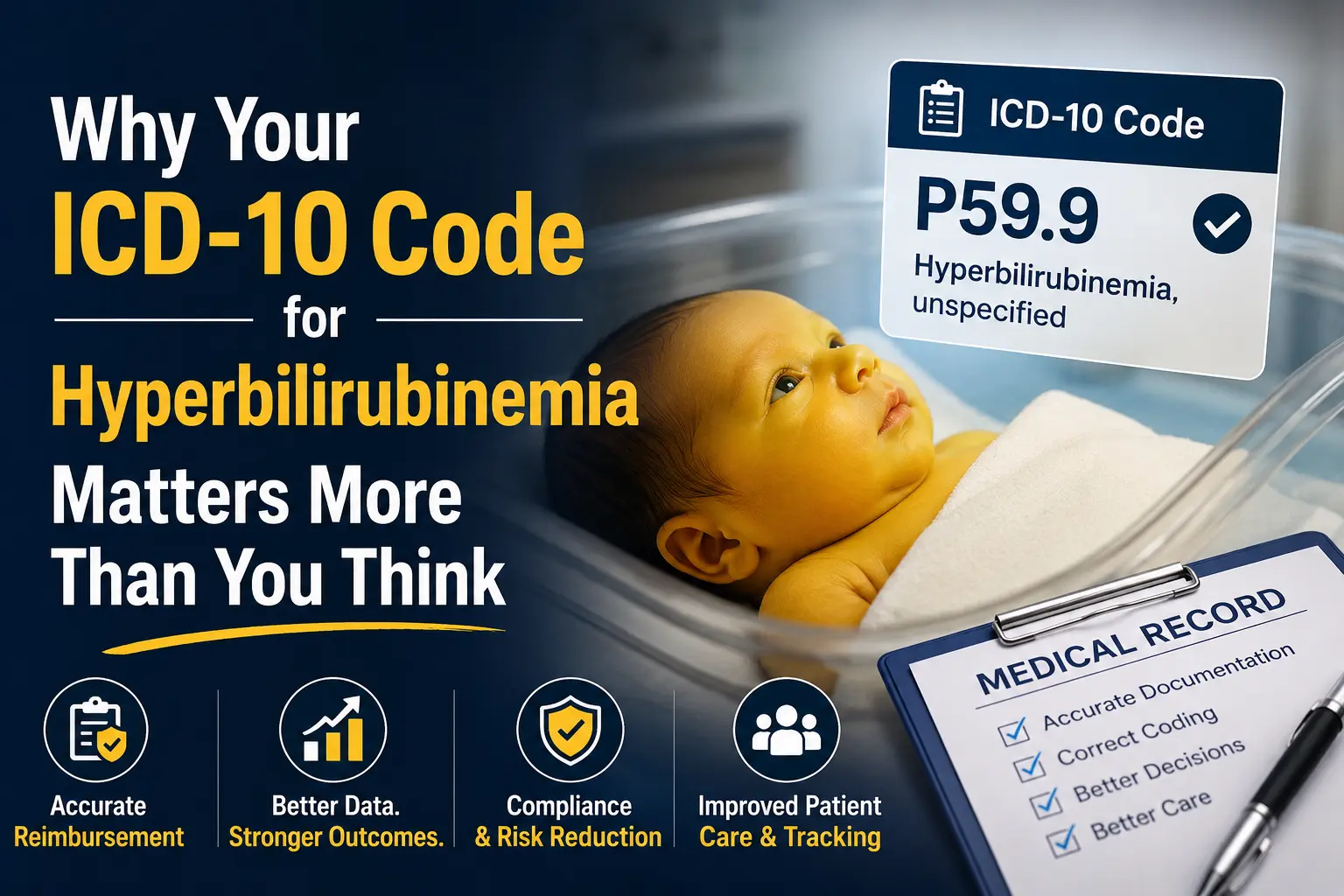
Welcome to the neonatal world, where everything is different. P59.9 is the ICD-10 code for hyperbilirubinemia in newborns whose jaundice isn’t due to a specific identified cause. Using the P59.9 ICD-10 code for hyperbilirubinemia labeled “unspecified” doesn’t mean you didn’t do your job. It means the baby has jaundice and you’ve ruled out or don’t have evidence for the specific conditions that would trigger a different ICD-10 code for hyperbilirubinemia in P59 range. Most term infants who develop mild jaundice in the first week of life will fall into the P59.9 ICD-10 code for hyperbilirubinemia category.
However, here’s where most newborn documentation falls short when selecting the P59.9 ICD-10 code for hyperbilirubinemia: you need the transcutaneous bilirubin (TcB) level documented. The ICD-10 code for hyperbilirubinemia is the same whether the bilirubin is 8 or 18 mg/dL, but the severity and treatment implications are completely different. Your documentation should include the TcB level, gestational age, and age in hours when using the P59.9 ICD-10 code for hyperbilirubinemia. This matters because phototherapy decisions are based on nomograms that consider all three factors together.
P58.0: Hemolytic Disease of Newborn Due to Isoimmunization
P58.0 is the specific ICD-10 code for hyperbilirubinemia when it results from hemolytic disease. This is when the mother’s blood type doesn’t match the baby’s, and the mother’s antibodies are attacking the baby’s red blood cells. Classic scenario for using the P58.0 ICD-10 code for hyperbilirubinemia: mother is O blood type (has anti-A and anti-B antibodies), baby is A or B. Another scenario requiring the P58.0 ICD-10 code for hyperbilirubinemia: mother is Rh negative, baby is Rh positive, and the mother was previously sensitized.
This diagnosis requiring the P58.0 ICD-10 code for hyperbilirubinemia requires proof of hemolysis. Your documentation needs the Coombs test result (also called direct antiglobulin test). A positive Coombs test confirms that maternal antibodies are bound to the baby’s red blood cells. That’s your evidence for coding the P58.0 ICD-10 code for hyperbilirubinemia.
If you code the P58.0 ICD-10 code for hyperbilirubinemia without documenting a positive Coombs, you’re vulnerable to a denial. The payer will ask for proof that actual hemolysis is happening, not just ABO incompatibility (which by itself doesn’t always cause significant jaundice when using the P58.0 ICD-10 code for hyperbilirubinemia).
P59.3: Neonatal Jaundice from Breast Milk Inhibitor
P59.3 is the ICD-10 code for hyperbilirubinemia when breastfeeding problems are the cause. Some infants, particularly in the first few days of life, develop jaundice because their mothers haven’t yet produced adequate volumes of mature milk. The infant isn’t getting enough calories, loses weight, becomes dehydrated, and bilirubin levels rise, which is when you use the P59.3 ICD-10 code for hyperbilirubinemia. This is breast milk jaundice (sometimes called breastfeeding failure jaundice).
To code the P59.3 ICD-10 code for hyperbilirubinemia, you need documentation that the baby is breastfeeding inadequately and showing signs of poor intake or weight loss. Your documentation might read: “Three-day-old breastfeeding infant, weight loss 10%, difficult latch noted by lactation consultant, TcB 16 mg/dL at 72 hours, consistent with breastfeeding failure jaundice” when selecting the P59.3 ICD-10 code for hyperbilirubinemia. That level of detail supports using the P59.3 ICD-10 code for hyperbilirubinemia versus just P59.9.
K71.89: Other Toxic Liver Damage
K71.89 is the ICD-10 code for hyperbilirubinemia when the liver itself is damaged by something. Drug-induced liver injury, alcohol-related liver disease, toxin exposure—these all require the K71.89 ICD-10 code for hyperbilirubinemia. When the liver is damaged, it can’t process bilirubin properly, and conjugated hyperbilirubinemia results, which is when you use the K71.89 ICD-10 code for hyperbilirubinemia.
Your documentation needs to identify what damaged the liver when you’re using the K71.89 ICD-10 code for hyperbilirubinemia. “Patient on acetaminophen for chronic pain, AST 280, ALT 310, total bilirubin 3.2 with elevated direct fraction” gives you enough evidence for using the K71.89 ICD-10 code for hyperbilirubinemia related to drug-induced liver injury.
The Decision Tree for Selecting the Right ICD-10 Code for Hyperbilirubinemia
Here’s the real-world question you need to answer first when determining which ICD-10 code for hyperbilirubinemia to use: Is this patient a newborn or an adult?
If the Patient Is a Newborn: Which ICD-10 Code for Hyperbilirubinemia?
Start with the P59 range (neonatal jaundice codes). Your follow-up question is: Why does the baby have hyperbilirubinemia requiring an ICD-10 code for hyperbilirubinemia? Common causes in order of frequency are breastfeeding problems, ABO or Rh incompatibility, and prematurity (immature liver).
Your documentation will guide which specific ICD-10 code for hyperbilirubinemia to use. If the baby is premature and jaundiced, you might use P59.1 as your ICD-10 code for hyperbilirubinemia. If there’s Coombs-positive hemolytic disease, use P58.0 as your ICD-10 code for hyperbilirubinemia. If breastfeeding is the issue, use P59.3 as your ICD-10 code for hyperbilirubinemia. If you don’t have a specific cause identified, use P59.9 as your ICD-10 code for hyperbilirubinemia.
If the Patient Is an Adult: Which ICD-10 Code for Hyperbilirubinemia?
Now you need to distinguish between metabolic causes, liver damage, and unspecified cases when selecting an ICD-10 code for hyperbilirubinemia. If there’s a family history or genetic component, think E80 series when choosing an ICD-10 code for hyperbilirubinemia. If there’s liver disease or toxin exposure, think K71 series when choosing an ICD-10 code for hyperbilirubinemia. If you don’t know the cause, use R17 temporarily as your ICD-10 code for hyperbilirubinemia, but keep working to find out what’s actually wrong.
The key principle: Get as specific as your documentation allows when selecting your ICD-10 code for hyperbilirubinemia. Generic codes trigger denials far more often than when you use the correct specific ICD-10 code for hyperbilirubinemia.
Documentation Mistakes That Cost You Money with the Wrong ICD-10 Code for Hyperbilirubinemia
Over the years, I’ve noticed the same documentation patterns that lead to denials when the wrong ICD-10 code for hyperbilirubinemia is used. Let me walk you through the most expensive ones.
Mistake One: Forgetting the Bilirubin Values When Coding ICD-10 Code for Hyperbilirubinemia
This is the single most common problem I see when providers submit claims with an ICD-10 code for hyperbilirubinemia. The provider documents “elevated bilirubin” or “jaundice noted” but doesn’t include the actual lab value. Insurance companies will deny a claim for insufficient documentation if the bilirubin level isn’t in the chart when you’re submitting an ICD-10 code for hyperbilirubinemia.
You need total bilirubin. You need direct bilirubin if it was measured. For newborns, you need TcB. These aren’t nice-to-have details when submitting an ICD-10 code for hyperbilirubinemia. They’re required for the code to stick.
Mistake Two: Using Adult Codes for Neonatal Patients When Selecting ICD-10 Code for Hyperbilirubinemia
I’ve seen this more times than I’d like to admit. A baby comes to the newborn nursery, develops jaundice, and someone selects R17 as the ICD-10 code for hyperbilirubinemia instead of P59.9. Medicare and many commercial payers will kick that back immediately. It’s an automatic denial because R17 is the wrong ICD-10 code for hyperbilirubinemia in a newborn. Always use P59 range when selecting an ICD-10 code for hyperbilirubinemia in newborns.
Mistake Three: Diagnosing Without Supporting Evidence When Choosing ICD-10 Code for Hyperbilirubinemia
You can’t select E80.6 as your ICD-10 code for hyperbilirubinemia (Gilbert’s syndrome) without documenting what makes you confident it’s Gilbert’s and not something serious. You need evidence that liver function is normal, that the patient is asymptomatic, and ideally that there’s a family history. The same applies to hemolytic disease in newborns. You can’t select P58.0 as your ICD-10 code for hyperbilirubinemia without documenting a positive Coombs test.
Mistake Four: Ignoring the Underlying Condition When Using ICD-10 Code for Hyperbilirubinemia
Hyperbilirubinemia is a symptom. Something caused it. If you treat the symptom but don’t document what caused it when submitting your ICD-10 code for hyperbilirubinemia, you’re leaving money on the table. A patient with hepatitis-induced jaundice should have the hepatitis code listed first, with the hyperbilirubinemia as secondary when you’re billing with an ICD-10 code for hyperbilirubinemia.
A patient with a blocked bile duct should have the obstruction code listed. This isn’t just about accuracy with your ICD-10 code for hyperbilirubinemia. It’s about showing the full clinical picture so payers understand why the treatment plan is what it is.
When you’re managing claims processing for complex cases with multiple diagnosis codes including the ICD-10 code for hyperbilirubinemia, proper sequencing ties directly into how you manage your entire revenue cycle management strategy.
Mistake Five: Documentation Lag Time When Updating ICD-10 Code for Hyperbilirubinemia
A patient has jaundice on day one. You initially code it R17 as a temporary ICD-10 code for hyperbilirubinemia. You get a recheck and find it’s Gilbert’s syndrome. Now you need to amend the initial ICD-10 code for hyperbilirubinemia from R17 to E80.6. But if you wait a week to make this amendment, you might miss the appeal window for the ICD-10 code for hyperbilirubinemia claim.
The best practice involves documenting what you’re looking for at the initial visit when you’re using a temporary ICD-10 code for hyperbilirubinemia, then promptly updating the ICD-10 code for hyperbilirubinemia once confirmation is available. This keeps your claims processing clean and prevents manual follow-up work.
Sequencing: How to Order Your ICD-10 Code for Hyperbilirubinemia Correctly
When a patient has multiple conditions, the order matters. This is called sequencing, and getting it wrong with your ICD-10 code for hyperbilirubinemia can mean a completely different reimbursement.
For a patient with hepatitis and elevated bilirubin, the hepatitis code comes first because it’s the primary condition. The ICD-10 code for hyperbilirubinemia is secondary because it’s a consequence.
For a newborn with ABO incompatibility and jaundice, the hemolytic disease code (P58.0) comes first (this is your primary ICD-10 code for hyperbilirubinemia), and the jaundice is listed because of the hemolysis.
For a patient with Gilbert’s syndrome, the E80.6 ICD-10 code for hyperbilirubinemia is the primary diagnosis when bilirubin elevation is the reason for the visit.
The principle: List the condition you’re treating or investigating as primary. List the findings and complications (like your ICD-10 code for hyperbilirubinemia) after it.
2026 Compliance Checklist for ICD-10 Code for Hyperbilirubinemia
Audits have changed. Payers are now using artificial intelligence to flag unusual coding patterns, and they’re looking at documentation consistency. Here’s what you need in place right now to stay compliant when submitting an ICD-10 code for hyperbilirubinemia:
First, your bilirubin levels must be in the medical record. Verbal mention isn’t enough. The lab value needs to appear somewhere in the documentation that ties to the ICD-10 code for hyperbilirubinemia claim.
Second, your diagnosis must be supported by documented clinical reasoning when you’re selecting an ICD-10 code for hyperbilirubinemia. Don’t just write “Gilbert’s.” Explain why you’re confident when using the ICD-10 code for hyperbilirubinemia.
Third, your treatment must align with your ICD-10 code for hyperbilirubinemia diagnosis. If you coded neonatal jaundice with an ICD-10 code for hyperbilirubinemia but didn’t order bilirubin monitoring or phototherapy, an auditor will question whether the condition was actually clinically significant when reviewing your ICD-10 code for hyperbilirubinemia submission.
Fourth, your modifier usage must be correct with your ICD-10 code for hyperbilirubinemia. If this is a follow-up evaluation for previously identified condition requiring an ICD-10 code for hyperbilirubinemia, that matters.
Fifth, your billing timing should match your documentation dates when you’re billing an ICD-10 code for hyperbilirubinemia.
Common Payer Denial Triggers When Using ICD-10 Code for Hyperbilirubinemia
Insurance companies have automated systems that flag certain combinations as high-risk when you submit an ICD-10 code for hyperbilirubinemia. If you know what triggers these flags, you can avoid them.
Flag one: Coding with an ICD-10 code for hyperbilirubinemia without documenting a follow-up plan. If you diagnosed elevated bilirubin but didn’t document what you’re going to do, payers assume the condition wasn’t significant enough for the ICD-10 code for hyperbilirubinemia claim.
Flag two: Using R17 (unspecified) as your ICD-10 code for hyperbilirubinemia more than once in a row without changing to a specific ICD-10 code for hyperbilirubinemia. After the initial workup, you should have enough information to use a specific ICD-10 code for hyperbilirubinemia.
Flag three: Coding Gilbert’s using the E80.6 ICD-10 code for hyperbilirubinemia without documenting that you ruled out serious liver disease. Payers know Gilbert’s is benign, but if your documentation doesn’t show you verified this when submitting the ICD-10 code for hyperbilirubinemia, they assume you didn’t do the appropriate workup.
Flag four: Coding neonatal conditions in an adult or vice versa when selecting an ICD-10 code for hyperbilirubinemia. This is automatic and will cause immediate denial.
Flag five: Submitting multiple claims for the same patient’s condition requiring an ICD-10 code for hyperbilirubinemia without clear evidence of different visits or significant clinical changes.
Practical Tips That Save Time When Using ICD-10 Code for Hyperbilirubinemia
Create a quick reference card for your staff with the five most common selections for ICD-10 code for hyperbilirubinemia on your unit. For a pediatrics practice, it might be P59.9, P59.3, P58.0, E80.6, and R17. Print it out. Post it in the billing area. When someone is uncertain about which ICD-10 code for hyperbilirubinemia to use, they can quickly reference whether this patient fits one of these scenarios.
Build documentation templates that include a specific field for bilirubin values. Don’t rely on people remembering to look for labs in a separate system when billing with an ICD-10 code for hyperbilirubinemia. Make it part of the standard note structure to support your ICD-10 code for hyperbilirubinemia.
Implement a rule where R17 triggers an automatic flag for follow-up. If someone codes with R17 as their ICD-10 code for hyperbilirubinemia, someone needs to check back in two weeks to see if the diagnosis has been clarified. If it has, the claim gets amended with the correct ICD-10 code for hyperbilirubinemia.
Talk to your laboratory director about standardizing how bilirubin results are reported. When you’re billing claims using an ICD-10 code for hyperbilirubinemia, make sure direct and indirect fractions are included when relevant.
For newborn practices, sync with obstetrics and pediatrics about who codes the initial event when an ICD-10 code for hyperbilirubinemia is needed. If a baby develops jaundice requiring an ICD-10 code for hyperbilirubinemia before discharge from obstetrics and then continues under pediatrics, both teams need to know who’s coding the ICD-10 code for hyperbilirubinemia.
How ICD-10 Code for Hyperbilirubinemia Fits Into Your Broader Billing Strategy
Using the correct ICD-10 code for hyperbilirubinemia isn’t isolated. It’s part of your entire claims processing workflow. When you get the ICD-10 code for hyperbilirubinemia right, you reduce the denials that then require A/R follow-up efforts. You protect your revenue cycle management before problems start by selecting the right ICD-10 code for hyperbilirubinemia.
Understanding the nuances of selecting the appropriate ICD-10 code for hyperbilirubinemia also means you’re thinking like a payer. You’re documenting with specificity when you’re using an ICD-10 code for hyperbilirubinemia. You’re building records that survive audits when you submit the ICD-10 code for hyperbilirubinemia. That same mentality applies to every other code you submit.
If you’re managing multiple diagnosis codes and complex sequencing including the ICD-10 code for hyperbilirubinemia, you’re essentially managing your entire medical billing services strategy. This foundational knowledge about how codes interact and what payers look for bleeds into every other condition you code beyond just the ICD-10 code for hyperbilirubinemia.
Moving Forward: Start Mastering ICD-10 Code for Hyperbilirubinemia Today
The practices that do well have three things in common: they document thoroughly, they code specifically, and they follow up to make sure their claims are paid without appeals when using an ICD-10 code for hyperbilirubinemia.
You’re not doing this just to satisfy insurance companies. You’re doing it because accurate coding reflects accurate clinical care. When your documentation is thorough, your team understands the patient’s condition better. When your ICD-10 code for hyperbilirubinemia is specific, payers pay appropriately. When you follow up on denials involving the ICD-10 code for hyperbilirubinemia, you create accountability that leads to fewer problems down the road.
The time you invest in getting the ICD-10 code for hyperbilirubinemia right is time you’re not spending on appeals, amendments, and audit responses. That’s not just good coding. That’s good business.
Start this week. Pick one of the common mistakes I mentioned above. Fix it in your workflow when you’re selecting the ICD-10 code for hyperbilirubinemia. Once that’s solid, move to the next. In three months, your team will handle these cases faster, more accurately, and with far fewer denials when billing with the ICD-10 code for hyperbilirubinemia.