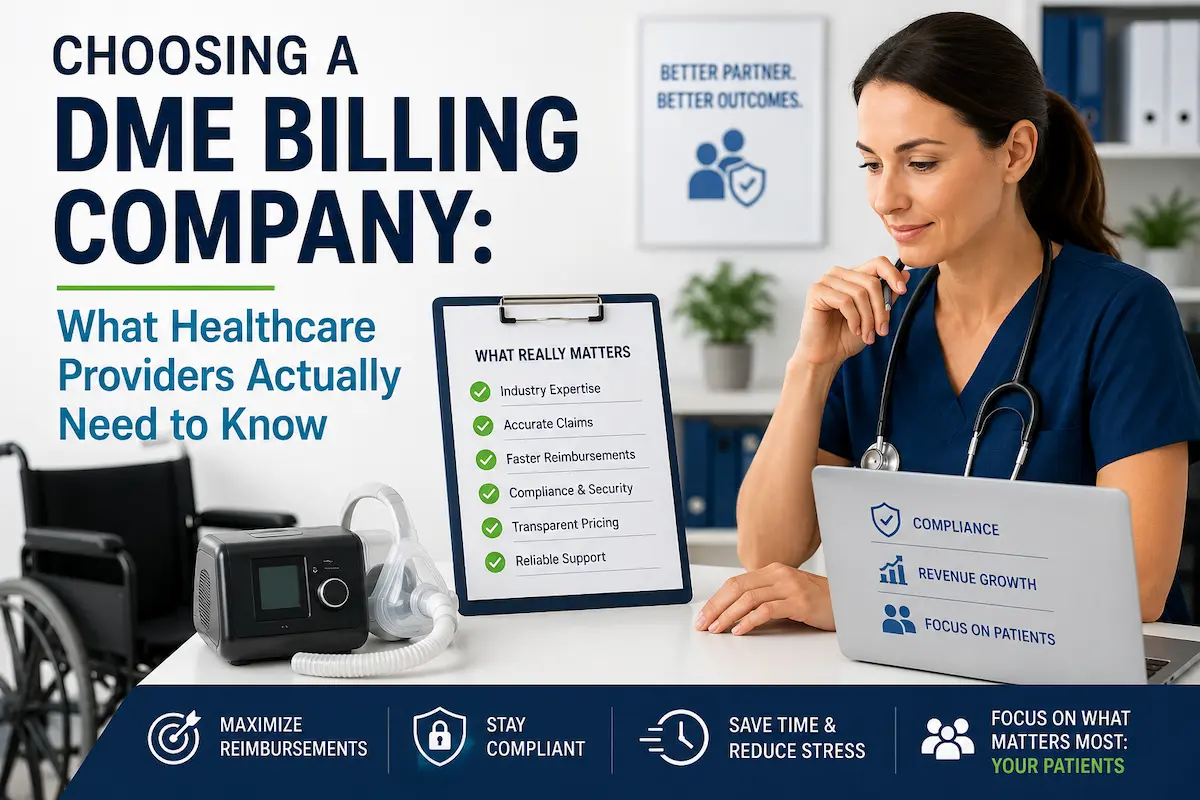
DME billing is one of the most underestimated aspects of running a medical equipment business. Most providers outsource it without really understanding what they’re getting into, and within six months they’re dealing with the consequences of that decision.
This guide walks through exactly what you need to evaluate when choosing a DME billing partner and what separates companies that deliver results from ones that just process claims.
Why Most DME Providers Get This Wrong
The first mistake: evaluating based on what sounds good in a sales call rather than what actually impacts your cash flow.
Billing companies will quote you clean claim rates above 95% and talk about fast turnaround times. Both of those are meaningless if your money isn’t actually getting collected. A claim can be submitted perfectly and still get denied for medical review reasons. A claim can be submitted today and paid back in ninety days because nobody’s following it up.
The second mistake: not understanding that DME billing isn’t generic medical billing. The companies that handle primary care billing perfectly often struggle with DME because the rules are completely different. Rental versus purchase modifiers, capped rental cycles, Certificate of Medical Necessity requirements, equipment-specific documentation—these aren’t afterthoughts. They’re the entire ballgame.
The third mistake: choosing based on what everyone else is using instead of what actually fits your specific equipment mix and business model.
What Actually Gets Claims Paid (And What Doesn’t)
Here’s what happens when claims don’t get paid, and it’s almost never because of a coding error.
Documentation gaps are the primary reason DME claims get denied. Not having a properly signed physician order. Missing patient diagnosis information. No evidence of medical necessity. A delivery date that doesn’t align with the prescription date. These aren’t coding problems—they’re workflow problems that happen before the claim even gets submitted.
Prior authorization delays are the second reason. A claim can’t be submitted until authorization comes back from the payer. Some payers take two weeks to respond. Some take six weeks. If your billing company is just submitting the claim and waiting, you’re bleeding cash. The best billing companies are proactively following up on pending authorizations and knowing which payers are lagging.
Payer-specific requirements are the third reason. Medicare has different rules than Cigna which has different rules than Aetna. Your billing company needs to know that one payer wants a specific modifier for rental month tracking while another payer doesn’t recognize that modifier at all. One payer requires a narrative description. Another one rejects claims with narratives longer than 100 characters. These are the kinds of details that separate clean submissions from constant denials.
Equipment-type specific challenges are the fourth reason, and this is where most billing companies fail completely.
If you’re billing wheelchairs, the rental conversion dates matter enormously. After the capped rental period ends, the claim needs to convert to a purchase claim. If your billing company misses this, denials multiply. If you’re billing oxygen equipment, the billing frequency, the oxygen type, the delivery method—all of this changes how claims get billed and what documentation you need. If you’re doing prosthetics and orthotics, the complexity jumps again with custom coding requirements.
One billing company might be exceptional at handling CPAP and respiratory equipment but mediocre at mobility aids. Another might handle routine equipment well but struggle with the complex prior authorization requirements for high-ticket items.
The billing company you choose needs to have specific expertise in the equipment you’re billing for.
The Hidden Reality About Clean Claim Rates
Every billing company advertises high clean claim rates. That metric is almost worthless.
A clean claim is one that passes technical validation during submission. It has all required fields. The member ID is valid. The code is correct. The claim gets submitted successfully.
That’s the entire definition. It tells you nothing about whether the claim will actually be paid.
A claim can be technically clean and denied for medical review. The documentation doesn’t support medical necessity. The prior authorization wasn’t obtained. The patient’s coverage changed. The diagnosis doesn’t justify the equipment. None of these things affect the “clean claim rate” metric.
I’ve seen billing companies with 98% clean claim rates where less than 80% of claims were getting paid. I’ve seen others with 92% clean claim rates where 95% of claims were eventually collected because their denial management and appeal process was exceptional.
The metric that actually matters is first-pass payment rate: what percentage of claims are accepted and paid by the payer without additional follow-up, resubmission, or appeal. Ask every billing company for this number. If they can’t give it to you, that’s a red flag.
Second, ask what percentage of their denials they appeal. An ethical billing company appeals every denial that has a reasonable chance of success. Some companies don’t appeal aggressively because denials are cheaper to process than appeals—they’re incentivized to just let money slip away.
Third, ask what your days in accounts receivable would be. That’s the number that actually matters for your cash flow.
Prior Authorization: Where Everything Gets Stuck
Between 15-25% of DME claims never get billed because the prior authorization is stuck somewhere in the process.
Here’s how it typically goes wrong. Your billing company submits an authorization request. Then they wait. Two weeks pass. No response. They submit again. Three weeks pass. Still nothing. Meanwhile, the patient is waiting for their equipment. Your facility is holding inventory. And you’re not billing anything because you can’t submit the claim without authorization.
Meanwhile, the payer actually approved the authorization two weeks ago but didn’t send confirmation, or they sent it to the wrong fax number, or it’s sitting in someone’s inbox marked “urgent” but that person is on vacation.
The difference between a good billing company and a bad one here is ruthless follow-up. They’re not just tracking whether authorization was received. They’re calling payers to verify status. They’re escalating when responses are late. They’re tracking authorization timelines by payer and equipment type so they know which ones are slow. They’re building workflows that push you to get patient information in early, before it becomes an emergency.
The best billing companies will tell you upfront how many days their average prior authorization takes by payer. If they can’t tell you that, they’re not tracking it well.
What Happens When Your Billing Company Doesn’t Specialize in Your Equipment
This is where you see the biggest performance gap between billing companies.
A company that handles routine medical equipment billing might be completely lost with high-ticket items that require detailed medical necessity documentation and extensive prior authorization. A company that’s strong with CPAP and respiratory equipment might have no idea how to handle the complexity of orthotics and prosthetics, where claims often require custom codes and narrative descriptions that exceed normal claim parameters.
This isn’t about capability. It’s about specialization and process. When a billing company encounters something outside their normal workflow, what happens? Do they ask an experienced person? Do they research payer requirements? Do they contact the payer for guidance? Or do they make their best guess and see if the claim gets denied?
The companies that perform well have built specific workflows for specific equipment types. They know the documentation requirements. They know the payer-specific rules. They know which modifiers matter and which ones will get rejected.
When you’re evaluating billing companies, ask them specifically which equipment types they handle most and how their processes are different for other equipment types. If they give you a generic answer, that’s a strong indicator they don’t specialize in what you need.
The Costs Beyond the Monthly Fee
Every billing company quotes a monthly fee or percentage of collections. That’s the visible cost. But there are several hidden costs that can actually exceed the stated fee if you’re not careful.
Integration costs and data transfer headaches. If your billing company doesn’t integrate directly with your practice management system, you’re manually moving data back and forth. That’s staff time. When integration exists but it breaks, how long until it gets fixed? If you have a small IT issue on their side, are you waiting days in queue with hundreds of other clients?
Reporting and visibility. A good billing company gives you actual business intelligence. Denials tracked by reason, not just by code. Performance metrics by payer and equipment type. Claims showing you where money is actually getting stuck. I’ve seen billing companies provide dashboards that look impressive but don’t actually answer the questions that matter to running your business.
Learning and transition costs. Your staff needs to learn their system. Portal navigation. Documentation submission. Authorization tracking. Status checking. That’s time spent training instead of working. And when you switch companies—which almost every provider does eventually—there’s a transition period where everything gets slower and claims get lost in handoffs.
Opportunity cost from incomplete service. If your billing company is only doing 80% of the work you need, you’re missing 20% of collections. If you could get to 95% collection rate instead of 85%, that might be 15-20% of your revenue. Your billing company might be saving you $40,000 in personnel costs while you’re losing $50,000 in undercollected revenue.
What You Should Actually Ask
Most providers ask billing companies the wrong questions. They ask about turnaround time and clean claim rates, which don’t tell you anything useful.
Ask these instead:
For claims they’ve never billed before, what’s your process? Do they reach out to the payer? Consult with experienced staff? Research the specific equipment type? Or guess?
What percentage of denied claims do you appeal? If it’s not close to 100% for reasonable denial reasons, they’re not incentivized to fight for your money.
Show me an actual dashboard report from one of your clients, not a template. Can it answer the questions you need answered—denials by reason, by payer, by equipment type? Performance trending? Or is it just surface-level metrics?
How do you handle staff turnover on my account? Is there continuity when my primary contact leaves, or does the new person need to learn everything from scratch?
What happens when your system goes down? Do you have contingency processes? Or do claims just sit in queue?
How are you different for the specific equipment I bill? What makes wheelchairs different from CPAP? What makes prosthetics different from routine supplies? If they give a vague answer, they probably don’t have specific workflows built.
Show me claims data from your other clients doing exactly what I do. Not aggregate metrics. Actual performance data from someone in my space.
What denials do you see most often for my equipment type, and how do you prevent them? This tells you if they actually understand your specific challenges or are just processing generically.
The Real Difference Between In-House and Outsourced Billing
Some practices should keep billing in-house. Some should outsource. The decision isn’t about size—it’s about whether you have deep billing expertise on your team.
If you have someone who understands medical billing compliance, payer requirements, coding specifics, and can catch problems before they become patterns, you should probably keep most billing in-house. You might outsource specific high-complexity areas or use a billing company for A/R follow-up and collections management, but you keep oversight internal.
If you don’t have that person, outsourcing becomes essential. But outsourcing doesn’t mean hands-off. You still need to review reports actively, hold the company accountable to metrics that matter, and make changes when things aren’t working.
The worst scenario: you try to outsource billing while keeping someone on staff who isn’t qualified to oversee the work. Then you have two people doing the job of one, paying twice as much, and getting worse results because nobody has the expertise to catch problems.
What to Look for in Performance Metrics
Clean claim rate, first-pass payment rate, turnaround time—these are all metrics billing companies throw around. Here’s what actually matters:
Days in accounts receivable. How long from submission to payment? If it’s higher than 60-70 days, claims are getting stuck somewhere.
First-pass payment percentage. What percentage of claims are paid without resubmission or appeal? Higher is better, and a good company should be above 90%.
Denial rate trends. Are denials getting better or worse month over month? Are you seeing the same denial codes repeatedly? If so, the billing company isn’t fixing the underlying issues—they’re just resubmitting the same problems.
Appeal success rate. Of all denied claims they appeal, what percentage are overturned? If it’s below 40%, they might not be appealing good cases.
Customer retention. How many clients do they lose per year? High turnover can indicate service problems.
Ask for benchmarks from their other clients so you understand if their numbers are actually good or just industry average.
The Equipment Type Problem: Specificity Matters
DME billing isn’t DME billing. The way you bill a wheelchair is completely different from the way you bill a CPAP machine which is different from how you bill prosthetics.
Wheelchairs involve capped rental calculations. The patient might rent for 12 months and then ownership transfers. The billing code needs to change. Some payers consider this a rental-to-purchase transition. Others have specific rules about when the transfer happens. Miss this, and you get constant denials.
CPAP and respiratory equipment involves ongoing monthly claims with very specific documentation requirements. One payer wants to see monthly orders. Another wants to see quarterly verification. Another wants to see annual certification that medical necessity still exists.
Prosthetics and orthotics involves custom coding. The specific materials used, the specific body parts, the specific fabrication method—all of this creates different codes and different prior authorization requirements. Some payers require extensive narrative descriptions that are longer than the claim form.
A billing company might have a great track record with wheelchairs but be completely lost with complex orthotics. Or they might handle routine supplies well but struggle with anything that requires advanced prior authorization.
This is where most billing companies fail. They’re generalists claiming to specialize, so they do everything adequately but nothing exceptionally well.
When evaluating, ask specifically what percentage of their claims are in your equipment category. If it’s low, they probably don’t specialize in it.
Red Flags That Should End the Conversation
If a billing company can’t tell you their first-pass payment rate, that’s a red flag. They’re either not tracking it or avoiding the question.
If they claim they appeal all denials without exception, that’s also a red flag. Some denials don’t make sense to appeal. A claim for equipment your patient’s coverage doesn’t include shouldn’t be appealed; it should be investigated for whether the patient was eligible.
If they can’t show you actual performance data for clients doing exactly what you do, they probably don’t have experience in your niche.
If they’re evasive about staff turnover, integration capabilities, or what happens when something goes wrong, keep looking.
If their sales process is focused on speed and getting you signed rather than understanding your specific business needs, that’s a major red flag.
If they use the phrase “industry standard” more than once, they’re about to give you average service.
The Opportunity Cost of Choosing Wrong
Picking the wrong billing company is expensive in ways that don’t show up on a P&L statement immediately.
You might collect 85% of claims instead of 95%, losing 10 percentage points of revenue. If you’re billing $500,000 per month, that’s $50,000 monthly that’s not getting collected. Over a year, that’s $600,000.
You might have days in A/R at 80 days instead of 50 days, creating cash flow problems that force you to carry debt or delay growth investments.
You might spend 15 hours per week managing the relationship with a billing company that should be handling it, pulling time away from business development.
You might get hit with a surprise audit because the billing company missed a compliance requirement you didn’t even know existed.
These costs often exceed what you’re paying the billing company in monthly fees.
The Reality of What a Good Partner Looks Like
A good DME billing company will tell you upfront what they’re good at and what they’re not. They’ll explain specifically how they handle your equipment type differently than other equipment types. They’ll show you performance data from clients doing exactly what you do.
They’ll ask you hard questions during the sales process instead of just trying to close. They’ll explain what your specific challenges are likely to be based on your equipment mix. They’ll walk you through their process for handling denials, prior authorizations, and payer-specific requirements.
They’ll be transparent about what they see in your claims today—the patterns they notice, the problems they’d fix, the workflow changes they’d recommend.
They’ll have experience managing the specific payers you work with and know their quirks, their slow response times, their specific documentation requirements.
They won’t promise that everything will be perfect. They’ll promise they’ll identify problems early and fix them.
They’ll measure success not by clean claim rates but by how much money actually lands in your bank account.
Making Your Final Decision
After you’ve done your evaluation, here’s the framework:
Calculate your actual cost of switching. What’s the revenue disruption going to cost you during transition? What’s the staff time to migrate systems and learn new processes? Is the potential improvement significant enough to justify that cost?
Get references from three clients doing exactly what you do and actually call them. Ask whether they’d choose again if they were starting over.
Run the math on what 5% improvement in collection rate would be worth to your business. That’s what you’re trying to buy—real improvement in cash flow.
Understand that the cheapest option is almost never the best option, but the most expensive option isn’t necessarily the best either. You’re looking for the company that’s best for your specific situation.
Set clear success metrics before you sign anything. What improvement are you actually expecting and in what timeframe? How will you measure success? When will you evaluate whether it’s working?
Build in a contingency plan for if it’s not working. How quickly can you identify that the relationship isn’t right? How will you handle transition if you need to switch?
The reality is that choosing a DME billing company matters. It directly impacts your cash flow, your compliance risk, and how much time you spend managing administrative work. Get this decision right, and you’ve got partners who understand your business and your challenges. Get it wrong, and you’re spending the next two years managing a relationship that’s not delivering.