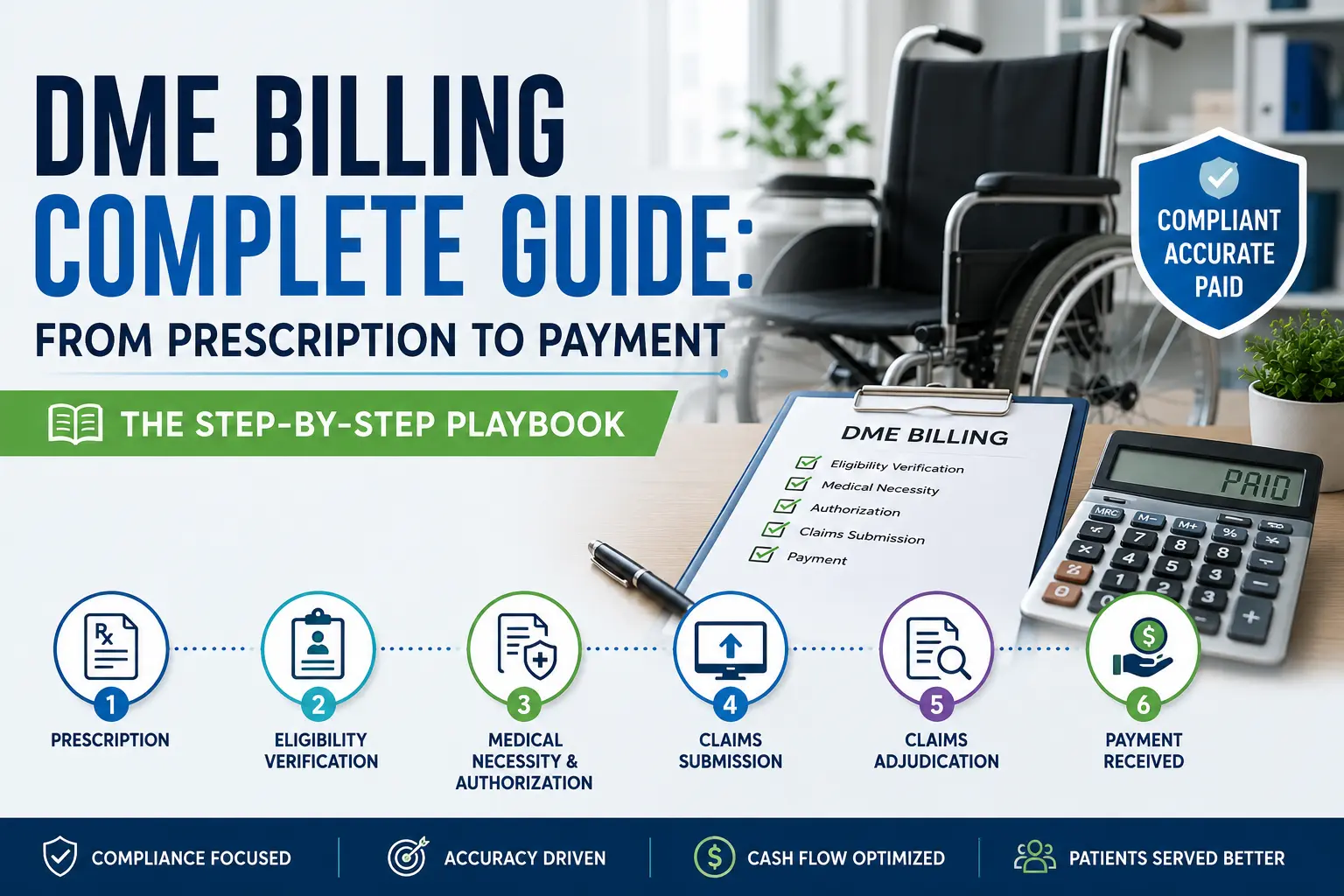
Look, I’ve been in healthcare billing for over 50 years now. I’ve seen the industry evolve from paper claims to electronic submissions, watched coding systems change more times than I can count, and worked with thousands of doctors and clinic owners who thought their DME billing was just another part of medical billing. Spoiler alert: it’s not. And that’s where most providers go wrong.
If you’re running a clinic, operating an independent medical practice, or managing medical equipment supplies, DME billing is likely costing you thousands of dollars every month without you even realizing it. I’m not exaggerating. The statistics are staggering. Over 40 percent of DME providers experience delayed payments because of missing documentation or incorrect coding. That’s not a small number. That’s nearly half your revenue sitting in limbo.
The reality is this: DME billing operates by completely different rules than standard medical billing. It has its own codes, its own documentation requirements, its own insurance verification process, and frankly, its own way of making providers pull their hair out. But here’s the good news. Once you understand the system, once you know what payers actually want and why they reject claims, you can run a clean, efficient DME billing operation that brings money in on time, every single time.
This guide is going to walk you through everything. Not the high-level overview that leaves you with more questions than answers. I’m talking about the real, practical, day-to-day workflow. The specific mistakes I’ve seen destroy revenue cycles. The strategies that actually work. By the time you finish reading, you’ll understand DME billing the way I do. And you’ll know exactly what needs to change in your practice.
What Exactly Is DME Billing? (And Why It’s Different)
Let’s start with the basics, but let me be clear: DME is not just another type of medical billing with a different name. It’s genuinely different.
DME stands for Durable Medical Equipment. These are devices that a patient uses at home to assist with daily living, mobility, or medical treatment. We’re talking about wheelchairs, oxygen machines, CPAP devices, hospital beds, orthotic braces, prosthetics, diabetic supplies, walkers, canes, nebulizers. Equipment designed to last at least three years and serve a medical purpose.
Now here’s where it gets interesting. When a patient needs a wheelchair, the process looks nothing like when they need an office visit for a sinus infection. Your doctor doesn’t just jot a note in the chart and send a claim. There’s a prescription, yes, but it’s not your standard prescription. There’s medical documentation proving the patient actually needs this equipment. There’s insurance verification to confirm whether Medicare or the commercial plan will cover it. There’s often a process called a prior authorization, which means you’re asking the insurance company for permission before you even provide the equipment. There are specific codes called HCPCS Level II codes that are completely different from the CPT codes you use for office visits. And there are modifiers. Lots of modifiers.
I’ve watched practices treat DME billing like they treat billing for everything else, and it’s a disaster. They use the wrong codes. They submit claims without the required documentation. They miss the prior authorization deadline. And then they’re confused when the claim comes back denied.
Here’s what separates DME from standard medical billing:
The coding system is different. Standard medical procedures use CPT codes. DME uses HCPCS Level II codes. These are the codes that start with letters like E, J, L, A, or K. For example, E0607 is the code for a home blood glucose monitor. L3010 is the code for a spinal orthosis. These codes are specific, numerous, and critically important. Getting the code wrong doesn’t just delay payment. It can result in a permanent denial.
The documentation requirements are different. When you bill for an office visit, you need a note in the chart. When you bill for DME, you need specific documentation proving medical necessity. For Medicare, this often means a Detailed Written Order or a Certificate of Medical Necessity. The insurance company wants to know why this patient needs this specific equipment. Not just a general reason. The specific reason for this particular patient.
The rental versus purchase distinction matters. This is something I see trip up practices constantly. Some equipment is billed as a rental, which means you bill a monthly fee for a set number of months. Some equipment is billed as a purchase, which means you bill it once. And here’s the kicker: some equipment can be billed either way depending on the circumstances. You need modifiers to indicate whether it’s a rental, a purchase, or a capped rental (which means the patient has now paid enough in monthly fees to own the equipment).
Insurance verification is more complex. Before you provide any DME, you need to verify that the insurance will actually cover it. But it’s not just about whether the insurance covers DME in general. You need to know whether they cover this specific equipment, what the reimbursement amount is, whether there’s a prior authorization required, what the authorization process is, and what documentation the specific insurance company requires. Different payers have different requirements for the same equipment.
The reimbursement timeline is different. Standard office visit claims often get paid within 30 to 45 days. DME claims can take significantly longer, especially if there’s a prior authorization involved or if the insurance company decides to do an audit. I’ve seen DME claims take 90 to 120 days to pay when everything goes right. When something goes wrong, it can take six months or longer.
This is why I always tell doctors: stop thinking of DME billing as just another service you provide. It’s a separate business within your business. It has its own process, its own codes, its own documentation, and its own reimbursement rules. Once you accept that and adjust your operations accordingly, everything becomes easier.
The Real Impact: Why This Matters to Your Bottom Line
Before I walk you through the process, I want to tell you why you should actually care about getting this right. Numbers matter.
Let’s say you’re a clinic with 15 DME claims per month. That’s 180 claims per year. Now, if your average DME claim reimbursement is $500, that’s $90,000 annually. But here’s what I’ve observed in hundreds of practices. On average, 20 to 30 percent of DME claims come back denied on the first submission. Some practices are even higher. That means anywhere from $18,000 to $27,000 in claims that aren’t getting paid. And that’s just the first level of impact.
When a claim gets denied, you have to resubmit it. That takes time. Your staff has to investigate why it was denied, correct the problem, and resubmit. Many practices give up after the first or second denial. The money just never comes in. Some practices do eventually get the claims paid, but it takes four times longer than it should, which means four times the administrative burden on your staff.
But the real financial impact goes deeper. When claims are constantly being denied, your cash flow suffers. You can’t predict income. You can’t budget accurately. You end up carrying extra overhead costs to cover the unpredictable gaps. Some practices I’ve worked with were literally hemorrhaging money without realizing the root cause was DME billing problems.
Then there’s the compliance side. Medicare and other payers are aggressive about DME fraud. They conduct regular audits. If your documentation is sloppy or your coding is off, even unintentionally, you could face financial penalties. I’ve seen practices get hit with demands to repay thousands of dollars because of coding mistakes made months or even years earlier. And that’s if they discover it. If it goes through a full audit investigation, you could be looking at legal costs and reputational damage.
The bottom line is this: get DME billing right, and you’re looking at a clean, predictable revenue stream that flows in on time. Get it wrong, and you’re looking at constant firefighting, delayed income, staff frustration, and potential compliance issues.
The Step-by-Step DME Billing Process (What Actually Happens)
Now let me walk you through exactly what happens when a patient needs DME. This is the real workflow from start to finish.
Step 1: The Doctor’s Prescription and Medical Assessment
It all starts with the patient and the provider. The patient comes in with a medical need. They have limited mobility, they need oxygen, they need a certain type of orthotic device. The doctor evaluates them, determines they need DME, and writes a prescription. But here’s where it diverges from standard prescribing. The prescription for DME needs to be specific. Not just “wheelchair.” It needs to be “lightweight manual wheelchair, 18-inch seat width, with specific measurements and features based on the patient’s condition.”
At the same time, the doctor needs to document the medical necessity. This isn’t a brief note. It’s a documented reason for why this patient needs this specific equipment. What condition do they have? What are the specific functional limitations that make this equipment medically necessary? The insurance company is going to want to see this.
Step 2: Insurance Verification
This is where many practices drop the ball. Before you do anything else, you need to verify coverage. Your administrative staff needs to contact the insurance company and find out several specific things:
Is DME covered under this particular plan? Not all plans cover all DME. Some commercial plans have strict limitations. Is this specific equipment covered? There’s a difference between coverage for wheelchairs in general and coverage for a specific type of wheelchair. What is the reimbursement amount for this equipment? You need to know the allowed amount before you provide the service, not after. Is a prior authorization required? For many pieces of DME, especially expensive equipment, the insurance company wants approval before you provide it. What documentation do they require? Every insurance company has specific documentation requirements. Medicare has one set. Medicaid has another. Commercial plans have their own requirements.
This verification step is critical. It takes maybe 30 minutes, and it prevents 90 percent of the problems that occur later.
Step 3: Prior Authorization (If Required)
If the insurance company requires prior authorization, this step happens before the patient gets the equipment. Your staff submits the prescription, the medical documentation, and any other required information to the insurance company. The insurance company reviews it and either approves or denies the authorization.
Here’s what I’ve learned over the decades: prior authorizations are the biggest time waster in DME billing. They can take days or weeks. Sometimes the insurance company requests additional documentation. Sometimes they deny the authorization, in which case you have to decide whether to appeal or tell the patient the insurance won’t cover it.
The key is to submit the prior authorization request as soon as the prescription is written, not after. Every day you wait is a day the patient is waiting for their equipment, and a day the clock is ticking on getting paid.
Step 4: Providing the Equipment and Documentation
Once you’ve verified coverage and obtained authorization if necessary, you provide the equipment to the patient. At this point, you need to document everything. What equipment was provided? When was it provided? Who provided it? What specific measurements or specifications apply? Was there a delivery? Was there instruction on how to use the equipment? Get the patient’s signature on documentation proving they received the equipment.
This documentation becomes the evidence supporting your claim. If you don’t have it, the insurance company has no way to verify that the patient actually received what you’re billing for. This is where audit problems start.
Step 5: Coding the Claim
Now we get to the coding. Remember those HCPCS Level II codes I mentioned? This is where you use them. You need to determine the exact code for the exact equipment provided. And you need to include the right modifiers.
Modifiers in DME are critical. A modifier is a two-digit code that provides additional information about the service or equipment. For example, the modifier RR indicates a rental. The modifier NU indicates new equipment. The modifier UE indicates used equipment. The modifier CC indicates a capped rental (meaning the patient has now paid enough in monthly rentals to own the equipment).
Getting the modifier wrong is a common reason for denials. I’ve seen claims denied because someone forgot to include the rental modifier, making it look like a purchase when it should have been a monthly rental. Coding takes real expertise. It’s not something to guess at.
Step 6: Gathering Supporting Documentation
Before you submit the claim, you need to gather all the supporting documentation. This typically includes:
The prescription from the doctor. The detailed written order or certificate of medical necessity. Proof of prior authorization from the insurance company if authorization was required. Documentation of delivery and patient signature. Any specific measurements or specifications related to the equipment. Insurance verification documentation.
Medicare in particular is strict about this. They want specific forms filled out correctly. Medicaid varies by state but is equally demanding. Commercial payers each have their own preferences.
Step 7: Claim Submission
Now you submit the claim. In 2026, most claims go through electronic clearinghouses. Your billing system or billing company submits the claim electronically to the insurance company through the clearinghouse. The claim goes through validation checks. If there are formatting errors or missing required information, the clearinghouse rejects it before it even reaches the insurance company. You need to fix those errors and resubmit.
If the claim passes clearinghouse validation, it goes to the insurance company.
Step 8: Insurance Company Review
The insurance company receives your claim. They review it against their coverage policies and the medical necessity documentation. They verify that the patient is eligible for benefits. They check their fee schedule to determine the allowed amount. This can take anywhere from a few days to several weeks.
Step 9: Remittance and Payment
Assuming the claim is approved, the insurance company sends a remittance explanation showing what they’re approving and what amount they’re paying. Your staff records this in the accounting system. The payment either arrives by check or by electronic transfer.
Step 10: Following Up on Denials
If the claim is denied, you receive an explanation of benefits or a denial notice. This is where the real work begins. You need to understand why it was denied. Was it a documentation issue? A coding issue? An eligibility issue? A coverage limitation? Once you understand the reason, you determine whether you can fix it and resubmit, or whether you need to appeal.
Appeals are a whole separate process. Some insurance companies have internal appeal processes. Some go to external review. Appeals take time. And they’re only worth pursuing if you have a legitimate argument that the claim should have been approved.
This is the real workflow. Not glamorous. Not quick. But this is what actually happens.
Equipment-Specific Billing: The Different Rules for Different Devices
Now, I need to tell you something important. Not all DME is billed the same way. The specific equipment matters significantly. Let me walk through the most common categories and what makes each one unique.
Mobility Equipment (Wheelchairs, Walkers, Canes)
These are the bread and butter of DME for many providers. A manual wheelchair might be billed as a one-time purchase with code K0001 through K0900 depending on the specific type and features. A motorized wheelchair gets a completely different code and reimbursement amount. Some payers cover manual wheelchairs but not motorized ones, or they cover motorized wheelchairs only if the patient meets specific criteria.
Walkers and canes are typically billed as purchases, not rentals. The reimbursement is usually lower, maybe $50 to $150 per item. But because they’re lower cost, insurance companies are more likely to approve them without a big fight.
The key with mobility equipment is understanding what your specific payer covers and what the documentation requirements are. Medicare has specific rules about wheelchair specifications. The doctor’s order needs to include seat width, seat depth, and other measurements. Get these wrong, and the claim can be denied for not meeting specifications.
Respiratory Equipment (Oxygen, CPAP, Nebulizers)
This is where things get complex. Oxygen equipment is one of the most frequently billed DME categories, but it’s also one of the most commonly denied categories. Why? Because the documentation requirements are strict, and many providers don’t get it right.
For Medicare oxygen, the doctor needs to document that the patient has a specific pulmonary or cardiac condition. They need to document oxygen saturation levels from a test. They need to specify the flow rate. The prescription needs to include whether it’s stationary oxygen, portable oxygen, or both. Some patients need oxygen only at night. Some need it during the day. Some need it all the time. All of this matters for coding and reimbursement.
CPAP devices are billed differently. They’re typically a monthly rental for a limited number of months, after which the patient owns the equipment. The documentation needs to prove the patient has sleep apnea.
Nebulizers are usually a one-time purchase. But which type of nebulizer? Jet nebulizer? Mesh nebulizer? The code depends on the specific type.
Orthotic and Prosthetic Devices (Braces, Artificial Limbs)
These devices are often custom-made for the patient, which means they’re more expensive and the documentation is more critical. A spinal orthosis might cost $2,000. An artificial limb might cost $10,000 or more. Insurance companies scrutinize these claims carefully.
The doctor’s documentation needs to explain the specific medical condition and why this specific orthotic or prosthetic device is necessary. Often, the provider making the device submits the documentation along with detailed descriptions of how it’s customized for this patient.
One thing I always emphasize with orthotic and prosthetic devices: the provider billing for the device is often not the provider writing the prescription. A prosthetist or orthotist might be billing separately from the patient’s primary care physician. The coordination between these providers and clear documentation from both is essential.
Diabetic Supplies (Glucose Monitors, Testing Strips, Lancets)
These are items the patient needs repeatedly. They’re billed as supplies, not equipment, but they fall under DME billing. The reimbursement is usually per test strip or per box of supplies. The patient gets a set quantity per month based on their testing needs.
The documentation is simpler for these because they’re routine maintenance supplies for a diagnosed condition. But the quantity matters. You need to bill the quantity the patient actually needs, documented by the doctor’s order. Some insurances limit supplies to a certain quantity per month, regardless of what the patient actually uses.
This is where accurate documentation of the patient’s actual usage becomes important. If the patient tests blood sugar four times daily, you’d expect to bill for around 120 test strips per month. If you bill for 300 test strips when the prescription only shows four times daily, that’s a red flag to the insurance company.
Other DME (Hospital Beds, Pressure Relief Mattresses, Enteral Feeding Supplies)
Each category of DME has its own nuances. Hospital beds need documentation showing the patient cannot sleep in a regular bed due to their medical condition. Pressure relief mattresses need documentation that the patient is at risk for pressure ulcers. Enteral feeding supplies need documentation that the patient cannot consume nutrition orally.
The pattern you see across all equipment types is the same: specific equipment requires specific documentation. The insurance company doesn’t just want to know the patient has a condition. They want to know why this specific equipment is medically necessary for this specific patient.
The Top DME Billing Mistakes (And How They Cost You Money)
After 50 years, I’ve identified the patterns. These are the mistakes I see repeatedly that destroy DME billing operations.
Mistake 1: Submitting Claims Without Prior Authorization
This is probably the most common and most expensive mistake. The doctor writes a prescription for a motorized wheelchair. Your staff assumes insurance will cover it because the patient has mobility issues. They submit the claim without getting prior authorization. Two weeks later, the claim comes back denied because the insurance company requires prior authorization for motorized wheelchairs.
Now you have to resubmit, but you’re behind schedule. The patient is frustrated. Your staff has already spent time on the claim. And you’ve delayed payment by at least two weeks. Do this fifty times a year, and you’re delaying payment significantly.
The fix: always verify whether prior authorization is required before providing equipment. Always request prior authorization before providing expensive equipment. Every single time.
Mistake 2: Incomplete or Incorrect Medical Necessity Documentation
The doctor writes “patient needs oxygen” in the chart. Your staff submits a claim. The insurance company denies it because they need specific documentation showing the oxygen saturation level, the specific diagnosis, and the specific flow rate needed.
Many denials happen because the documentation in the medical record is insufficient. The doctor documented enough for their clinical purposes but not enough for the insurance company’s purposes. You then have to go back to the doctor, ask them to add more documentation, submit the claim again, and wait.
The fix: know exactly what each payer requires for medical necessity documentation before the patient leaves your office. Have templates or checklists to ensure documentation is complete.
Mistake 3: Using the Wrong HCPCS Codes
A practice bills E0601 for a continuous positive airway pressure (CPAP) device when they should bill E0603. These are different codes with different reimbursement amounts. The insurance company either denies the claim or pays the wrong amount.
Or worse, they bill a code for a motorized wheelchair when they should bill a different code for a motorized scooter. These are different equipment types with completely different reimbursement amounts.
HCPCS codes are incredibly specific. There are hundreds of DME codes. Getting them right requires real knowledge of the coding system and the equipment.
The fix: invest in proper coding training or partner with a company that specializes in DME billing if this isn’t your area of expertise. A $50 coding mistake per claim adds up quickly if you’re billing 15 claims a month.
Mistake 4: Missing or Incorrect Modifiers
Someone bills an oxygen system without the modifier indicating the flow rate. They bill a wheelchair rental without the rental modifier, making it look like a purchase. They bill a capped rental without indicating it’s the final month of the capped rental.
Modifiers change how the claim is interpreted. Missing modifiers or using the wrong modifiers result in denials or underpayment.
The fix: understand modifier usage. Have a reference guide for your billing staff. Double-check claims before submission to ensure modifiers are correct.
Mistake 5: Billing for Equipment the Patient Never Received
I’ve seen this more than I’d like to admit. A practice bills for a wheelchair but the patient picked it up and immediately returned it. They bill for oxygen supplies but the patient received a different amount than billed. They bill for monthly rentals but the patient stopped using the equipment after one month.
If the insurance company audits the claim and discovers the patient never actually received the equipment they’re being billed for, that’s fraud. Even if it’s an innocent mistake, it’s still a problem.
The fix: document everything. Get signed receipts showing the patient received the equipment. Track what’s actually delivered versus what’s billed. Have a reconciliation process at month-end.
Mistake 6: Not Following Up on Denials
A claim gets denied. Your staff doesn’t investigate why. The money never comes in. Months later, you wonder why your DME revenue is lower than expected. When you finally investigate, you find dozens of unpaid claims sitting in the system.
Many practices are too understaffed to effectively follow up on denials. Denials pile up. Some get paid eventually. Many never do.
The fix: assign someone specific responsibility for denial management. Track denials. Investigate them. Determine whether they can be corrected and resubmitted, or whether an appeal is necessary. Have a system for following up until the claim is resolved.
Mistake 7: Not Verifying Insurance Eligibility
A patient comes in with an insurance card. Your staff verifies they have coverage for medical services. They submit a DME claim without verifying whether the patient’s coverage includes DME or whether there are specific limitations. The claim gets denied because the patient doesn’t actually have DME coverage under their specific plan.
The fix: verify not just whether the patient has insurance, but specifically whether they have DME coverage and what the coverage limitations are.
Mistake 8: Providing Equipment Before Getting Authorization
This is different from the prior authorization issue. I’m talking about giving the patient the equipment before you’ve even verified that the insurance will cover it. Then the claim gets denied, and you’re stuck. The patient has the equipment. The insurance won’t pay. You can either write it off or try to collect from the patient.
Practices sometimes do this to be nice to the patient or because the patient is in pain and needs the equipment urgently. But it puts you in a bad position financially.
The fix: get authorization before providing expensive equipment. If the patient absolutely needs it immediately, consider having them sign an acknowledgment that they understand the insurance might not cover it and they may be responsible for the cost.
Mistake 9: Not Billing Monthly Rentals Correctly
Some equipment is billed as monthly rentals for a set number of months, say 13 months. After 13 months of rental payments, the total paid equals the purchase price, and the patient is considered to own the equipment. After that, you stop billing.
Many practices mess this up. They either don’t track the months correctly, or they keep billing after the patient has paid off the equipment, or they don’t include the correct modifiers to indicate which month of the rental it is.
The fix: use billing software that tracks rental cycles automatically. Have a system for monitoring when a capped rental period ends and the equipment transfers to patient ownership.
Mistake 10: Not Staying Current with Payer Policy Changes
Insurance companies change their coverage policies, their documentation requirements, and their coding preferences regularly. A reimbursement amount that was standard three years ago might not be anymore. A form that was required might no longer be needed. A code that was acceptable might be denied now.
If you’re not actively monitoring payer communications and staying current with changes, your denial rate will creep up over time without you even realizing why.
The fix: have someone responsible for monitoring payer updates. Join professional organizations that communicate payer changes. Review your denial reasons regularly to identify trends that might indicate a payer policy change you missed.
HCPCS Codes Explained (Without Making Your Head Hurt)
I know HCPCS codes intimidate people. But they don’t have to. Let me demystify them.
HCPCS stands for Healthcare Common Procedure Coding System. It’s divided into levels. Level I codes are CPT codes, which are used for procedures and office visits. Level II codes are the ones used for DME, supplies, and certain services. Level II codes start with a letter followed by four numbers. The letter indicates the category of service.
Here are the most common letters you’ll see in DME:
E codes are for durable medical equipment. E0001 through E1999 are various types of DME. E1390 is an oxygen concentrator. E0607 is a home blood glucose monitor.
L codes are for orthotic and prosthetic services. L3000 through L4999 are various orthotics and prosthetics. L3010 is a spinal orthosis.
J codes can include drugs and certain supplies. J1100 might be a specific medication given via injection.
K codes are used when there’s no other appropriate code. These are often new equipment types or updates to existing equipment.
A codes are for certain medical supplies and services. A0001 through A9999 include things like orthotics supplies.
Now, within each category, there are hundreds of specific codes. The key is finding the code that matches the specific equipment the patient received. Is it a manual wheelchair or a motorized wheelchair? Is it a portable oxygen concentrator or a stationary one? Is it a specific type of orthotic brace?
The way to find the right code is to look at the equipment documentation, the patient’s condition, the specific features of the equipment, and then consult the HCPCS code book. Most EMR and billing systems now include code lookup tools that help you find the right code.
Here’s my advice: if you’re billing DME, get trained on the codes. Don’t guess. A wrong code doesn’t just delay payment. It might result in underpayment or outright denial. If coding is not your strength, partner with someone who knows it.
Denial Prevention: The Real Strategy
Now I want to talk about the one thing that has the biggest impact on your DME billing success: preventing denials in the first place.
Most practices are reactive with denials. A claim gets denied, they react, they resubmit. But the best practices are proactive. They prevent denials before they happen.
How do you prevent denials? By understanding the most common denial reasons and systematically eliminating them.
Denial Reason 1: Lack of Medical Necessity Documentation
This is the number one reason for DME denials. Prevent it by making sure your documentation is complete before you submit any claim. Have a checklist for each equipment type showing what documentation needs to be in the medical record.
Denial Reason 2: Prior Authorization Not Obtained
Prevent this by checking every single claim to determine whether prior authorization is required before you provide the equipment.
Denial Reason 3: Incorrect Coding
Prevent this by having a coding review process. Before claims are submitted, someone who knows DME coding should review them to verify the codes are correct.
Denial Reason 4: Eligibility Issues
Prevent this by thoroughly verifying insurance eligibility and coverage limitations before providing the equipment.
Denial Reason 5: Missing Supporting Documentation
Prevent this by having documentation procedures in place. When equipment is provided, document it. When it’s delivered, get a signature. Have a filing system that keeps everything organized and readily available if the insurance company requests it.
Denial Reason 6: Quantity Limitations
Some insurance companies limit the quantity of supplies a patient can receive per month. Prevent overage denials by knowing these limits and billing within them.
The pattern here is clear: prevention requires systematic processes, good documentation, knowledge of payer requirements, and attention to detail. It’s not glamorous work, but it’s incredibly effective.
In-House Billing Versus Outsourcing: The Honest Comparison
At this point, you might be wondering whether to handle DME billing in-house or outsource it to a specialist company. Let me give you the honest assessment based on decades of experience working with hundreds of practices.
The Case for In-House DME Billing
If you have a small number of DME claims (maybe five per month or fewer) and someone on your staff who has DME billing expertise or is willing to become an expert, you can absolutely handle it in-house. The advantage is control. You control the timeline, the quality, the communication with patients. You keep all the revenue without paying a middleman.
But here’s the reality: DME billing requires specific knowledge. It’s not something to give to a staff member who also handles other billing tasks. They need to be focused on this. They need to stay current with code changes and payer requirements. They need to have good relationships with insurance companies to follow up on claims effectively.
If you go the in-house route, budget for training. Budget for coding references. Budget for time spent on prior authorizations and denial follow-up.
The Case for Outsourcing
If you’re billing more than 10 DME claims per month, or if DME is important to your revenue but you don’t have the in-house expertise, outsourcing to a DME billing specialist makes sense.
A good DME billing company handles everything. They verify insurance. They handle prior authorization. They code the claims. They submit them. They follow up on denials. They handle appeals. They provide detailed reporting so you know what’s happening with your revenue.
The cost is typically a percentage of collections or a flat fee per claim. If you’re billing $100,000 per year in DME and you pay a billing company 10 percent to handle it, that’s $10,000 per year. But if outsourcing reduces your denial rate from 25 percent to 5 percent, you’re recovering $20,000 in claims that would have otherwise been unpaid. The math works out.
My honest take: most practices get more value outsourcing DME billing to a specialist than trying to handle it in-house without expertise. The complexity is just too high for a generalist billing person to handle well.
Common Misconceptions About DME Billing (Let’s Clear These Up)
After five decades in this business, I’ve heard every misconception about DME billing. Let me address the biggest ones.
Misconception 1: “DME Billing is Just Like Regular Medical Billing”
No. It’s categorically different. Different codes, different documentation, different insurance rules. Stop treating it the same way.
Misconception 2: “Insurance Always Covers DME”
Wrong. Some plans don’t cover certain types of DME. Some plans have significant limitations. Always verify before you provide equipment.
Misconception 3: “We Can Provide the Equipment and Figure Out Authorization Later”
This is dangerous. If the insurance denies authorization, you’re stuck with an unpaid claim and a patient who has equipment they might not have been able to afford.
Misconception 4: “The Doctor’s Note is All the Documentation We Need”
For many claims, the doctor’s note is insufficient. Insurance companies need specific documentation proving medical necessity. The note might need to be supplemented with test results, measurements, or specific forms.
Misconception 5: “Once a Claim is Denied, We Might as Well Write It Off”
Many denials can be reversed if you understand why they were denied and correct the problem. Don’t give up without investigating.
Misconception 6: “HCPCS Codes Never Change”
They change every year. New codes are added. Some codes are deleted. Old reimbursement amounts change. Staying current is essential.
Misconception 7: “We Don’t Need to Track Monthly Rentals Carefully”
You absolutely do. Billing monthly rentals incorrectly is a common source of denials and audit findings.
Misconception 8: “The Clearinghouse Will Catch All Our Errors”
The clearinghouse validates formatting and some data elements. They won’t catch coding errors, modifiers, or missing medical necessity documentation. Your staff still needs to review claims.
Revenue Optimization: Strategies That Actually Work
Beyond just getting claims paid on time, there are specific strategies to optimize your DME revenue.
Strategy 1: Verify Full Coverage Before Providing Equipment
Some patients have secondary insurance that covers equipment that primary insurance doesn’t cover, or covers it better. If you only bill primary insurance, you’re leaving money on the table. Always verify whether there’s secondary insurance and bill appropriately.
Strategy 2: Understand Your Payers’ Reimbursement Rates
Each payer has a different fee schedule. Medicare’s rate for a specific wheelchair might be $600. A commercial payer’s rate might be $800. If you’re accepting assignment (which most practices do), you’re getting the contracted rate. But knowing what it is helps you understand whether a patient’s copay is reasonable and helps you project revenue accurately.
Strategy 3: Batch Similar Claims
If you’re handling billing in-house, batching claims by payer and processing them together is more efficient than processing random claims throughout the day. You’re verifying one payer’s requirements, then processing all their claims, rather than jumping between different payer requirements.
Strategy 4: Negotiate Provider Fees
If you’re providing equipment, you might be able to negotiate better reimbursement rates with insurance companies, especially if you’re billing high volumes. This is an advanced strategy but worth considering if DME is significant to your revenue.
Strategy 5: Track Metrics That Matter
Most practices track total revenue but not the metrics that predict whether DME billing is healthy. Track denial rates by payer. Track average time from claim submission to payment. Track the percentage of claims requiring follow-up. These metrics tell you where your problems are.
Frequently Asked Questions About DME Billing
Q: How long does it take to get paid for a DME claim?
A: Typically 30 to 45 days if everything goes smoothly. If there’s a prior authorization delay, it can easily be 60 to 90 days. If the claim is denied, it depends on how long the denial takes to resolve. Some claims take six months or longer.
Q: What happens if a patient refuses to pay their copay or coinsurance?
A: That’s between you and the patient. You’re entitled to collect their cost-sharing amount. Some practices write it off. Some have collection policies. That’s a decision for your practice.
Q: Can we bill for equipment if it’s just sitting in our office and hasn’t been used yet?
A: No. You bill for equipment when it’s actually provided to the patient. If it’s sitting in your office, it hasn’t been provided yet. If a patient never picks it up, you don’t bill.
Q: What’s the difference between a Certificate of Medical Necessity and a Detailed Written Order?
A: The Detailed Written Order is more specific and detailed. For Medicare, you need a Detailed Written Order for most DME. The Certificate of Medical Necessity is used for some insurance companies. They serve the same basic purpose but the format is different.
Q: If an insurance company denies a claim, can we always appeal?
A: You have the right to appeal, but whether the appeal is worth pursuing depends on the reason for the denial and the likelihood of success. Some denials are worth appealing. Some aren’t.
Q: How do we know if we need a prior authorization?
A: Ask your insurance company directly, or contact your billing company. Most practices maintain a list of equipment types that require prior authorization for each major payer.
Q: What happens if we bill the wrong modifiers?
A: The claim might be denied, or it might be paid less than it should be. Either way, it’s a problem. The insurance company has specific requirements for which modifiers to use when.
Q: Can a patient use equipment from a different supplier than the one that billed for it?
A: Yes. The patient can buy a wheelchair from any supplier. But only one supplier can bill the insurance company for it. If multiple suppliers bill for the same equipment, one will be denied as a duplicate.
Q: How often do insurance companies audit DME claims?
A: It varies by payer and your claim volume. Medicare conducts regular audits. High-volume suppliers are audited more frequently than low-volume suppliers.