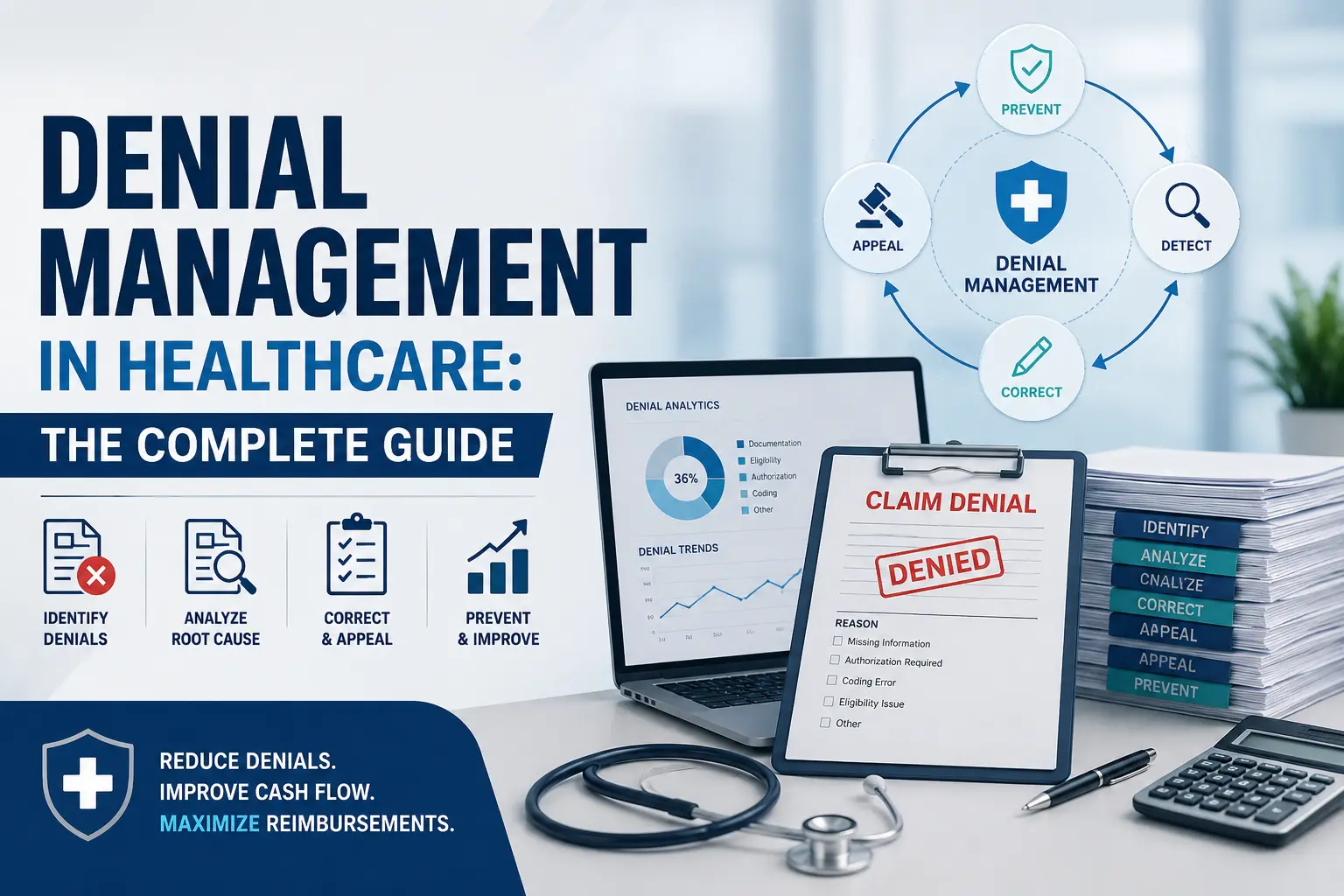
Denial management is the ongoing process of identifying why insurance claims get denied, correcting and appealing the ones that can be recovered, and using that data to stop the same denial from happening again. It’s not a one-time fix. It’s a continuous cycle that sits at the center of a healthy revenue cycle, and practices that treat it as a system rather than a fire drill consistently collect more of what they’re actually owed.
Claim denials aren’t rare. The industry-wide initial denial rate has climbed to nearly 12% in recent years, and U.S. providers lose well over $260 billion a year to claims that get denied on first submission. What separates practices that stay financially healthy from ones that don’t isn’t whether they get denials. Every practice does. It’s whether they have a real process for catching, fixing, and preventing them.
This guide breaks down what denial management actually involves, the types of denials you’re dealing with, and the framework that turns denial management from a constant scramble into a repeatable system.
Denial vs. Rejection: Know the Difference First
These two terms get mixed up constantly, and the confusion causes real workflow problems.
A rejection happens before the claim ever reaches the payer. Your clearinghouse or claim scrubber catches a formatting error, a missing field, or an invalid code, and kicks the claim back so you can fix it and resubmit. No one at the insurance company has looked at it yet.
A denial happens after the payer receives and processes the claim, and decides not to pay it, whether that’s for medical necessity, missing authorization, or a coverage issue. This requires a formal appeal, not just a resubmission.
Treating rejections and denials the same way is one of the most common reasons practices lose track of recoverable revenue. They need separate workflows and separate staff attention.
The Four Types of Claim Denials
Not all denials carry the same weight, and knowing which type you’re looking at determines whether it’s worth fighting or not.
| Denial Type | Recoverable? | What Causes It | Typical Action |
|---|---|---|---|
| Soft denial | Yes, usually | Missing info, minor coding error, incomplete documentation | Correct and resubmit, no formal appeal needed |
| Administrative denial | Often | Eligibility issues, authorization not on file, timely filing questions | Correct the administrative gap and resubmit or appeal |
| Clinical denial | Sometimes | Medical necessity not established, level of care disputed | Requires a formal appeal with clinical documentation |
| Hard denial | Rarely | Non-covered service, missed filing deadline, final payer determination | Usually written off unless a clear appeal ground exists |
The mistake most billing teams make is spending equal time on all four categories. A mature denial management process triages fast: soft and administrative denials get corrected same-day, while clinical and hard denials get routed to whoever can build the strongest appeal case, since those take real documentation work to recover.
The 4-Stage Denial Management Framework
Strip away the jargon and denial management really comes down to four connected stages. Skip any one of them and the whole system breaks down.
1. Identify. Every denial arrives on the remittance advice with a Claim Adjustment Reason Code (CARC) and often a Remark Code (RARC) explaining why. The first job is logging every denial as it comes in, not letting them pile up unopened in a payer portal.
2. Investigate. This is where soft denials get separated from clinical and hard ones. Someone needs to determine whether the claim can simply be corrected and resubmitted, or whether it requires a documented appeal.
3. Resolve. For soft denials, this means fixing the error and resubmitting. For denials requiring appeal, this means building a case with clinical notes, medical necessity documentation, and payer-specific policy references. Appeals filed within 48 hours of the denial consistently recover more revenue than ones that sit for weeks.
4. Prevent. This is the stage most practices skip entirely, and it’s the one that actually shrinks your denial rate over time instead of just reacting to it. Every resolved denial should feed back into a root-cause log. If the same reason code keeps showing up, that’s a process gap, not bad luck.
For a detailed breakdown of daily, weekly, and monthly tasks inside this cycle, along with real KPI benchmarks and payer-specific appeal tactics, our complete denial management playbook covers the operational side of this framework step by step.
The Denial Management Maturity Model
Most practices fall into one of three stages, and knowing which one you’re in tells you exactly what to fix next.
Reactive (most practices start here). Denials get worked whenever staff has spare time, which usually means weeks after the fact. There’s no tracking by reason code, no root-cause review, and appeal win rates are inconsistent because no one is learning from past denials.
Proactive. Denials are logged and categorized as they arrive, appeals go out within 48 hours, and someone reviews denial trends monthly. This is where most well-run practices sit, and it’s enough to keep denial rates in a manageable range.
Predictive. Claims get flagged for likely denial risk before submission, using payer-specific rules and historical patterns. Front-end staff get real-time prompts for missing authorization or eligibility gaps. This stage is where AI-assisted scrubbing tools are making the biggest difference in 2026, catching the exact patterns that used to only show up after a denial hit.
Moving from reactive to proactive is mostly a workflow and staffing fix. Moving from proactive to predictive usually requires the right technology stack layered on top of a process that’s already working.
Core KPIs to Track
You can’t manage what you don’t measure. At minimum, track these monthly:
- Denial rate: total denied claims divided by total claims submitted
- Clean claim rate: percentage of claims accepted on first submission with no errors
- Appeal win rate: percentage of filed appeals that get overturned and paid
- Days to first appeal: how quickly your team acts once a denial hits
- Denial rate by reason code: which categories are actually driving your losses
A denial rate under 5 to 8% is generally considered healthy. Above 10% usually points to a systemic issue in front-end verification, coding, or authorization workflows rather than a series of one-off mistakes. Tracking these alongside your clean claim rate and net collection rate gives a much clearer picture of where revenue is actually leaking.
What Actually Causes Most Denials
Across most specialties, denials cluster around a handful of root causes:
- Eligibility and coverage not verified before the visit
- Prior authorization missing or expired
- Coding and diagnosis mismatch, or missing modifiers
- Medical necessity not clearly documented
- Timely filing deadlines missed
- Duplicate claims or incomplete patient information
The specific breakdown varies a lot by specialty. Behavioral health and physical therapy practices tend to see much higher denial rates than primary care, largely driven by authorization timing and visit-limit rules. If you want the full reason-code breakdown with real CPT and ICD-10 examples by specialty, that’s covered in depth in our claim denial management playbook.
Building a Denial Prevention Checklist
Prevention is where the real revenue protection happens, since a denial you never receive doesn’t cost you anything to fix. A solid front-end checklist includes:
- Verifying eligibility and benefits within 24 to 48 hours of every appointment
- Confirming prior authorization is on file before the date of service, not after
- Running claims through an automated scrubber before submission
- Matching diagnosis codes to service level and documentation before coding is finalized
- Reviewing payer policy updates quarterly, since coverage rules shift often
- Auditing a sample of claims by provider monthly to catch patterns early
This connects directly to broader revenue integrity work and to preventing revenue leakage across the practice, since denial prevention rarely lives in isolation from documentation, coding, and scheduling processes.
Who Should Own Denial Management
In smaller practices, denial management often falls to whoever on the billing team has time that week, which is exactly why it tends to stay reactive. As claim volume grows, most practices eventually need either a dedicated denial specialist internally or a partner who handles this full-time.
There’s no universal right answer here. It depends on your denial rate, your claim volume, and whether your current team has the bandwidth to work appeals within 48 hours consistently. If you’re weighing whether to build this function internally or bring in outside help, we’ve laid out the real cost comparison and vendor evaluation criteria in our guide on denial management services and outsourcing. If you’d rather talk through your specific numbers, our denial management team can walk through where your practice currently stands.
Frequently Asked Questions
What is denial management in simple terms? It’s the process of figuring out why an insurance claim didn’t get paid, fixing or appealing it, and making changes so the same denial doesn’t happen again. It covers everything from the moment a claim is denied through final resolution.
What are the main types of claim denials? Soft denials, administrative denials, clinical denials, and hard denials. Soft and administrative denials are usually correctable and resubmittable. Clinical and hard denials typically require a formal appeal or result in a write-off.
What is the difference between denial management and rejection management? A rejection happens before a payer ever processes the claim, usually caught by a clearinghouse for formatting or data errors. A denial happens after the payer reviews the claim and refuses payment. Rejections just need correction and resubmission. Denials need investigation and often a formal appeal.
How long does denial management take to show results? Practices that build a consistent workflow, logging denials daily and appealing within 48 hours, typically see measurable improvement in their denial rate within 60 to 90 days. Deeper prevention gains, from fixing root causes, usually show up over 6 months as front-end processes improve.
Who is responsible for denial management in a medical practice? It varies by practice size. Front-end staff handle eligibility and authorization to prevent denials before they happen, coders ensure accuracy on submission, and either a dedicated denial specialist or an outsourced partner handles the actual investigation and appeal work once a denial arrives.
The Bottom Line
Denial management stops feeling like a losing battle once you stop treating every denial as a one-off problem. Categorize what type of denial you’re facing, work it through a consistent four-stage process, and feed every resolved case back into your prevention system. That’s the difference between a practice that’s constantly chasing denied claims and one that’s steadily shrinking its denial rate year over year.