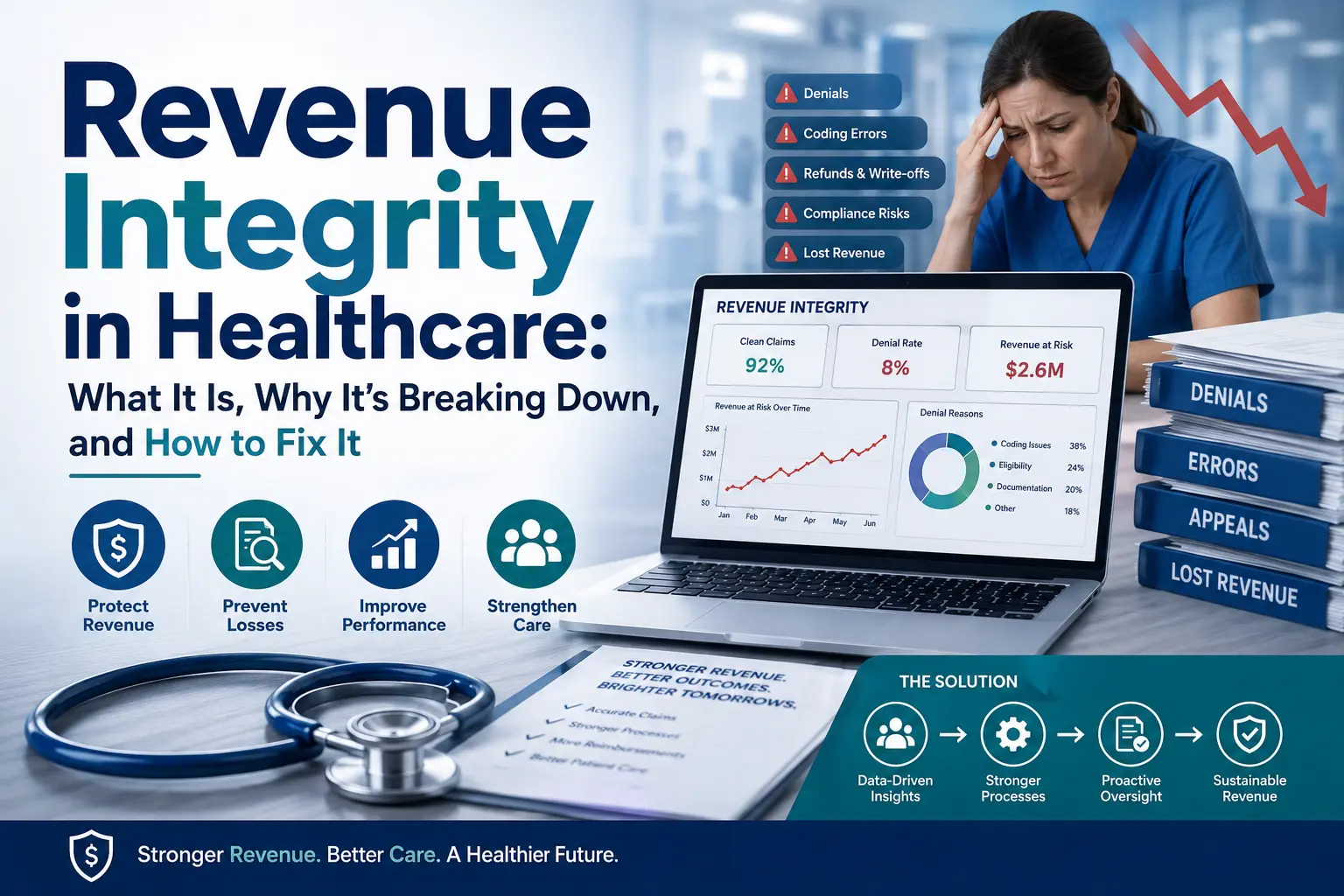
Quick answer: Revenue integrity is the discipline of making sure clinical documentation, coding, charges, and compliance all line up before a claim ever reaches a payer. It sits upstream of billing, not on top of it. Revenue cycle management moves a claim from registration to payment. Revenue integrity makes sure that claim was correct in the first place.
If you run billing for a practice, a group, or a hospital department, you’ve probably felt the symptom without naming the disease. Denials that shouldn’t happen. Coding that technically passes but doesn’t hold up under a payer audit. A charge that quietly falls off a superbill and nobody notices for three months. None of these are billing failures in the traditional sense. They’re revenue integrity failures, and most organizations don’t have a formal way to catch them until the money is already gone.
This guide covers what revenue integrity actually means, how it’s different from revenue cycle management, why the gap between the two has gotten more expensive in 2026, and what a working revenue integrity program looks like in practice, whether you’re building one in-house or leaning on a billing partner to run it for you.
What Is Revenue Integrity in Healthcare?
Revenue integrity is the set of processes, controls, and cross-functional checks that keep three things in sync: what a provider actually did for a patient, what got documented in the chart, and what ends up on the claim. When those three things match, the claim is clean and defensible. When they don’t, you get one of two outcomes: undercoding, where the practice leaves money on the table for care it actually delivered, or overcoding, which invites denials, refund demands, and in the worst cases, compliance penalties.
The goal of revenue integrity is not to bill more. It’s to bill correctly, every time, so reimbursement reflects the care that was actually given. That distinction matters, because a program built around “capture more charges” tends to drift toward compliance risk, while a program built around accuracy tends to protect revenue and pass audits without much drama.
Revenue integrity grew out of hospital coding compliance offices in the early 2000s, largely as a response to increasingly aggressive payer audits and OIG scrutiny. It’s since spread well beyond hospitals. Multi-provider groups, specialty clinics, and even smaller practices now treat it as a standing function rather than a project you run once a year.
Revenue Integrity vs. Revenue Cycle Management: Where One Ends and the Other Begins
The two terms get used interchangeably, which causes real confusion when leadership tries to assign ownership. They’re related, but they answer different questions.
| Aspect | Revenue Cycle Management | Revenue Integrity |
|---|---|---|
| Primary goal | Move a claim from patient registration to final payment | Make sure the claim is accurate and defensible before it’s billed |
| Timing | Runs across the entire patient financial journey | Concentrated pre-bill and mid-cycle, with a feedback loop back to the front end |
| What it optimizes for | Speed, cash flow, days in A/R | Accuracy, documentation quality, compliance |
| Typically owned by | Billing and accounts receivable teams | Coding, HIM, compliance, and clinical documentation, working together |
| What failure looks like | Slow payments, rising days in A/R | Denials, payer audits, refund demands, compliance penalties |
If you want the full picture of how a claim moves from the front desk to a posted payment, our guide on what medical billing actually involves walks through the entire cycle step by step. And if you’d rather see how these pieces come together operationally, our revenue cycle management services page breaks down how we run the full process for practices that don’t want to manage it themselves.
Why Revenue Integrity Matters More in 2026 Than It Did Five Years Ago
Three trends have converged to make revenue integrity a lot less optional than it used to be.
First, denial rates keep climbing. Initial denial rates sat near 11 to 12 percent in recent industry benchmarking, and payer audit activity has grown roughly 30 percent year over year. Every one of those denials or audit flags traces back to a documentation, coding, or charge capture gap that a revenue integrity check would have caught before the claim went out.
Second, the financial exposure of skipping revenue integrity is larger than most leaders assume. Organizations without a formal revenue integrity program typically lose somewhere between 3 and 8 percent of net collectible revenue to undercoding, missed charges, and denials that never get reworked. On a practice billing several million dollars a year, that’s not a rounding error. It’s the difference between hiring another provider and running lean.
Third, the regulatory backdrop has gotten less forgiving. Federal audits of Medicare and Medicaid payments have identified well over $100 billion in improper payments in a single fiscal year, and the vast majority of the Medicaid side traced back to insufficient documentation rather than fraud or intentional abuse. That’s the exact gap revenue integrity is designed to close: not catching bad actors, but catching the disconnect between what happened in the exam room and what the paperwork says happened.
What It Actually Costs to Skip Revenue Integrity
The cost shows up in three places, and none of them are as visible as a denied claim sitting in your work queue.
- Undercoding that never gets flagged. Services get delivered but not fully captured on the claim, often because documentation didn’t support the level billed or a charge simply never made it into the system.
- Rework that eats staff time. Every denied or corrected claim needs someone to research it, fix it, and resubmit it. That time comes straight out of capacity that could go toward new patient volume or faster A/R follow-up.
- Audit and compliance exposure. A pattern of coding errors, even unintentional ones, is exactly what triggers a payer audit. Once you’re in one, the cost isn’t just the audit itself, it’s the refund demands, the legal review, and the reputational risk with the payer going forward.
If denials are already stacking up in your queue, it’s worth tracing them back to the source rather than just resubmitting and hoping. Our claim denial management guide walks through how to categorize denials by root cause so you’re fixing the actual problem instead of the symptom.
The Core Pillars of a Working Revenue Integrity Program
Every revenue integrity program that actually holds up under audit is built on the same five pillars. Skip one and the whole structure gets weaker, even if the other four are solid.
1. Clinical documentation accuracy
Everything downstream depends on this. If a provider’s note doesn’t support the complexity of the visit, no amount of clean coding fixes that gap. Strong programs build documentation queries and templates directly into the EHR workflow so providers get prompted for missing detail at the point of care, not three weeks later when the claim already bounced.
2. Charge capture and coding accuracy
This is where most revenue actually leaks. A missed charge, a mismatched modifier, or an outdated code set will either underbill a legitimate service or create a denial risk. Regular internal audits, paired with coder education when patterns repeat, close this gap faster than any single software tool.
We see the same handful of errors show up again and again across specialties. Our breakdown of medical billing mistakes practices make is a useful checklist to run your own claims against.
3. Compliance and regulatory alignment
Revenue integrity and compliance overlap heavily but aren’t identical. Compliance sets the rules; revenue integrity is one of the operational mechanisms that keeps you inside them day to day. That means staying current on payer-specific billing rules, National Correct Coding Initiative edits, and documentation requirements that shift more often than most billing teams have time to track.
For a deeper look at the specific rules and audit triggers practices need to stay ahead of, our medical billing compliance guide covers the areas payers scrutinize most.
4. Front-end accuracy: eligibility and authorization
Revenue integrity doesn’t start at coding. It starts at scheduling and registration. A visit billed against a lapsed policy or a service delivered without the required prior authorization is a denial before the claim is even coded. Front-end accuracy is the cheapest place to prevent a problem and the most expensive place to fix one after the fact.
Getting this right consistently usually comes down to process, not effort. Our insurance eligibility verification guide covers the checks that catch coverage problems before the appointment even happens.
5. Denial prevention, not just denial management
Most billing teams are set up to react to denials after they happen. A mature revenue integrity program flips that: it uses denial data as a feedback loop, feeding recurring denial reasons back into documentation templates, coding edits, and front-end checks so the same denial doesn’t happen twice. That shift, from reactive to preventive, is usually the single biggest ROI lever in the whole program.
Who Should Own Revenue Integrity at Your Practice?
In large hospital systems, revenue integrity is often its own department, reporting jointly to the CFO and the HIM director, with dedicated analysts who audit charges and coding on a rolling basis. That structure doesn’t translate to a 5-provider practice or a mid-size specialty group, and it doesn’t need to.
For most outpatient practices, revenue integrity works best as a shared responsibility with one clear accountable owner, usually the practice manager or the RCM lead, who pulls in coding, compliance, and clinical input on a regular cadence rather than trying to staff a standalone department. The function matters more than the org chart. What matters is that someone is looking at documentation, coding, and denial patterns together, on a schedule, rather than only when something already went wrong.
This is also the point where many practices decide it makes more sense to fold revenue integrity into an existing billing partnership rather than build the function from scratch. A partner who already sees your claims end to end is positioned to catch these patterns without adding headcount on your side.
Building a Revenue Integrity Program: A Practical Roadmap
You don’t need a hospital-sized budget to build this. Here’s the sequence that works whether you’re starting from nothing or tightening up a program that’s gone stale.
- Run a baseline audit. Pull 30 to 60 days of claims and compare documentation, coding, and payment against what was actually delivered. This tells you where the leakage actually is instead of where you assume it is.
- Map the leakage points. Most practices find the same two or three categories account for the majority of lost revenue, whether that’s a specific CPT code, a specific payer, or a specific provider’s documentation habits.
- Fix the documentation workflow first. Build prompts or templates into the EHR that catch missing detail at the point of care, since this is the cheapest place in the whole cycle to prevent an error.
- Build pre-bill edits and claim scrubbing rules around your specific leakage points, not generic payer rules alone.
- Set KPIs and a reporting cadence. Monthly is usually enough for a smaller practice; weekly makes sense if denial rates are already elevated.
- Review and adapt quarterly. Payer rules change, staff turn over, and EHR updates shift documentation defaults. A program that isn’t revisited quarterly drifts out of date within a year.
The KPIs That Actually Measure Revenue Integrity
Not every RCM metric tells you about revenue integrity specifically. These are the ones that do.
- Clean claims rate: the percentage of claims accepted on first submission with no edits. Strong programs run at 95 percent or higher.
- First-pass resolution rate: how many claims get fully resolved without any manual rework.
- Denial rate: aim to keep this under 5 to 8 percent; anything higher signals a systemic documentation or coding gap, not a payer being difficult.
- Days in A/R: a lagging indicator, but a useful one. HFMA benchmarking puts the median around 38 days for hospitals and health systems, with top performers closer to 30.
- Charge lag: the time between service delivery and charge entry. Long lag times correlate strongly with missed charges.
- Coding accuracy rate, measured through periodic internal audits against documentation.
Days in A/R only improves once the accuracy problems upstream are fixed, follow-up alone won’t move the number for long. If aging claims are already a pain point, our A/R follow-up process is built specifically to work in tandem with the accuracy fixes described here, not as a substitute for them.
Where Technology Helps, and Where It Doesn’t
AI-assisted charge capture and natural language processing tools that scan documentation for missed charges have gotten genuinely useful over the last couple of years. Manual coding alone carries an error rate that industry estimates put well above 25 percent, and automated pre-bill review catches a meaningful share of that before a claim ever goes out.
That said, technology is a support layer, not a replacement for judgment. A claim scrubber will flag a missing modifier. It won’t tell you whether a provider’s documentation actually supports the complexity level they billed. That still takes a trained coder or auditor reading the note. The practices that get the most out of RCM software treat it as a first-pass filter that routes exceptions to a human, not as the final word.
If you’re evaluating platforms for claim scrubbing or charge capture, our medical billing software guide compares the tools most practices are choosing between right now.
Common Mistakes That Quietly Undermine Revenue Integrity Programs
- Treating it as a one-time audit instead of an ongoing discipline. Payer rules and documentation patterns shift constantly; a program that isn’t revisited goes stale within months.
- Siloing compliance from coding. When these two functions don’t talk to each other, coding fixes a denial pattern that compliance never signs off on, or compliance flags a risk that never reaches the coding team.
- Chasing volume metrics instead of accuracy metrics. A high charge capture rate means nothing if a meaningful share of those charges wouldn’t survive an audit.
- Ignoring front-end data. Eligibility and authorization failures get logged and forgotten instead of feeding back into scheduling workflows.
- No feedback loop to providers. Coders spot a documentation gap, fix the claim, and move on, without ever telling the provider so the same gap repeats on the next visit.
- Understaffing the function relative to claim volume. Even a strong process breaks down if the people running it don’t have time to actually review exceptions.
When Outsourcing Revenue Integrity Makes Sense
Building a full in-house revenue integrity function usually only pencils out once a practice or group is large enough to justify a dedicated analyst or director, which for most specialty practices is a bigger investment than the leakage it’s meant to fix. For everyone below that size, it usually makes more financial sense to build revenue integrity into an existing billing relationship rather than staff it separately.
The advantage of that route is that the same team already looking at your claims day to day is positioned to catch documentation and coding patterns without adding a new layer of coordination or a new headcount line.
If you’d rather have this built into your billing relationship instead of managing it as a separate project, take a look at our full range of services to see how documentation, coding, and denial prevention get handled together rather than as separate line items.
Frequently Asked Questions
What is the difference between revenue integrity and revenue cycle management?
Revenue cycle management is the full financial process of a patient encounter, from registration through payment posting. Revenue integrity is the accuracy and compliance layer inside that process, making sure documentation, coding, and charges match what was actually delivered before a claim goes out.
What causes revenue leakage in healthcare?
The most common causes are missed charges, documentation that doesn’t support the billed service level, outdated or mismatched codes, eligibility and authorization gaps at the front end, and denials that never get reworked or traced back to a root cause.
How much revenue do practices typically lose without a revenue integrity program?
Organizations without a formal program typically lose between 3 and 8 percent of net collectible revenue to undercoding, missed charges, and denials that go unaddressed.
What are the best KPIs for tracking revenue integrity?
Clean claims rate, first-pass resolution rate, denial rate, days in A/R, charge lag, and coding accuracy rate, measured together rather than in isolation, give the clearest picture of whether a program is working.
Does a small practice need a dedicated revenue integrity team?
Not usually. Most small and mid-size practices are better served by assigning clear ownership of the function to an existing role, or folding it into a billing partnership, rather than staffing a standalone department.
Is revenue integrity the same thing as compliance?
They’re related but not identical. Compliance sets the regulatory rules a practice has to follow. Revenue integrity is one of the operational functions that keeps day-to-day billing inside those rules.
Final Thoughts
Revenue integrity isn’t a department you bolt on once things get bad enough. It’s a habit of checking that documentation, coding, and compliance actually agree with each other before a claim leaves the building. Practices that build this habit spend less time reworking denials and a lot less time worrying about what an audit might find.
If you’d rather have an experienced team build this into your billing process instead of managing it yourself, get in touch with our team and we’ll walk you through what a revenue integrity check on your current claims would actually turn up.