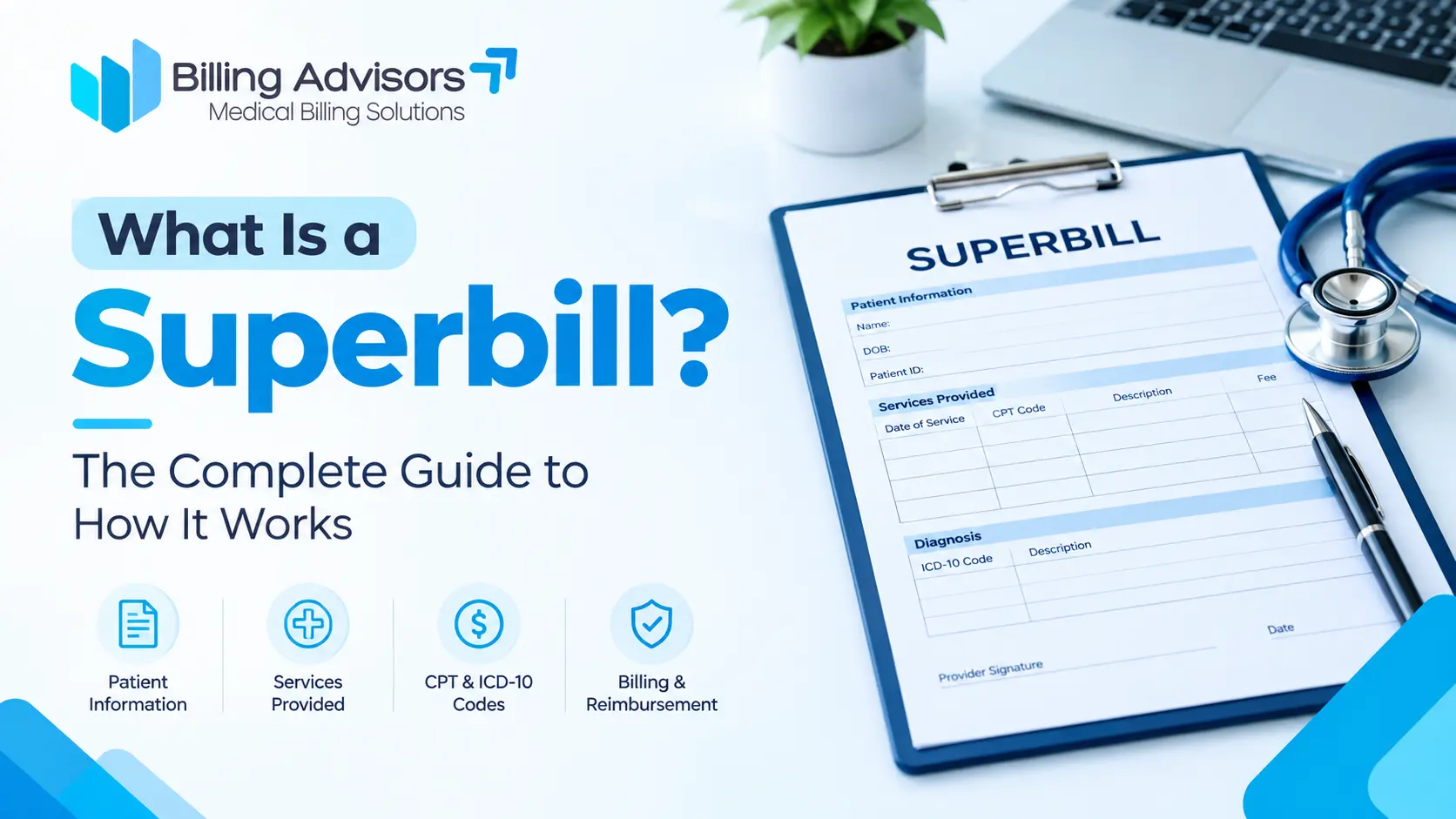
A superbill is an itemized statement of a patient encounter that a provider gives directly to the patient instead of billing the insurance company. It lists the diagnosis codes, procedure codes, provider information, and charges for a visit, and the patient submits it to their insurer to ask for reimbursement. It is not a bill in the traditional sense. It is closer to a receipt with a translation layer built in, one that turns “here’s what happened at your appointment” into the exact codes an insurance company needs to process a claim.
If you have ever paid a therapist, chiropractor, or dermatologist out of pocket and wondered how to get some of that money back from your insurance plan, a superbill is almost always the answer.
What Is a Superbill in Medical Billing?
In plain terms, a superbill is the source document a provider hands to a patient when the provider does not bill insurance directly. The patient (or sometimes the provider, on the patient’s behalf) then sends that document to the insurance company as the basis for an out-of-network reimbursement claim.
The name is a little misleading. Nothing about a superbill is “super” in the sense of being better than a regular bill. The name refers to the fact that it does the work of several documents at once. It carries the patient’s identity, the provider’s credentials, the clinical detail of the visit, the medical codes that translate that visit into insurance language, and the charges, all on one page.
There is no single federally mandated format for a superbill. Different EHR systems and practice management platforms generate slightly different layouts. What stays consistent across almost every version is the underlying information insurers require to even consider a reimbursement request.
What Information Appears on a Superbill?
A complete, payer-ready superbill typically includes:
- Provider information: full name, credentials (MD, DO, LCSW, DC, etc.), National Provider Identifier (NPI), Tax ID or Social Security Number, and practice address
- Patient information: full name, date of birth, and address
- Date of service: the exact date the visit took place
- Diagnosis codes: one or more ICD-10 codes explaining the medical reason for the visit
- Procedure codes: CPT or HCPCS codes describing exactly what was done during the visit
- Modifiers: where applicable, to clarify how a service was performed
- Charges: the fee for each service listed, plus the total amount the patient paid
- Place of service code: where the visit happened (office, telehealth, etc.)
- Provider signature or practice stamp: confirming the information is accurate
Miss any one of these, especially the NPI, the ICD-10 code, or a valid CPT code, and the insurer has a built-in reason to deny or delay the reimbursement. Getting these fields right the first time is really a coding accuracy problem more than a paperwork problem. It’s the same discipline that goes into standard translating a captured service into the correct CPT, HCPCS, and ICD-10 codes for a regular claim, just routed through the patient instead of straight to the payer. The Billing Advisors
Superbill vs. Medical Bill vs. Insurance Claim vs. CMS-1500
These four terms get used almost interchangeably by patients, and that’s where a lot of confusion starts.
| Document | Who creates it | Who receives it | Purpose |
|---|---|---|---|
| Superbill | Provider | Patient (who forwards it to insurer) | Gives the patient what they need to request reimbursement |
| Medical bill / invoice | Provider or billing office | Patient | States what the patient owes directly |
| Insurance claim | Provider’s billing team | Insurance company | Requests payment directly from the payer, on the provider’s behalf |
| CMS-1500 form | Provider’s billing team | Insurance company | The standardized paper/electronic claim form used for professional services, the in-network equivalent of what a superbill triggers out-of-network |
The simplest way to think about it: a claim and a CMS-1500 move money from the insurer to the provider. A superbill moves money from the insurer to the patient, who already paid the provider directly. Same underlying codes, opposite direction of cash flow.
Who Actually Uses Superbills?
Superbills show up most often with providers who don’t hold in-network contracts with insurance companies, or who choose not to bill insurance directly for other reasons. That includes:
- Mental health providers: therapists, psychologists, and psychiatrists, especially private-pay practices
- Chiropractors and physical therapists operating on a cash basis
- Direct primary care and concierge medicine practices
- Dermatologists and specialists who see a mix of in-network and out-of-network patients
- Dentists, for certain procedures under a patient’s medical (not dental) plan
- Durable medical equipment suppliers, in specific out-of-network situations, which carries its own documentation requirements worth understanding through a dedicated look at how DME billing actually works
The common thread isn’t the specialty. It’s the billing relationship. Any provider who doesn’t submit claims directly to a specific payer, whether by choice or because they’re not credentialed with that payer, can offer a superbill so the patient has a path to partial reimbursement.
How the Superbill Reimbursement Process Works, Step by Step
From the patient’s side, the process generally runs like this:
- Pay at the time of service. The patient pays the provider’s full fee out of pocket. The superbill doesn’t change this part, the provider still gets paid up front.
- Receive the superbill. The provider (or their practice management software) generates the document after the visit, sometimes automatically, sometimes on request.
- Confirm out-of-network benefits. Before submitting anything, the patient should call their insurer or check their plan documents to see if out-of-network reimbursement is even part of the plan. Not every plan, especially HMOs, offers it at all.
- Submit the superbill. This is usually done through the insurer’s online portal, a mailed paper form, or an app, depending on the payer.
- Insurer reviews the claim. The payer checks the codes against medical necessity rules, the patient’s deductible status, and the plan’s allowed amount for that service.
- Reimbursement is issued, or the claim is denied. If approved, the payer sends a check or direct deposit to the patient, not the provider, for the covered portion.
That last point trips people up constantly. Even when a superbill is accepted and paid, the money goes to the patient, not back to the provider. The provider was already paid at the time of the visit.
How Providers Create a Superbill (and Common Mistakes)
Most modern EHR and practice management systems can auto-generate a superbill from the encounter notes and billing codes already entered for the visit. That’s the reliable path. The riskier path is a manually typed superbill, filled out from memory at the end of a busy day, which is where errors creep in.
The most common mistakes we see on manually prepared superbills:
- Mismatched diagnosis and procedure codes, where the ICD-10 code doesn’t support medical necessity for the CPT code billed
- Missing or incorrect NPI, which stops a claim before it’s even reviewed
- Outdated CPT or ICD-10 codes, since both code sets update annually and a stale cheat sheet will quietly generate denials
- Vague or generic diagnosis codes used out of habit instead of the most specific code the documentation supports
- No signature or credential listed, which some payers treat as an incomplete document
Because a superbill still carries protected health information, the same handling rules apply as any other billing document, including how it’s transmitted and stored. It’s worth reviewing that against a practice’s broader medical billing compliance program rather than treating the superbill as a lightweight afterthought.
For group practices generating a high volume of superbills across multiple providers, small errors like these compound fast, and they’re one of the quieter contributors to the kind of physician group revenue leakage that’s hard to spot until it shows up in the numbers months later.
How Much Will Insurance Actually Reimburse From a Superbill?
This is the question every patient actually cares about, and the honest answer is: it depends on three separate numbers.
- Deductible status. If the patient hasn’t met their out-of-network deductible yet, the insurer may apply the entire claim toward the deductible and reimburse nothing this time.
- Allowed amount. Insurers don’t reimburse based on what the provider charged. They reimburse based on their own “usual, customary, and reasonable” (UCR) rate for that service in that area, which is frequently lower than the provider’s actual fee.
- Coinsurance percentage. After the deductible is met, most out-of-network plans only cover a percentage, commonly 50 to 70 percent, of the allowed amount, not the full charge.
A simplified example: a therapy session costs $180. The insurer’s allowed amount for that CPT code is $130. If the deductible is already met and the plan covers 60 percent out-of-network, the reimbursement is 60 percent of $130, or $78, not 60 percent of the original $180. That gap between what was paid and what gets reimbursed catches a lot of patients off guard, and it’s worth setting that expectation up front rather than after the first claim comes back lower than hoped.
The No Surprises Act, Good Faith Estimates, and Superbills in 2026
Since January 2022, the No Surprises Act has required providers to give uninsured and self-pay patients a Good Faith Estimate of expected charges before non-emergency care. This runs in parallel with, not in place of, a superbill. A Good Faith Estimate is what the patient sees before the visit. A superbill is what the patient submits after it.
Where this intersects with superbills directly: if a patient later receives a bill that’s at least $400 higher than their Good Faith Estimate, they have the right to dispute it through the federal patient-provider dispute resolution process. Practices that issue clean, accurate estimates up front tend to see fewer billing disputes downstream, and fewer confused calls asking why a superbill reimbursement didn’t match the amount originally discussed. In 2026, with out-of-network scrutiny continuing to increase, treating the estimate and the superbill as two connected touchpoints in the same patient financial journey, rather than two unrelated forms, is what separates practices with clean AR from ones fielding constant billing complaints.
Why Superbills Get Denied or Reduced (and How to Prevent It)
Beyond the coding errors already covered, a few other issues routinely sink superbill reimbursement:
- The plan has no out-of-network benefits at all. This should be confirmed before the visit, not after the superbill is submitted. It’s exactly the kind of gap that a proper insurance eligibility verification check, done before the appointment rather than after, is designed to catch.
- The service required prior authorization that was never obtained, regardless of how clean the superbill itself is.
- Timely filing deadlines were missed. Most payers give patients a limited window, often 90 to 365 days, to submit a superbill after the date of service.
- The diagnosis doesn’t meet the plan’s medical necessity criteria for that particular CPT code.
- Duplicate or inconsistent information between the superbill and any other documentation the payer already has on file.
Most of these are preventable with a five-minute benefits check before the first appointment rather than a denial letter six weeks later.
Can You Use a Superbill for HSA or FSA Reimbursement?
Yes, and this is one of the more underused parts of a superbill. Even when a service isn’t reimbursed by insurance at all, or only partially, the superbill still serves as valid documentation for a Health Savings Account or Flexible Spending Account reimbursement, since it lists the date of service, the provider, and the medical nature of the expense. Patients should keep a copy regardless of whether they submit it to insurance, since HSA and FSA administrators frequently ask for exactly this kind of itemized proof during an audit or year-end reconciliation.
Superbill Checklist: What to Confirm Before You Submit
- Provider’s full name, credentials, and NPI are listed and correct
- Practice Tax ID is present
- Date of service matches the actual visit date
- At least one valid, specific ICD-10 diagnosis code is included
- CPT or HCPCS codes accurately reflect the services performed
- Total charges and any payments already made are itemized, not just a lump sum
- Place of service is noted
- You’ve confirmed your plan offers out-of-network benefits before submitting
Frequently Asked Questions
Is a superbill the same as a bill?
No. A regular bill states what the patient owes. A superbill is a receipt-style document the patient uses to request reimbursement from their insurer after already paying the provider.
Do I need insurance to use a superbill?
Yes. A superbill is only useful if you have insurance with out-of-network benefits. Without those benefits, there’s no reimbursement path for the insurer to process.
How long does superbill reimbursement take?
Most insurers process out-of-network claims within 30 to 45 days of receiving the superbill, though this varies by payer and can take longer if the claim is flagged for additional review.
Can a provider refuse to give me a superbill?
Providers aren’t legally required to issue one in every state or situation, though most out-of-network practices provide them as standard practice, sometimes automatically after each visit and sometimes on request.
Will insurance reimburse 100% of the cost through a superbill?
Almost never. Reimbursement is based on the insurer’s allowed amount, not the provider’s actual charge, and is further reduced by any unmet deductible and the plan’s out-of-network coinsurance percentage.
What’s the difference between a superbill and a CMS-1500 form?
Both carry the same core coding information. A CMS-1500 is submitted by the provider’s billing office directly to the payer to get the provider paid. A superbill is handed to the patient, who submits it themselves to get partially reimbursed for what they already paid.
The Bottom Line
A superbill is the bridge between paying for care out of pocket and getting some of that money back from your insurance plan. It works only when the codes are accurate, the provider information is complete, and the patient’s plan actually offers out-of-network benefits in the first place. For practices generating these regularly, the real leverage isn’t the document itself, it’s the coding accuracy and eligibility checks happening before the superbill is ever printed. If claim accuracy or out-of-network reimbursement rates have been a recurring headache for your practice, our team can walk through what’s actually driving it.