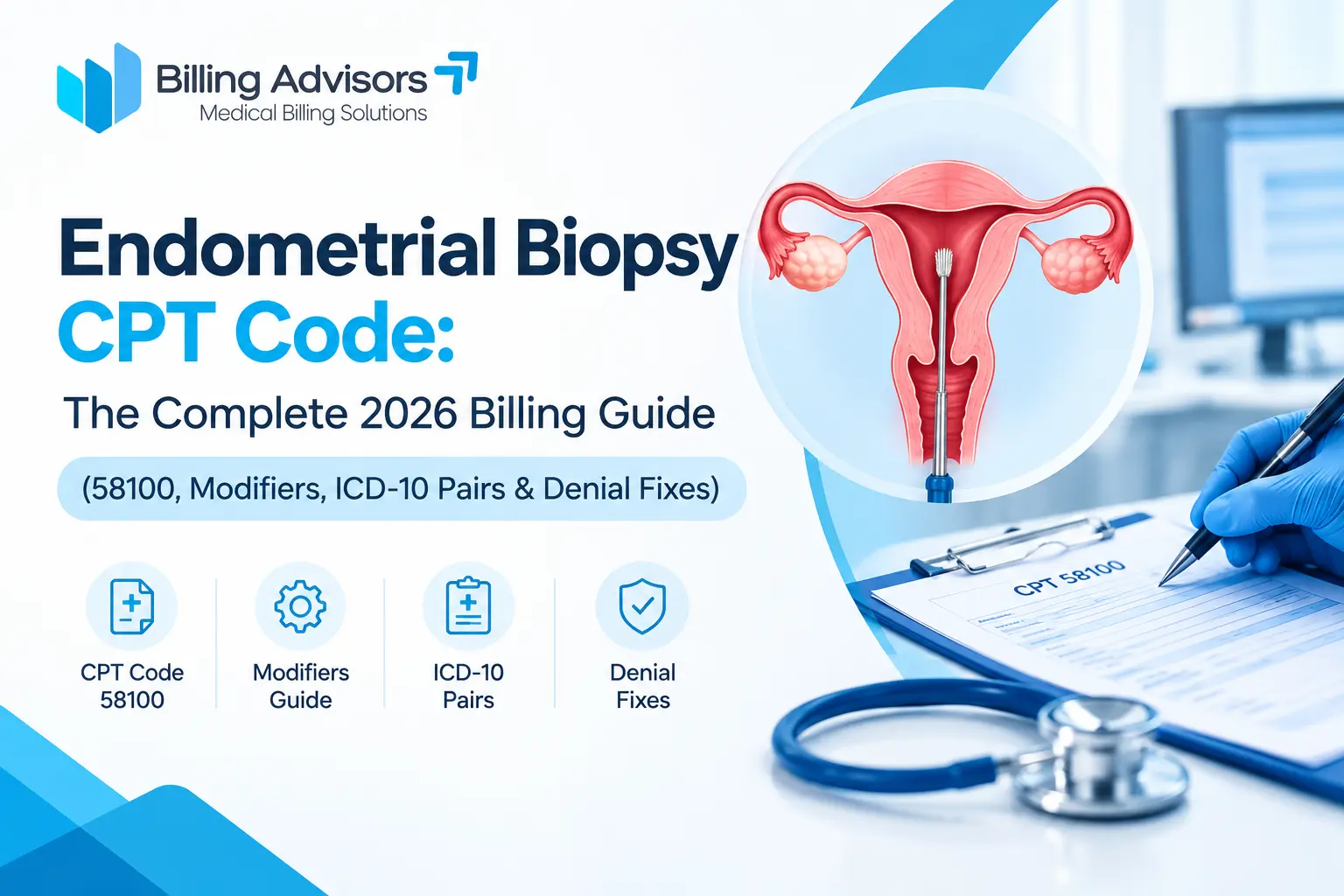
If you’ve landed here because a claim for an endometrial biopsy just bounced back, you’re not alone. This is one of the most billed OB/GYN office procedures in the country, and it’s also one of the most quietly denied ones. Not because the coding is hard. It’s because the small details, the modifier on the wrong line, a diagnosis code that doesn’t match the payer’s policy, a bundling edit nobody double-checked, are the details payers are trained to catch.
Quick answer: The endometrial biopsy CPT code is 58100 (“Endometrial sampling [biopsy] with or without endocervical sampling [biopsy], without cervical dilation, any method”). It’s a 0-day global period procedure, it carries a work RVU of 1.18, and Medicare’s 2026 national non-facility payment is around $98.20 before geographic adjustment.
That one paragraph answers the search query. Everything below it is what actually keeps the claim from being denied, which is the part most guides skip.
What CPT 58100 Actually Covers
CPT 58100 describes a procedure where a clinician collects a small tissue sample from the lining of the uterus, and sometimes from the cervical canal at the same time, without dilating the cervix first. It’s almost always done in the office, takes about 10 to 15 minutes, and doesn’t need general anesthesia. A thin, flexible catheter is passed through the cervix, and gentle suction or a rotating motion pulls a small strip of endometrial tissue for pathology.
Two things trip people up right away:
- It’s a “separate procedure” code. That label matters. When 58100 is performed as an incidental part of a larger procedure, it usually isn’t billed on its own. It’s only reported when it’s the actual reason the patient is in the office.
- The endocervical sample is bundled in. If the physician also samples the endocervix during the same visit, you still bill 58100 once. There’s no separate add-on code for that portion.
The most common reasons a provider orders this procedure are abnormal uterine bleeding, postmenopausal bleeding, irregular cycles, a thickened endometrial stripe found on ultrasound, infertility workup, or monitoring a patient on tamoxifen or unopposed estrogen therapy. Ruling out endometrial hyperplasia or carcinoma is usually the underlying clinical goal, even when the visit note doesn’t say “rule out cancer” directly.
58100 vs. the Codes It Gets Confused With
This is where most billing errors start. Coders see “biopsy” or “endometrial” in a note and grab the first matching code, without checking whether dilation, hysteroscopy, or imaging guidance was actually involved. Here’s how the related codes break down.
| CPT Code | Description | Setting | Key Difference |
|---|---|---|---|
| 58100 | Endometrial sampling, with or without endocervical sampling, without cervical dilation | Office | No dilation, no scope, no anesthesia typically |
| 58110 | Endometrial sampling performed in conjunction with colposcopy (add-on code) | Office | Only reported with a primary colposcopy code, never alone |
| 58120 | Dilation and curettage (D&C), diagnostic or therapeutic | Office/ASC/hospital | Cervix is dilated; usually more tissue is obtained |
| 58558 | Hysteroscopy with biopsy and/or polypectomy | ASC/hospital, often under anesthesia | Uses a scope for direct visualization; biopsy is incidental to the hysteroscopy |
| 57800 | Dilation of cervical canal, instrumental | Office/ASC | Bundled into 58100 under CCI edits; not separately billable with it |
| 76942 | Ultrasound guidance for needle placement | Office | Only applicable if imaging guidance was used and documented |
| 88305 | Pathology, surgical, gross and microscopic exam | Lab/pathology | Billed separately by the pathologist reading the tissue, not by the OB/GYN |
The decision that matters most: if the cervix was dilated before sampling, 58100 is the wrong code. Per CPT guidance, 58100 specifically excludes cervical dilation, and CMS’s Correct Coding Initiative bundles 57800 (cervical dilation) into 58100 with a modifier indicator that generally does not allow separate reporting. When dilation was clinically necessary, for example, in a postmenopausal patient with cervical stenosis, the correct code shifts to 58120, not 58100 plus 57800.
Similarly, if a hysteroscope was used to directly visualize the cavity before sampling, you’re in 58558 territory, and 58100 should not be billed alongside it. Reporting both on the same date is one of the more common bundling denials in gynecology billing.
ICD-10 Codes That Support Medical Necessity
Payers deny 58100 constantly for one reason above all others: the diagnosis code on the claim doesn’t line up with what the payer’s coverage policy expects to see for that procedure. This is where a clean insurance eligibility verification process before the visit actually prevents a denial that would otherwise surface weeks later.
Diagnoses that most commonly and appropriately justify 58100 include:
- N93.9 – Abnormal uterine and vaginal bleeding, unspecified
- N95.0 – Postmenopausal bleeding
- N92.0–N92.6 – Excessive, frequent, or irregular menstruation
- N85.00–N85.9 – Endometrial hyperplasia (various types)
- N85.9 – Noninflammatory disorder of uterus, unspecified
- C54.1 – Malignant neoplasm of endometrium (when biopsy confirms or monitors known malignancy)
- D07.0 – Carcinoma in situ of endometrium
- Z87.891 or a tamoxifen-related long-term drug therapy code, when the biopsy is a surveillance procedure for a patient on hormone therapy
- N88.2 – Cervical stenosis, only relevant when documenting why dilation was or wasn’t attempted
Two rules keep this section out of denial territory. First, code to the highest specificity the pathology and clinical findings support; unspecified codes get flagged faster by Local Coverage Determination (LCD) edits than specific ones. Second, never code a definitive diagnosis, like endometrial cancer, before the pathology report confirms it. Code the presenting symptom (bleeding, thickened stripe, irregular cycle) at the time of biopsy, then update the claim or add a secondary diagnosis once results return.
Modifiers That Actually Apply to 58100
| Modifier | When to Use It | Common Mistake |
|---|---|---|
| 25 | Appended to the E/M code (not to 58100) when a significant, separately identifiable evaluation happens on the same day, beyond the routine pre-procedure work | Attaching it to 58100 itself instead of the E/M line, or using it on a purely routine, pre-planned visit |
| 59 / XU | Indicates a distinct procedural service when another unrelated procedure is billed the same day and a payer’s bundling edit needs to be overridden appropriately | Using it just to force payment through an edit without documentation that actually supports separate, distinct services |
| 52 | Reduced services, when sampling was attempted but incomplete due to anatomical limits like cervical stenosis | Forgetting to document why the sample was limited, which is what the modifier is supposed to explain |
| 26 / TC | Splits the professional and technical component, relevant mainly in facility settings where equipment and staff are billed separately from physician work | Applying it in a straightforward office setting where the physician owns both components |
The modifier 25 rule deserves its own callout because it is, by a wide margin, the most frequently misused modifier on this claim type. If a patient comes in specifically for a scheduled biopsy and the physician does a brief pre-procedure check, that’s not a separately billable E/M service, and modifier 25 doesn’t apply. It only applies when the documentation shows real, additional decision-making that goes beyond what’s normally bundled into getting a patient ready for the procedure. Auditors look at this modifier first for a reason.
CCI Edits and Bundling: Where Claims Quietly Get Cut
The Correct Coding Initiative bundles cervical dilation (57800) into endometrial sampling codes including 58100 through 58110. Depending on the modifier indicator in place for a given code pair, some bundles can be split with an appropriate modifier and clear documentation, while others cannot be split under any circumstance. Before appending a modifier to break an edit, check the current CCI modifier indicator for that specific pair rather than assuming last year’s rule still applies, since CMS updates these edits multiple times a year.
The same logic applies to hysteroscopy codes. 58558 generally includes the sampling that 58100 would otherwise describe, so billing both for the same encounter usually triggers an automatic denial on the second line. If a stand-alone office biopsy genuinely occurred on a different date from a later hysteroscopic procedure, that’s a different clinical story, and the documentation needs to clearly show two distinct encounters, not one procedure billed twice.
2026 Medicare Reimbursement for CPT 58100
Under the CY 2026 Medicare Physician Fee Schedule, CPT 58100 carries a work RVU of approximately 1.18 and a total RVU near 2.94 in the non-facility setting. Using CMS’s 2026 conversion factor of $33.4009, that works out to a national non-facility payment of roughly $98 before geographic adjustment. The procedure carries a 0-day global period, which means related E/M services on other days aren’t automatically bundled into it the way a longer global surgical package would be.
Two caveats worth remembering. First, this is a national average; actual payment shifts up or down based on the Geographic Practice Cost Index for the provider’s locality, so a practice in a major metro area will typically see a higher adjusted rate than the national figure. Second, commercial payer rates are contracted separately and often diverge meaningfully from Medicare’s number, sometimes higher, sometimes lower, depending on the payer and the region. Practices tracking reimbursement trends against a broader revenue cycle management strategy should benchmark actual remittances against the fee schedule regularly rather than assuming the published rate is what’s landing in the bank.
Documentation Checklist Before You Submit the Claim
Most 58100 denials trace back to documentation gaps rather than coding errors. Before the claim goes out, confirm the note supports every one of these:
- Indication for the biopsy is stated in clinical terms (bleeding pattern, ultrasound finding, surveillance indication), not just “biopsy performed.”
- No cervical dilation is documented, or if dilation was needed, the code has been switched to 58120 accordingly.
- Whether endocervical sampling was also performed, since it’s included but still worth noting for the record.
- Tissue adequacy is noted; if sampling was incomplete, that supports modifier 52 rather than leaving the claim to look like a routine, fully completed procedure.
- Separate E/M work, if modifier 25 is used, is written out distinctly from the pre-procedure exam, with its own assessment and plan.
- Pathology order is documented as sent, since payers occasionally cross-check that a specimen was actually submitted for interpretation.
A quick internal pass using a medical billing audit checklist before submission catches most of these gaps before they ever reach a payer’s desk, which is a far cheaper fix than an appeal three weeks later.
Common Denial Reasons and How to Fix Them
| Denial Reason | What’s Usually Happening | Fix |
|---|---|---|
| Diagnosis doesn’t support medical necessity | Unspecified ICD-10 code used, or code doesn’t match the payer’s LCD | Code to the highest specificity supported by documentation; check the payer’s current LCD before submission |
| Bundled with another same-day procedure | 58100 billed alongside 57800 or 58558 without a valid, documented reason to unbundle | Verify current CCI edit status; only append 59/XU when the service is truly distinct and documented as such |
| Modifier 25 denied on the E/M line | Documentation doesn’t show a significant, separately identifiable service | Ensure the note has a distinct history, exam, and medical decision-making component beyond routine pre-procedure work |
| Duplicate claim | 58100 billed twice for the same date due to a repeated attempt at sampling | Document the reason for the repeat attempt (inadequate sample, patient tolerance) and, where appropriate, append modifier 76 or 77 |
| Prior authorization missing | Some commercial and Medicaid managed care plans require pre-authorization for gynecologic procedures | Confirm authorization requirements during scheduling, not after the claim is filed |
If denials for this code keep showing up on your aging report despite clean documentation, it’s usually a sign the front-end verification step is the actual gap, not the coding itself. That’s a common enough pattern that it’s worth reviewing through a full denial management process rather than fixing each claim one at a time.
A Real Billing Scenario, Walked Through
A 52-year-old patient presents with three months of postmenopausal spotting. The physician performs a focused history and exam, discusses findings with the patient, and proceeds directly to an in-office endometrial biopsy without cervical dilation. The sample is adequate and sent to pathology.
Here’s how that claim should look:
- CPT 58100 with diagnosis N95.0 (postmenopausal bleeding) as the primary code.
- No separate E/M code, since the exam was the standard pre-procedure workup bundled into the biopsy, not a distinct, separately billable service.
- No modifier needed on 58100 itself.
- The pathology lab bills 88305 separately once the tissue is read.
Now change one detail: the same patient has a history of cervical stenosis, and the physician has to dilate the cervix before the catheter will pass. That single change moves the correct code from 58100 to 58120, with diagnosis codes for both the bleeding and the stenosis (N88.2) documented to support the added step. Submitting 58100 in that scenario, even though a biopsy technically occurred, would misrepresent the procedure that was actually performed and is likely to be flagged on audit even if it initially pays.
Frequently Asked Questions
What is the CPT code for an endometrial biopsy? CPT 58100 is the standard code for an endometrial biopsy performed in the office without cervical dilation. It also covers endocervical sampling if done during the same visit.
Is CPT 58100 the same as a D&C? No. A dilation and curettage uses cervical dilation and typically removes more tissue; it’s billed as CPT 58120. CPT 58100 specifically excludes cervical dilation.
Can 58100 be billed with an E/M visit on the same day? Yes, but only when the documentation supports a significant, separately identifiable evaluation beyond the routine work of preparing for the biopsy, and modifier 25 is appended to the E/M code, not to 58100.
Does CPT 58100 include pathology interpretation? No. 58100 covers tissue collection only. The pathologist bills separately, most commonly with CPT 88305, for reading and interpreting the specimen.
What ICD-10 code is most commonly billed with 58100? N93.9 (abnormal uterine and vaginal bleeding, unspecified) and N95.0 (postmenopausal bleeding) are among the most frequently used, though the correct code always depends on the documented clinical indication.
Does CPT 58100 have a global period? It has a 0-day global period, meaning there’s no extended post-procedure bundling window the way there is with major surgical codes.
Can 58100 be billed alongside a hysteroscopy? Generally no. Hysteroscopy codes like 58558 typically include the sampling that 58100 describes, so billing both for the same encounter usually results in a bundling denial unless the services occurred on genuinely separate dates.
Getting the Claim Right the First Time
CPT 58100 looks simple on paper, one code, one short procedure, but the denial patterns around it are almost entirely preventable once you know where payers are looking: the diagnosis-to-procedure match, the modifier 25 documentation, and the CCI bundling rules around dilation and hysteroscopy. Practices that treat this as a routine, low-attention code are usually the ones that see it show up repeatedly on their accounts receivable reports.
If your practice is spending more time chasing endometrial biopsy denials than it should, that’s exactly the kind of recurring revenue leak our team at The Billing Advisors works through every day as part of full-service medical billing services, from eligibility checks before the visit to clean claim submission and denial follow-up after it. Reach out and we’ll take a look at what’s actually driving your denial rate on this code, and fix it at the root instead of one appeal at a time.