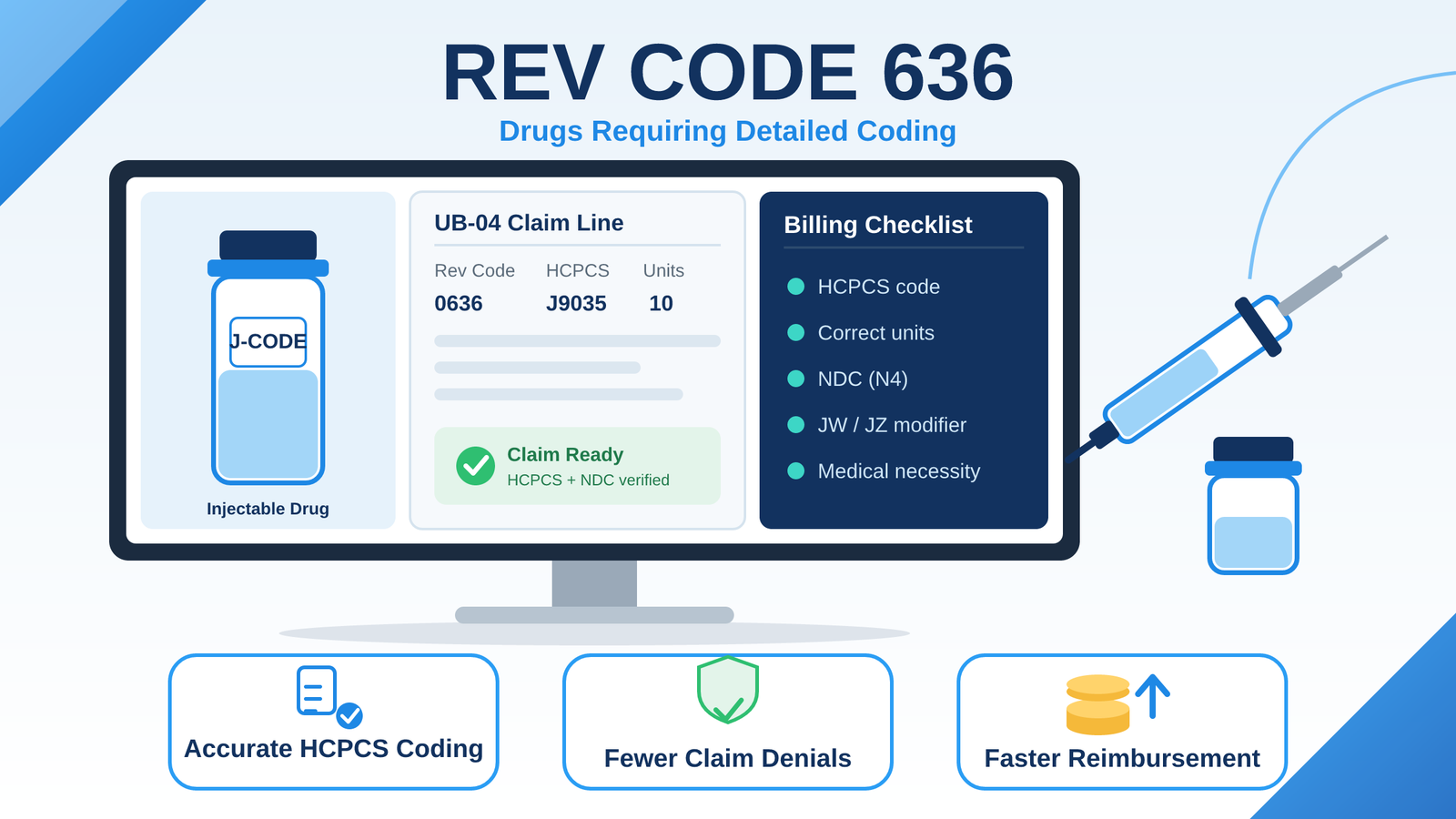
If your hospital or outpatient facility keeps seeing rejected drug lines, there is a good chance Rev Code 636 is part of the problem. Revenue code 0636 looks simple on a UB-04, yet it triggers some of the strictest edits in hospital billing. One missing HCPCS code or a wrong unit count can turn a clean claim into a denial and a delayed payment. In this guide, the medical billing team at The Billing Advisors explains what Rev Code 636 means, why payers deny it, and how to fix and prevent those denials.
What Is Rev Code 636?
Rev Code 636 (written as 0636 on the UB-04) is the revenue code for drugs requiring detailed coding. Facilities use it to report drugs and biologicals that payers want identified by a specific HCPCS code instead of a general pharmacy charge. Think injectables, chemotherapy agents, infusion drugs, and many J-code drugs given in outpatient departments, emergency rooms, and infusion centers.
Because the payer needs to know exactly which drug was given and how much, the revenue code alone is never enough. It must travel with a valid HCPCS code, the correct units, and an accurate charge.
When Should You Use Rev Code 636 on a UB-04?
Use Rev Code 636 when a drug is administered and the payer requires HCPCS-level detail. On the UB-04 (CMS-1450), that typically looks like this:
- Form Locator 42: revenue code 0636
- Form Locator 43: drug description, plus the NDC with the N4 qualifier when the payer requires it
- Form Locator 44: the HCPCS code
- Form Locator 46: billing units that match the HCPCS descriptor
Medicare and many commercial plans expect this level of detail, and Medicaid plans often add NDC requirements on top. Always confirm the payer’s current policy, because rules differ from plan to plan.
Why Do Rev Code 636 Claims Get Denied?
Most Rev Code 636 denials come from a small group of repeat errors. The most common hospital billing denials we see include:
- Missing or invalid HCPCS code: the line is billed with 0636 but no drug code, or with an outdated code.
- Unit mismatches: billing the milliliters or vials used instead of the units in the HCPCS descriptor.
- Missing or incorrect NDC: a wrong number, a bad format, or no NDC where the payer requires one.
- Missing JW or JZ modifier: required on Medicare claims for drugs from single-dose containers.
- Self-administered drugs: Medicare often will not cover these, and they may belong under a different revenue code.
- Medical necessity gaps: the diagnosis code does not support the drug under the payer’s policy.
- No prior authorization: common with high-cost specialty drugs.
- Packaged drugs: under outpatient payment rules, some drugs are bundled into the procedure payment, so a separate line pays at zero or denies.
How to Fix Missing or Invalid HCPCS Codes on Rev Code 636 Claims
Fixing a HCPCS code problem starts with the charge description master (CDM). Follow these steps:
- Match the drug to the right HCPCS code using the current quarterly code set.
- Check the descriptor. A code for 10 mg billed with 50 mg given means 5 units, not 1.
- Update the CDM so the drug, revenue code, and HCPCS code stay linked every time.
- Correct and resubmit the claim if it was rejected before adjudication, or file a corrected claim (bill type frequency code 7) if it was already processed.
A CDM that is reviewed every quarter prevents most HCPCS code billing errors before they reach the payer.
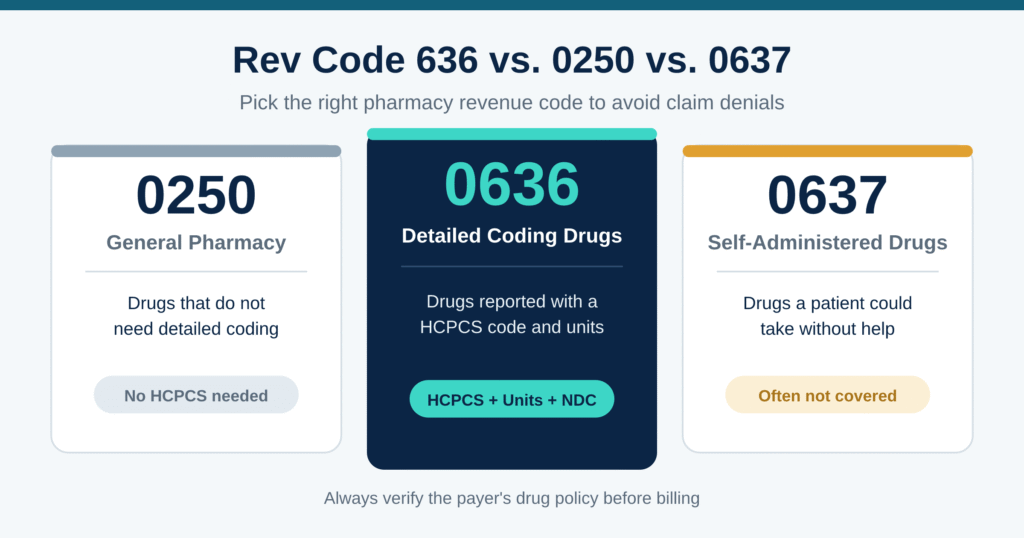
Rev Code 636 vs. 0250 vs. 0637: What Is the Difference?
Mixing up pharmacy revenue codes is a classic cause of denials.
- 0250 (General Pharmacy): drugs that do not need detailed coding.
- 0636 (Drugs Requiring Detailed Coding): drugs that must be reported with a HCPCS code and units.
- 0637 (Self-Administered Drugs): drugs the patient could take without help, which Medicare often excludes.
If a drug has an assigned HCPCS code and the payer wants detail, 0250 will usually trigger a denial. If the drug is self-administered, 0636 may be rejected as non-covered. Always check the payer’s drug list first.
How Do JW and JZ Modifiers Affect Rev Code 636 Billing?
Since 2023, Medicare requires facilities to report drug waste on single-dose container drugs. Use the JW modifier on a separate line for the discarded amount, and the JZ modifier when no drug was discarded. Leaving both off a Rev Code 636 line is a frequent reason for Medicare rejections.
Example: a vial holds 100 units, the patient receives 80, and 20 are discarded. Bill 80 units on one line and 20 units with JW on another. Document the waste in the medical record, because auditors will look for it.
How to Fix and Appeal a Denied Rev Code 636 Claim
A fast denial management process protects your cash flow. Here is a practical workflow:
- Read the remark codes. The CARC and RARC codes on the remittance advice tell you why the line denied.
- Sort the denial: is it a coding error, a documentation gap, or a coverage issue?
- Fix what you can. Coding and unit errors usually need a corrected claim, not an appeal.
- Appeal the rest. For medical necessity denials, send the order, administration record, drug lot details, and supporting clinical notes with a clear letter.
- Watch the deadlines. Timely filing and appeal windows vary by payer, and missing them ends your options.
Best Practices to Prevent Rev Code 636 Denials
Prevention is cheaper than rework. Build these habits into your revenue cycle management process:
- Run quarterly HCPCS and NDC updates in your billing system.
- Add claim scrubber edits that flag any 0636 line without a HCPCS code or units.
- Verify benefits and secure prior authorization before high-cost infusions.
- Train nurses and pharmacy staff to document dose, waste, route, and time.
- Track your denial rate by payer and drug, then fix root causes.
Why Choose The Billing Advisors for Rev Code 636 Billing Support?
Coding rules change every quarter, and payers rarely explain their edits clearly. The Billing Advisors is a U.S.-based medical billing company that helps hospitals, clinics, and infusion centers with drug billing, coding audits, and claim denial management. Our experienced billers and coders review payer policies, clean up your charge master, and work every denial until it is paid or properly appealed. You get clear reporting, compliant processes, and a team that treats your revenue like its own.
Tired of chasing Rev Code 636 denials? Contact Billing Advisors today for a free claims review, and let us turn your denied drug claims into paid revenue.
Frequently Asked Questions About Rev Code 636
Does Rev Code 636 always require a HCPCS code?
In most cases, yes. The revenue code exists so payers can see drugs at the HCPCS level, so a line without one is likely to deny.
Is Rev Code 636 used for inpatient or outpatient billing?
It appears on both, but it is most common in outpatient drug billing. Inpatient drugs are often bundled under the stay payment.
Can I bill Rev Code 636 for oral self-administered drugs?
Usually not to Medicare. Review the payer’s self-administered drug policy before billing.