Accurate medical coding is the backbone of a successful revenue cycle for any gastroenterology practice or outpatient surgical center in the United States. Among the most frequent diagnostic endoscopies performed, upper gastrointestinal endoscopies demand precise coding to satisfy strict payer guidelines. Understanding how to master EGD ICD 10 selection directly determines whether your practice receives swift reimbursement or faces time-consuming claim denials.
At The Billing Advisors, we specialize in streamlining complex gastroenterology billing workflows to maximize practice revenue and maintain full compliance with Medicare and private insurance policies. This complete guide breaks down everything you need to know about navigating diagnosis coding, pairing procedure codes, and ensuring frictionless claim processing.
What Is EGD ICD 10 Coding and Why Does It Matter?
An Esophagogastroduodenoscopy (EGD) allows physicians to visually inspect the esophagus, stomach, and duodenum. However, insurance carriers do not pay for procedures based solely on what was done; they demand proof of medical necessity.
The primary EGD ICD 10 code indicates why the diagnostic or therapeutic procedure was medically required. Whether a patient presents with chronic heartburn, dysphagia, or unexplained gastrointestinal bleeding, entering the precise icd 10 code for egd validation guarantees that your claim meets payer coverage criteria right out of the gate.
Most Common ICD 10 Codes for EGD Procedures
Selecting the proper diagnosis code requires reviewing the clinical documentation, pre-procedure symptoms, and post-procedure pathology reports. Below are the most frequently billed diagnosis codes for an icd 10 egd procedure:
- Gastroesophageal Reflux Disease (GERD):
K21.9(GERD without esophagitis) orK21.0(GERD with esophagitis). - Abdominal Pain:
R10.11(Right upper quadrant pain) orR10.13(Epigastric pain). - Dysphagia:
R13.10(Unspecified difficulty in swallowing). - Gastrointestinal Bleeding:
K92.0(Hematemesis) orK92.1(Melena). - Gastritis and Duodenitis:
K29.70(Unspecified gastritis without bleeding). - Barrett’s Esophagus:
K22.70(Barrett’s esophagus without dysplasia).
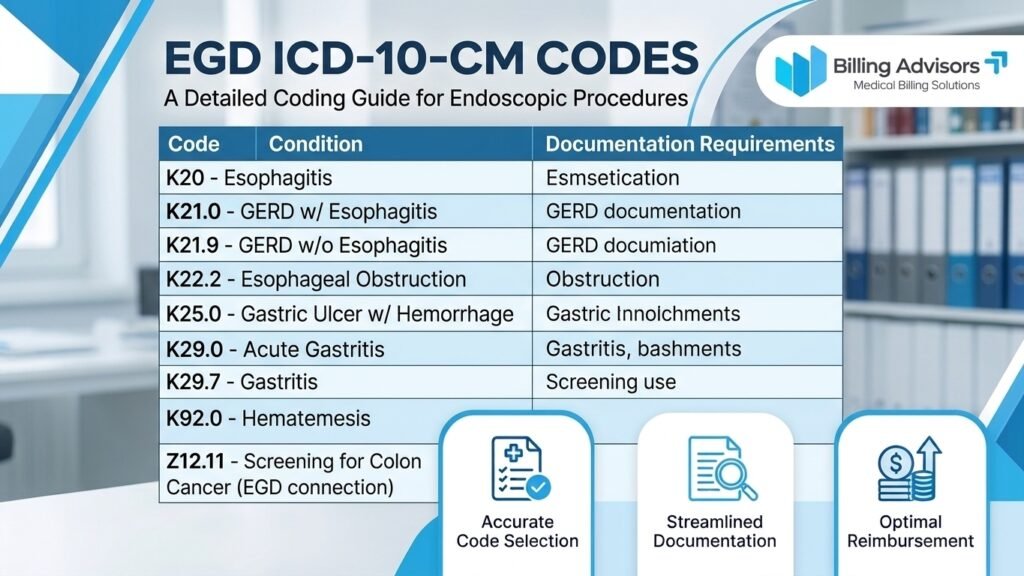
Using a generic or unsupported icd 10 code egd search result can lead to immediate clearinghouse rejections or insurer medical necessity denials.
How to Match EGD CPT Codes with the Correct ICD-10 Diagnosis
A clean medical claim requires a seamless link between the CPT procedure code and the corresponding icd 10 egd diagnosis code. Billed CPT codes for upper GI endoscopies usually fall within the 43235 to 43270 numerical range:
| CPT Code | Procedure Description | Common Primary ICD-10 Link |
| 43235 | Diagnostic EGD (visual exam, collection of specimens) | Epigastric Pain (R10.13), Dysphagia (R13.10) |
| 43239 | EGD with single or multiple biopsies | GERD with Esophagitis (K21.0), Gastritis (K29.70) |
| 43249 | EGD with transendoscopic balloon dilation | Esophageal Stricture (K22.2) |
| 43255 | EGD with control of bleeding | Hematemesis (K92.0), Acute Gastric Ulcer (K25.0) |
Ensuring that your clinical notes clearly justify why a biopsy (43239) was performed instead of a basic diagnostic exam (43235) prevents audit flags.
Pre-Procedure Symptoms vs. Post-Procedure Pathology Findings
One of the most frequent errors in gastroenterology medical billing involves mismanaging pre-procedure symptoms versus confirmed post-procedure diagnoses.
- Pre-Procedure Billing: Prior to receiving pathology results, code the claim using the primary signs or symptoms that justified the procedure (e.g., upper abdominal pain or chronic nausea).
- Post-Procedure Billing: Once the pathology report is returned, replace the symptom code with the definitive diagnosis (e.g., H. pylori gastritis or Barrett’s esophagus).
If a biopsy yields a definitive result, the finalized condition takes precedence as the primary icd 10 code for egd billing.
Local Coverage Determinations (LCDs) and Medical Necessity Rules
Medicare Administrative Contractors (MACs) and commercial insurers enforce strict Local Coverage Determinations (LCDs) for endoscopic procedures. These policies explicitly state which diagnosis codes establish medical necessity.
If a coder submits an EGD ICD 10 combination that falls outside the payer’s published LCD guidelines, the claim will be rejected as “not medically necessary.” To prevent this:
- Cross-reference Medicare MAC policies prior to claim batching.
- Ensure pre-authorizations are obtained when required by commercial payers.
- Verify that symptom severity (e.g., refractory GERD failing PPI therapy) is thoroughly documented in the patient’s EHR chart.
How Poor EGD Coding Impacts Your Practice Cash Flow
Inaccurate coding creates cascading financial bottlenecks for medical practices. When coders use unspecified or unlinked diagnosis codes, the consequences include:
- Delayed Reimbursements: Appeals and corrected claims push payments back by 30 to 90 days.
- Increased Administrative Costs: Staff members spend valuable hours researching denied claims and re-submitting documentation.
- Audit Exposure: Frequently using non-specific codes like
R10.9(Unspecified abdominal pain) for complex interventions raises flags during payer compliance audits.
Partnering with certified billing professionals ensures your practice achieves a first-pass clean claim rate exceeding 98%.
Best Practices to Prevent EGD Claim Denials
Implementing proactive coding controls guarantees faster reimbursements and reduces payer pushback.
- Conduct Specific Documentation Reviews: Require providers to record precise locations, clinical findings, and prior failed conservative treatments.
- Apply Appropriate Modifiers: Use Modifier
53(Discontinued Procedure) if an EGD cannot be completed due to patient safety concerns or inadequate prep. - Verify Unbundling Rules: Never separate incidental procedures that are bundled under National Correct Coding Initiative (NCCI) edits.
- Leverage Specialized Billing Expertise: Outsource billing operations to dedicated gastroenterology certified coders.
Why Outsource Gastroenterology Billing to The Billing Advisors?
Navigating changing coding guidelines, LCD rules, and payer-specific mandates requires dedicated expertise. At The Billing Advisors, our certified medical billers and coders bring years of specialized experience in gastroenterology revenue cycle management.
We perform comprehensive pre-submission claim scrubbers, verify medical necessity for every icd 10 egd procedure, and handle rigorous denial management to maximize your practice’s collection rates.
Ready to Eliminate EGD Claim Denials and Boost Revenue?
Stop letting coding errors and medical necessity rejections compromise your practice’s bottom line. The Billing Advisors provides end-to-end medical billing and coding solutions customized for US healthcare providers.
Contact The Billing Advisors Today to schedule a free revenue cycle consultation, or explore our dedicated resource on EGD Procedure Coding & Billing Solutions to optimize your workflow today!