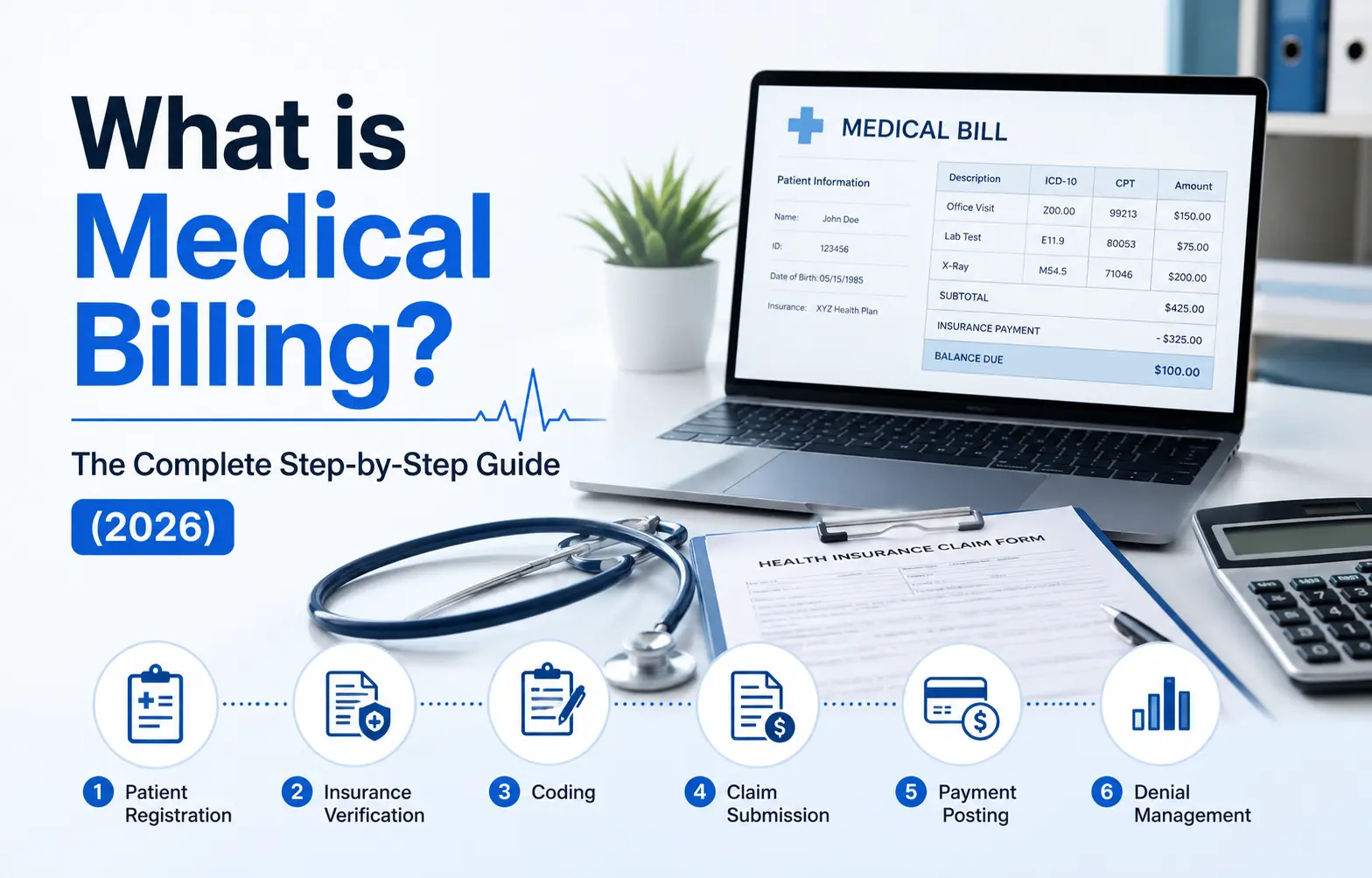
Medical billing is one of those things most people never think about until they are holding a confusing piece of paper from a hospital asking them to pay a large sum. And on the other side of that paper is a healthcare provider who performed a service and needs to get paid to keep their practice running. Medical billing is the system that connects those two realities.
But calling it just a “system” undersells what it actually is. Medical billing is the financial backbone of the entire healthcare industry in the United States. Without it, doctors do not get paid, clinics close, and patients lose access to care. Understanding how it works matters whether you are a healthcare professional trying to protect your revenue, a patient trying to make sense of your bills, or someone exploring medical billing as a career.
This guide covers everything. We will walk through what medical billing actually means, how the process works from start to finish, what the codes mean, what mistakes cost providers billions every year, how AI is reshaping the field in 2026, and what patients can do to protect themselves from billing errors. By the end, you will have a clearer picture of medical billing than most people who work in healthcare.
What is Medical Billing, Really?
At its most basic level, medical billing is the process of submitting and following up on claims with insurance companies so that healthcare providers receive payment for the services they delivered to patients.
When a doctor sees a patient, treats a wound, orders a test, or performs surgery, that service has a financial value attached to it. Medical billing is how that value gets communicated to an insurance company (or directly to the patient) in a way that results in actual payment.
The process involves translating medical procedures, diagnoses, and treatments into standardized codes. Those codes go into a claim. That claim gets submitted to a payer, which might be a private insurance company, Medicare, Medicaid, or the patient themselves. The payer reviews the claim, decides how much to reimburse, and sends payment accordingly.
It sounds straightforward. In reality, it involves dozens of steps, hundreds of possible codes, multiple parties, strict deadlines, and enough variables that even experienced billing teams make costly errors regularly. According to research cited by Experian Health, up to 80% of medical claims contain some form of error. That is not a rounding error. That is a systemic problem costing the healthcare system billions of dollars every year.
Medical Billing vs. Medical Coding: What’s the Difference?
People often confuse medical billing and medical coding, and understandably so. They go hand in hand, but they are different roles.
Medical coding is the process of translating clinical information from a patient’s medical record into standardized alphanumeric codes. A coder reads the physician’s notes and assigns codes for the diagnosis (why the patient was seen) and the procedure (what was done). These come from systems like ICD-10, CPT, and HCPCS, which we will explain in detail shortly.
Medical billing takes those codes and uses them to build a claim. The biller submits that claim to the insurance company, tracks its status, handles any rejections or denials, posts the payments received, and manages any remaining patient balance.
Think of the coder as the translator and the biller as the communicator. Both roles require precision, because an error at either stage can result in a denied claim, delayed payment, or worse, an accusation of fraud.
The Three Cycles of Medical Billing
Medical billing does not happen in a single moment. It flows through three distinct cycles, each with its own responsibilities and risks.
The front-end cycle begins before the patient ever sees a doctor. This includes scheduling the appointment, collecting patient demographics, verifying insurance eligibility, and obtaining any necessary prior authorizations. Errors made here ripple through everything that comes after. If a patient’s insurance ID is entered incorrectly during registration, that mistake will likely result in a denied claim weeks later.
The mid-cycle happens during and immediately after the patient visit. This is where clinical documentation occurs, where the physician records what was assessed and treated, and where coders assign the appropriate codes to that documentation. Accurate and complete documentation at this stage is critical. If a procedure is not documented thoroughly, it cannot be billed. If it is documented incorrectly, the claim may be denied or flagged for audit.
The back-end cycle is where the financial work gets completed. Claims are submitted, payments are posted, denials are appealed, and patient balances are collected. This is also where performance is measured through metrics like denial rates, accounts receivable aging, and first-pass claim acceptance rates. Most of the financial pain in a medical practice lives in a poorly managed back end.
How the Medical Billing Process Works: A 13-Step Breakdown
Let us walk through the complete medical billing cycle from the moment a patient makes an appointment to the moment the account is fully settled.
Step 1: Patient Registration
Everything starts here. When a patient schedules an appointment, the front desk or administrative team collects their personal information, including full legal name, date of birth, address, and contact details. They also collect insurance information, including the insurance company name, policy number, group number, and the insured’s relationship to the patient if it is a dependent.
This step seems simple, but a typo in a policy number or an incorrect date of birth is enough to get a claim rejected outright. Accuracy here is not optional.
Step 2: Insurance Eligibility Verification
Before the patient even walks through the door, the billing team should verify that their insurance coverage is active and that the services they need are covered under their plan. This verification should happen 24 to 48 hours before the appointment, not on the day of.
Eligibility verification answers important questions: Is the patient’s policy currently active? What is their deductible, and how much of it has been met? Do they need a referral to see a specialist? Is prior authorization required for any procedures?
Practices that skip this step often end up providing services that insurance will not cover, then struggle to collect from patients who may not be able to pay.
Step 3: Prior Authorization
For many services, particularly surgeries, advanced imaging like MRIs, and certain medications, the insurance company must approve the service before it is performed. This approval is called prior authorization.
Without it, the insurance company may refuse to pay the claim entirely. In January 2024, the Centers for Medicare and Medicaid Services (CMS) finalized the Interoperability and Prior Authorization Final Rule, which mandates electronic authorization processing by 2026, significantly speeding up this historically slow step. You can read the full rule at cms.gov.
Step 4: Medical Documentation and Encounter Notes
After the patient is seen, the provider creates a clinical record of the encounter. This is the foundation for everything that follows in the billing process. The documentation must clearly describe the patient’s symptoms, the provider’s assessment, the diagnosis, and any procedures performed or ordered.
Vague or incomplete documentation is one of the leading causes of claim denials. Coders can only bill for what is documented. If the physician treated a patient for hypertension but the notes do not specifically mention it, that diagnosis cannot be coded and therefore cannot be billed.
Step 5: Medical Coding
This is where clinical language gets converted into universal medical codes. There are three primary coding systems in use.
ICD-10 codes (International Classification of Diseases, 10th revision) describe the patient’s diagnosis or condition. There are over 70,000 ICD-10 codes covering everything from a common cold to rare genetic disorders. These codes tell the insurance company why the patient sought care.
CPT codes (Current Procedural Terminology) describe what the provider did during the visit. These codes are maintained by the American Medical Association (AAPC) and cover office visits, surgeries, diagnostic tests, and thousands of other procedures. For example, a standard evaluation and management visit for an established patient might be coded as 99213.
HCPCS codes (Healthcare Common Procedure Coding System) cover services and supplies that CPT codes do not, including ambulance services, durable medical equipment, and certain drugs.
Coders must choose codes that accurately reflect the documentation. Upcoding, meaning billing for a more expensive service than was actually provided, is illegal and can result in fraud charges. Undercoding, meaning billing for less than what was done, is also harmful because it leaves money on the table.
Step 6: Charge Entry
Once the codes are assigned, the billing team enters all the charges into the practice management system. Each code gets a corresponding fee based on the provider’s fee schedule. This creates a billable claim that reflects the full cost of the services provided.
At this stage, the biller also reviews the claim for obvious errors before it goes out. This internal quality check is sometimes called a pre-bill review or scrubbing.
Step 7: Claim Submission
The completed claim is submitted electronically to the insurance company through a clearinghouse, which is a third-party company that acts as a middleman between the provider and the payer. The clearinghouse runs the claim through a series of automated checks to catch formatting errors and data mismatches before the claim reaches the insurance company.
Claims that pass clearinghouse validation are forwarded to the payer. Claims that fail are returned to the biller with error codes explaining what needs to be corrected.
Step 8: Insurance Adjudication
Once the insurance company receives the claim, it goes through a process called adjudication. During adjudication, the payer reviews the claim against the patient’s benefits, the provider’s contract, and its own internal rules to determine how much it will pay.
The payer may approve the claim in full, approve it in part, or deny it. Partial approvals are common and reflect situations where a patient has not yet met their deductible, where certain services are subject to copays or coinsurance, or where the payer determines a different code should have been used.
Step 9: Explanation of Benefits (EOB)
After adjudication, the insurance company sends an Explanation of Benefits to the provider (and often to the patient). The EOB is not a bill. It is a summary of what the insurance company decided to pay, what portion the patient owes, and if the claim was denied, the reason why.
Understanding the EOB is essential for the billing team. Every line item tells a story about what worked, what did not, and what needs to be appealed or corrected.
Step 10: Payment Posting
When payment arrives from the insurance company, the billing team posts it to the patient’s account. This step involves reconciling the payment received against what was expected, identifying any discrepancies, and writing off any contractual adjustments, meaning the portion of the charge that the provider agreed to waive as part of their contract with the insurance company.
Payment posting sounds administrative, but it is critical for tracking the financial health of the practice and identifying patterns of underpayment.
Step 11: Denial Management
Denied claims are a normal part of medical billing. What separates profitable practices from struggling ones is how effectively they manage those denials.
According to Experian Health’s 2025 State of Claims report, 41% of healthcare providers report that 10% or more of their claims get denied. Missing or inaccurate claim data accounts for 50% of those denials. Authorization issues cause 35%. The good news is that most denials are preventable and most denied claims can be appealed.
When a claim is denied, the billing team reviews the denial reason, corrects the underlying issue if possible, and resubmits the claim or files a formal appeal with the insurance company. Tracking denial trends over time is one of the most powerful ways to identify systemic problems in the billing process.
Step 12: Patient Billing
Once the insurance company has paid its portion, any remaining balance becomes the patient’s responsibility. The billing team sends a statement to the patient showing what the insurance paid and what they owe. This might be a copay, a deductible amount, coinsurance, or charges for services that were not covered by their plan.
Patient collections have become increasingly important as high-deductible health plans have become more common. Today’s patients often owe a larger share of their healthcare costs than ever before, which makes clear, timely, and courteous patient communication essential.
Step 13: Accounts Receivable Monitoring and Reporting
The billing cycle never truly ends. The billing team continuously monitors outstanding claims, tracks accounts receivable aging, and runs reports on collection rates, denial trends, and first-pass acceptance rates. These metrics reveal where the billing process is working and where it is breaking down.
Key performance indicators like days in accounts receivable, net collection rate, and clean claim rate give practice managers the data they need to make improvements.
Ready to streamline your medical billing process? Whether you are a small clinic or a large health system, getting your revenue cycle right starts with understanding where the gaps are. Consider a free billing audit with a certified billing partner to identify where your practice may be losing money. Contact a certified medical billing specialist today.
Types of Medical Billing Systems
Not every healthcare organization handles billing the same way. There are three main approaches.
A closed billing system is used by large, self-contained healthcare organizations like hospital networks or integrated health systems. All billing is handled by an internal department that works exclusively with that organization’s patients and payers. This model offers tight control but requires significant infrastructure investment.
An open billing system allows providers to work with patients from any insurance network. This is common in independent practices and allows for broader patient access, but it comes with greater complexity in managing multiple payer contracts and rules.
An isolated billing system is typically used by specialty providers or facilities like ambulatory surgery centers or imaging centers that have highly specific billing needs. The billing rules and codes in these environments are specialized enough that generic billing approaches often fail.
Many small to mid-sized practices also choose to outsource their billing entirely to a third-party medical billing company. This removes the administrative burden from the practice and places it in the hands of experts who specialize in revenue cycle management.
Common Medical Billing Codes Explained
The coding systems used in medical billing are not arbitrary. They were designed to create a universal language that any provider and any payer anywhere in the country can use to communicate.
ICD-10-CM codes are the diagnosis codes. The current version, ICD-10-CM, has been in use in the United States since October 2015. Each code is a combination of letters and numbers that pinpoints the specific condition being treated. For instance, the code Z00.00 represents an adult encounter for a general medical examination with no findings.
CPT codes are the procedure codes that tell the payer what was done. They are five-digit numeric codes developed and maintained by the American Medical Association. Every office visit, surgery, injection, and diagnostic service has one or more associated CPT codes. Providers and payers rely on the AAPC for coding education and credentialing. Their resources at aapc.com are among the most trusted in the industry.
HCPCS Level II codes cover items and services that fall outside the scope of CPT codes. These include medical supplies, prosthetics, orthotics, and certain drugs administered in a clinical setting.
Modifiers are two-digit codes added to CPT codes to indicate that a service was somehow altered or adjusted from its standard description, without changing the core code itself. For example, a modifier might indicate that a procedure was performed on the left side of the body, or that a service was provided by more than one physician.
The Cost of Medical Billing Errors in 2026
The numbers here are genuinely alarming. Research from Experian Health shows that missing or inaccurate claim data now accounts for 50% of all claim denials, up from 46% in 2024. Authorization issues cause 35% of denials. Incomplete patient registration data drives 32%.
Each denied claim costs a practice between $25 and $50 to rework. Somewhere between 35% and 65% of denied claims never get resubmitted at all. Practices that let denials pile up without addressing them are essentially writing checks for services they provided and throwing those checks away.
For patients, the picture is equally troubling. A survey published in JAMA Health Forum in 2024 found that about one in five people received a medical bill they disagreed with or could not afford. A significant portion of those bills contained actual errors, including duplicate charges, services never received, and coding mistakes that patients had no way to detect without requesting an itemized statement.
The most common billing errors that cost providers money include incorrect patient demographic information, wrong insurance ID numbers, missing prior authorizations, mismatched diagnosis and procedure codes, unbundling (billing separately for services that should be billed as a package), and upcoding (billing for a higher level of service than was actually provided).
How AI is Changing Medical Billing in 2025 and 2026
Artificial intelligence has moved from buzzword to practical tool in medical billing over the past two years. This is one of the angles most existing guides have not addressed deeply enough.
AI-powered coding tools can now read clinical documentation and suggest the correct CPT and ICD-10 codes with remarkable accuracy. These tools reduce the time coders spend on routine cases and flag documentation gaps that would otherwise lead to denials.
Prior authorization has traditionally been one of the most time-consuming and frustrating parts of the billing process. AI tools are now automating the collection and submission of prior authorization requests, significantly reducing wait times. The CMS 2026 mandate for electronic authorization processing has accelerated adoption considerably.
Predictive denial management is another area where AI is making a real difference. Machine learning models can analyze historical claim data and flag claims that have a high probability of being denied before they are submitted. Billing teams can then correct those issues proactively rather than reactively.
On the patient side, AI chatbots and automated communication tools are helping patients understand their bills, set up payment plans, and resolve questions without requiring a call to the billing office. This reduces administrative burden and improves collection rates.
AI is not replacing medical billers. It is making them more effective by handling the repetitive, rule-based work so billing professionals can focus on complex cases, appeals, and strategy.
Medical Billing from the Patient’s Perspective
Most medical billing guides are written for healthcare providers. But patients interact with the results of this process every time they receive a bill, and most patients have very little idea how to read or evaluate what they are looking at.
Here is what every patient should know.
When you receive a medical bill, always request an itemized statement before paying anything. A standard bill from a hospital often shows only the total amount due without breaking down individual charges. An itemized bill shows every service, supply, or medication that was billed. This is where errors often become visible.
Compare the itemized bill against your insurance company’s Explanation of Benefits. The EOB shows what your insurance was billed, what they paid, and what you owe. If a charge appears on your bill that does not appear on the EOB, or if the amounts do not match, call the billing department and ask for an explanation.
If you received a bill for a service you do not recall receiving, or for a service that was clearly part of a larger procedure you were already billed for separately, those are red flags worth investigating.
Do not be afraid to appeal a bill or request a payment plan. Hospitals and clinics deal with billing disputes regularly. Most billing departments would rather work with a patient than send an account to collections.
If you genuinely cannot afford a medical bill, ask about financial assistance or charity care programs. Nonprofit hospitals are legally required to maintain these programs, and income thresholds are often higher than patients expect.
Are you a patient struggling to understand a medical bill? You have the right to request an itemized statement from any provider. You also have the right to appeal charges you believe are incorrect. Do not pay a bill you do not understand. Schedule a Consultation.
Medical Billing as a Career
Medical billing and coding is one of the more stable and accessible career paths in healthcare, and it does not require years of clinical training or a medical degree.
Entry-level medical billers typically need a postsecondary certificate or associate’s degree in medical billing and coding. Several community colleges and online programs offer these in under two years. Certification from organizations like AAPC (Certified Professional Biller, or CPB) or AHIMA significantly improves job prospects and earning potential.
The work can be done remotely, which has expanded the job market considerably. Many medical billing professionals now work from home, contracting with practices across different states.
In 2026, billers with knowledge of AI-assisted coding tools and experience with denial management are in high demand. Practices are actively looking for people who can interpret data, identify trends, and work with technology rather than against it.
Median salaries for medical billers in the United States range from $38,000 to $55,000 depending on experience and specialization, with senior billing managers and certified coders earning considerably more.
Medical Billing Software: What Providers Need to Know
The days of paper claims and manual billing ledgers are long gone. Today’s medical billing is managed through sophisticated software platforms that integrate with electronic health records (EHR), clearinghouses, and patient portals.
Good medical billing software should handle patient registration and eligibility verification, claim creation and submission, real-time claim tracking, denial management and appeal workflows, payment posting and reconciliation, patient statement generation, and reporting and analytics.
When evaluating billing software, practices should look for seamless EHR integration, clearinghouse connectivity, denial reporting capabilities, and compliance with current HIPAA requirements. They should also consider whether the software’s vendor provides training and support, and how frequently the system is updated to reflect coding and regulatory changes.
Medical Billing Compliance and Regulations
Medical billing does not exist in a regulatory vacuum. Providers and billing companies operate under strict rules that govern how billing must be conducted.
HIPAA (Health Insurance Portability and Accountability Act) governs the privacy and security of patient health information. Medical billing involves handling sensitive patient data, and any breach of that data can result in severe penalties.
The False Claims Act is a federal law that prohibits knowingly submitting fraudulent claims to government healthcare programs. Upcoding, billing for services not rendered, and billing for medically unnecessary services are all potential violations. Penalties include significant fines and potential exclusion from Medicare and Medicaid.
The No Surprises Act, which took effect in 2022, protects patients from unexpected bills for out-of-network care in certain situations, particularly in emergency settings. Billing teams need to understand when this law applies and how to handle the independent dispute resolution process it established.
CMS issues annual updates to Medicare physician fee schedules and coding guidelines. Billing teams must stay current with these changes because a code that was valid last year may be bundled differently, redefined, or retired this year.
Revenue Cycle Management vs. Medical Billing
You will often hear the term Revenue Cycle Management, or RCM, used alongside or instead of medical billing. These are related but not identical concepts.
Medical billing refers specifically to the claims submission and payment collection process. RCM is a broader term that encompasses the entire financial process of a healthcare organization, from the moment a patient schedules an appointment to the moment the last dollar is collected and posted.
RCM includes medical billing, but it also includes practice management, patient access, charge capture, financial reporting, and strategic planning around payer contracts and fee schedules. Think of medical billing as a key component within the larger RCM ecosystem.
For small practices, the distinction may not matter much in day-to-day operations. For larger health systems, having a dedicated RCM strategy with clear metrics and leadership is essential for financial sustainability.
Frequently Asked Questions About Medical Billing
What is medical billing in simple terms?
Medical billing is the process of translating healthcare services into billing claims and submitting those claims to insurance companies or patients to receive payment. It is how healthcare providers get compensated for the care they deliver.
What is the difference between medical billing and medical coding?
Medical coding is the process of assigning standardized codes to diagnoses and procedures based on clinical documentation. Medical billing uses those codes to create and submit claims for payment. Coding comes first, then billing.
What codes are used in medical billing?
The three main coding systems are ICD-10 (for diagnoses), CPT (for procedures), and HCPCS (for supplies and services not covered by CPT). Modifiers are added when a service needs to be described more specifically.
How long does medical billing take?
The timeline varies. A clean claim submitted electronically is typically processed by the insurance company within 14 to 30 days. Denied claims that require correction or appeal can take 60 to 90 days or longer.
What is a clean claim in medical billing?
A clean claim is one that has all required information filled out correctly and passes through adjudication without needing correction or additional information. Clean claims are paid faster and cost less to process.
What causes claim denials in medical billing?
The most common causes are missing or inaccurate patient information, invalid or mismatched codes, missing prior authorizations, services not covered by the patient’s plan, and billing to the wrong insurance company.
What is the revenue cycle in medical billing?
The revenue cycle is the complete financial process of a healthcare organization, starting from patient scheduling and ending when all payments are collected. Medical billing is a core part of the revenue cycle.
Can patients dispute a medical bill?
Yes. Patients have the right to request an itemized statement, compare it against their Explanation of Benefits, and dispute any charges that appear incorrect or unauthorized. Billing errors are common, and disputing them can save significant money.
What is prior authorization in medical billing?
Prior authorization is approval obtained from an insurance company before certain services are performed. Without it, the insurance company may refuse to pay for the service. It is required for many surgeries, advanced imaging studies, and specialty medications.
What is the No Surprises Act?
The No Surprises Act is a federal law that protects patients from unexpected out-of-network charges in emergency situations and certain other circumstances. It limits what patients can be charged when they unknowingly receive care from an out-of-network provider.
What does a medical biller do all day?
A medical biller spends their day reviewing claim statuses, correcting and resubmitting denied claims, posting payments, communicating with insurance companies, sending patient statements, and running reports on the financial health of the practice’s revenue cycle.
Is medical billing a good career in 2026?
Yes. Medical billing remains a stable career with remote work flexibility, growing demand for technology-savvy billers, and clear certification pathways through AAPC and AHIMA. Experience with AI-assisted coding tools and denial management is especially valuable right now.
Final Thoughts
Medical billing is one of those invisible systems that holds the healthcare industry together. It affects every patient who receives care, every provider who delivers it, and every payer who finances it. When it works well, providers get paid accurately and on time, patients receive bills they can understand, and the financial engine of healthcare keeps running. When it breaks down, the consequences ripple out across all three.
For healthcare providers, the biggest opportunity in 2026 is treating billing not as an administrative afterthought but as a strategic priority. Investing in accurate coding, proactive denial management, and technology-assisted processes pays dividends in ways that go far beyond the balance sheet.
For patients, knowledge is the best protection. Ask for itemized bills. Read your Explanation of Benefits. Do not pay a charge you cannot verify. And know that help is available if a bill feels wrong, because it very often is.
Medical billing will continue to evolve. New regulations will arrive. Coding systems will be updated. AI will take on more of the routine work. But the core purpose stays the same: connecting the care that patients receive with the payment that providers deserve.