Drug billing is one of the easiest places for a hospital claim to go wrong. A single missing HCPCS code or mismatched unit count can stall payment for an otherwise clean claim. That is where Rev Code 636 comes in. This guide explains what the code means, when hospitals should use it, how it differs from other pharmacy revenue codes, and what documentation helps claims get paid. Billing rules vary by payer and change over time, so treat this as a foundation and confirm current requirements before submitting claims.
What Is Rev Code 636 in Hospital Billing?
Rev Code 636 is the UB-04 pharmacy revenue code for drugs requiring detailed coding. Hospitals use it when the payer requires the drug to be reported with a HCPCS code and billing units, rather than as a general pharmacy charge.
Rev Code 636 is a pharmacy revenue code reported on UB-04 (CMS-1450) institutional claims. Its official descriptor is “drugs requiring detailed coding.” In plain terms, it tells the payer that the drug line must be supported by a specific HCPCS code and a unit count, rather than being summarized as a general pharmacy charge.
Revenue codes tell the payer what type of service or supply was provided. HCPCS Level II codes identify the exact drug. Together, they let payers price and review the line accurately.
When Should Hospitals Use Revenue Code 636?
Use the 636 revenue code when a drug or biological is billed with a HCPCS code that the payer requires you to report. Common situations include:
- Injectable drugs billed with J-codes
- Biologicals and infusion drugs identified by HCPCS Level II codes
- Drugs given in outpatient, emergency, or observation settings
- Drugs where the payer needs the exact HCPCS code and units to price the line
For example, a patient receives an infusion in the hospital outpatient department. The hospital reports Rev Code 636, the drug’s HCPCS code, and the billing units on the claim line. The administration service is billed separately under its own revenue code and CPT code.
Which Drugs Qualify for Rev Code 636?
Not every drug belongs under this code. Qualification depends on whether a HCPCS code is required for the drug on that claim, not on the drug’s price or class alone. This is why you should never assume that every drug automatically qualifies for Rev Code 636.
Drugs commonly reported this way include injectables, infusion drugs, and biologicals that have a HCPCS Level II code. Drugs without a HCPCS code, such as many oral medications and common IV solutions, typically fall under general pharmacy codes (0250 series) instead. Some payers also have their own rules about which pharmacy code applies, so check each payer’s billing manual.
How Rev Code 636 Differs From Other Drug Revenue Codes
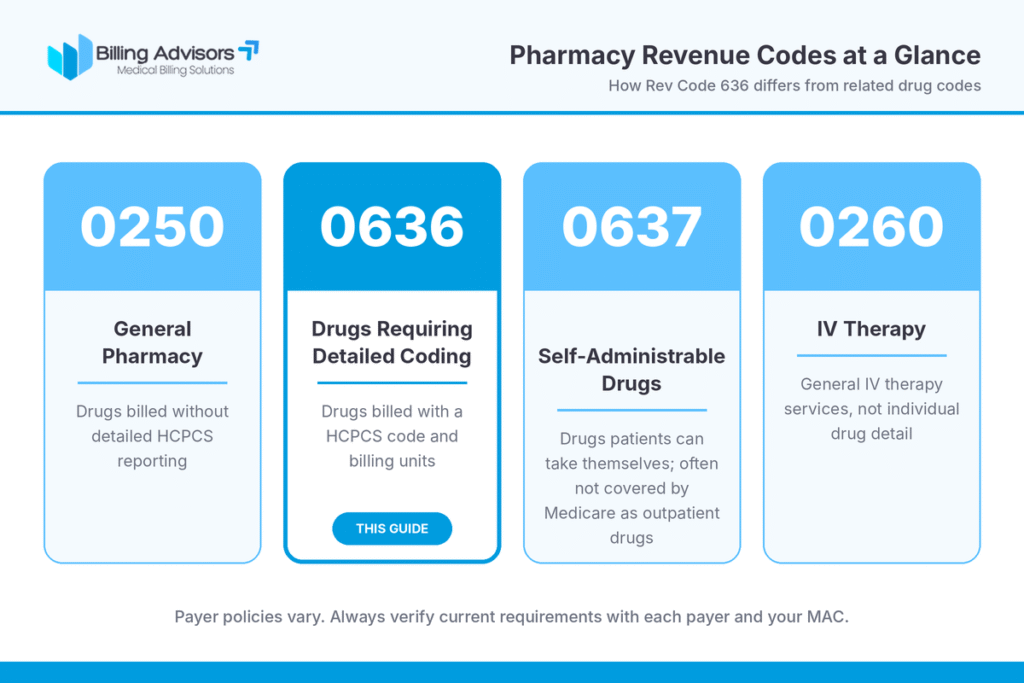
The pharmacy revenue code family (025X and 063X) can look similar, but each serves a different purpose:
- 0250 (general pharmacy): Drugs billed without detailed HCPCS reporting
- 0636 (drugs requiring detailed coding): Drugs billed with a HCPCS code and units
- 0637 (self-administrable drugs): Drugs patients can take themselves, which Medicare often does not cover as outpatient drugs
- 0260 (IV therapy): General IV therapy services, not individual drug detail
The practical difference is the detail. If the payer expects a HCPCS code and units for the drug, 636 revenue code reporting is usually the better fit. If not, a general pharmacy code may apply. Verify with each payer, since policies differ.
Documentation and Billing Requirements for 636 Rev Code
Clean drug claims start with clear records. Before billing, confirm that the claim includes:
- Provider order and medication administration record (MAR) supporting the drug given
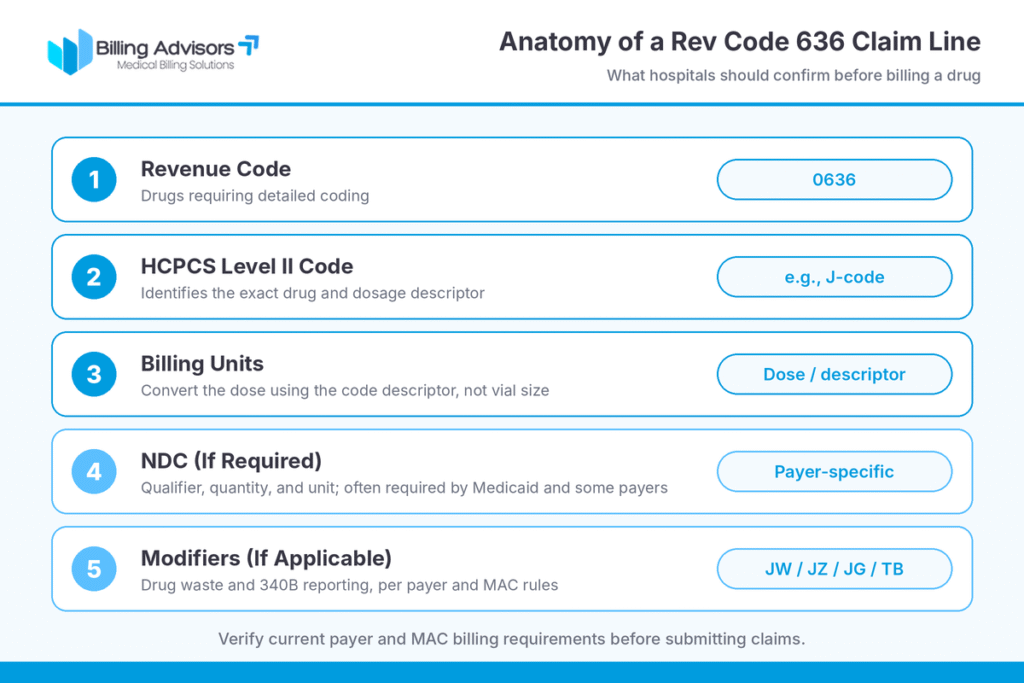
- Correct HCPCS Level II code matching the drug and dosage descriptor
- Accurate billing units based on the HCPCS descriptor, not the vial size
- Dates of service, charges, and administration details
- Documentation of any wasted or discarded drug, where applicable
Units are a frequent source of errors. If a HCPCS code describes 10 mg and the patient receives 50 mg, the claim should show 5 units. Always convert the administered dose using the code’s descriptor.
HCPCS Codes, NDC Reporting, and Units of Service
HCPCS Level II codes identify the drug, while the NDC (National Drug Code) identifies the specific product, manufacturer, and package. Revenue code 636 lines typically need the HCPCS code and units. NDC reporting is not universal. Medicaid programs and some commercial payers require it, often with an NDC qualifier, quantity, and unit of measure. Check each payer’s policy rather than assuming.
Modifiers can matter too. Examples include JW or JZ for discarded drug amounts and JG or TB for 340B-acquired drugs, depending on payer rules. Medicare, for instance, has required JZ on certain single-dose container claims with no discarded amount. Confirm current modifier rules with your MAC.
Medicare and Commercial Payer Considerations
payment status is determined under the Outpatient Prospective Payment System (OPPS). Some drugs are separately payable while others are packaged into the associated procedure, but hospitals generally still report them with HCPCS codes. Medicare Administrative Contractors may publish additional guidance, and the CMS Medicare Claims Processing Manual is the authoritative starting point.
Commercial payers often follow similar logic but can diverge on revenue code mapping, NDC requirements, prior authorization, and units. Some may reimburse a drug under a different revenue code or require a specific one. Always review the payer’s contract and billing manual rather than relying on Medicare rules alone.
Common Rev Code 636 Billing Errors and Denial Prevention
Most 636 rev code denials trace back to a few repeat issues:
- Missing or invalid HCPCS code on the drug line
- Incorrect units caused by ignoring the HCPCS descriptor
- Missing or mismatched NDC when the payer requires it
- Wrong revenue code for self-administered or non-HCPCS drugs
- Absent or incorrect JW, JZ, or 340B modifiers
- Outdated HCPCS codes after quarterly code updates
- Charges that do not match the order or MAR
To prevent denials, build front-end claim edits that flag drug lines without HCPCS codes or units, review denial trends monthly, and update your chargemaster (CDM) whenever CMS or payers release new codes.
Best Practices for Accurate Hospital Reimbursement
Strong drug billing combines coding accuracy, clear workflows, and ongoing education.
- Keep the chargemaster current. Map each drug to the correct HCPCS code, revenue code, and unit conversion.
- Coordinate pharmacy, nursing, and billing. Administration records should show dose, route, time, and any waste.
- Audit regularly. Sample drug claims to catch unit errors and revenue code mismatches early.
- Track payer updates. Review MAC bulletins, CMS quarterly updates, and payer policy changes.
- Train your team. Coders and billers should understand how revenue codes, HCPCS codes, and NDCs work together.
Many of these topics, such as drug waste modifiers, NDC billing, and 340B claims, deserve a deeper look and are natural subjects for focused follow-up guides.
Get Expert Support With Drug Billing and Revenue Cycle Accuracy
Drug billing rules are detailed, and small errors can mean delayed payments or denied claims. The Billing Advisors helps hospitals and healthcare providers strengthen billing accuracy, reduce preventable denials, and improve revenue cycle performance, including correct use of Rev Code 636, HCPCS reporting, and unit calculations. If your team wants a second set of expert eyes on drug claims, contact The Billing Advisors today to discuss how professional medical billing support can help.