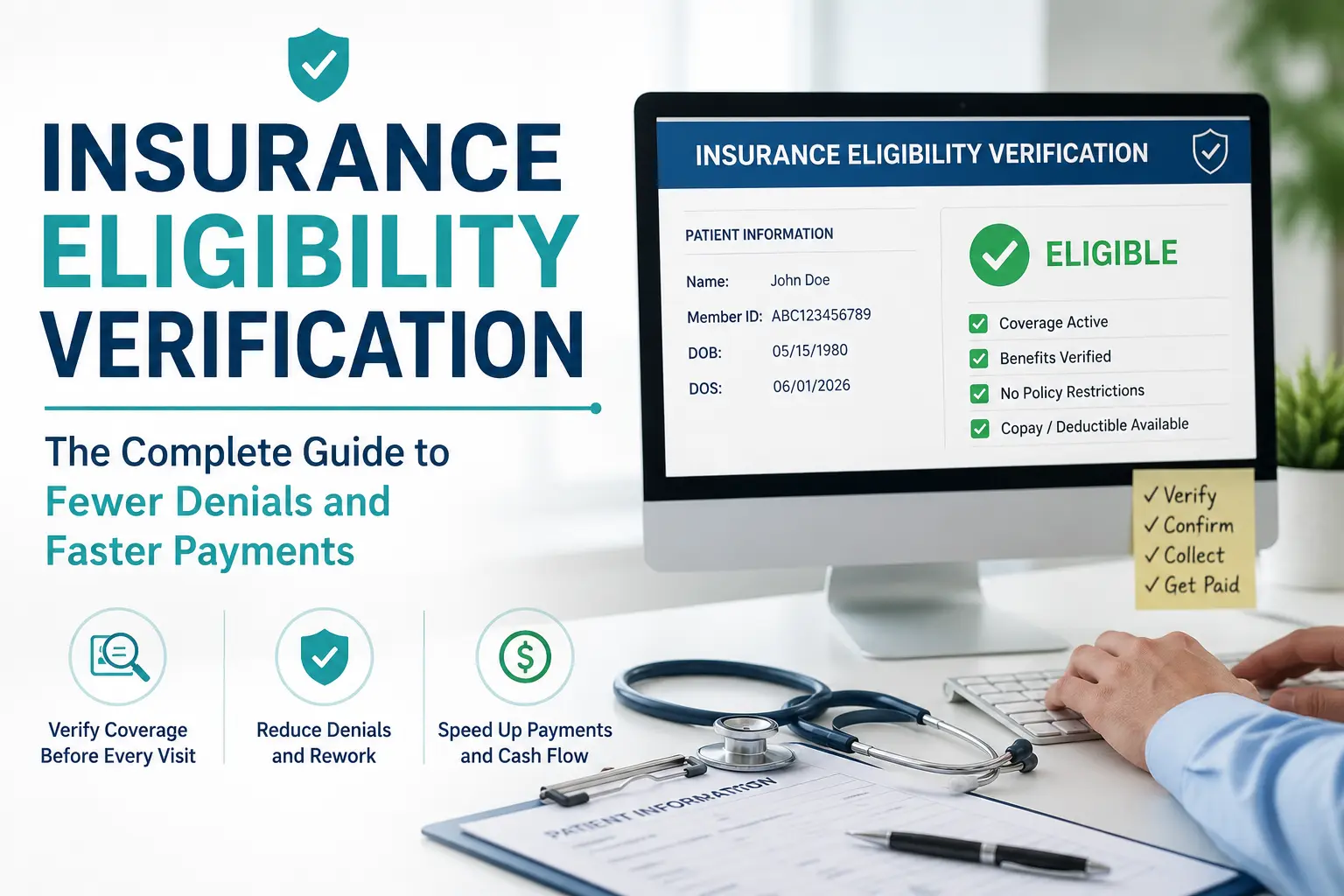
If you have ever watched a clean claim bounce back with a denial code that traces all the way back to something as simple as an inactive policy or a mismatched plan, you already know the real cost of skipping insurance eligibility verification. It is not just a line item on a front desk checklist. It is the single decision point that determines whether a claim gets paid on the first pass or spends the next 45 days bouncing between your billing team and the payer.
After decades of watching claims move through the revenue cycle, one pattern never changes: practices that verify eligibility properly, every time, before every visit, collect more money with less staff effort than practices that treat it as an afterthought. This guide breaks down exactly what insurance eligibility verification is, how it actually works behind the scenes, where most practices lose money, and how to build a process that holds up against today’s payer requirements.
What Is Insurance Eligibility Verification?
Insurance eligibility verification is the process of confirming, before a patient is seen, that their health insurance policy is active, that it covers the specific service being rendered, and that the practice understands the patient’s financial responsibility such as copays, coinsurance, and remaining deductible.
It sounds simple on paper. In practice, it means checking a policy against dozens of variables: plan type, effective and termination dates, network status, service-specific coverage limits, prior authorization requirements, and coordination of benefits when a patient has more than one payer. Miss any one of these and you are looking at a denial that could have been caught before the patient ever sat in the waiting room.
It is worth separating two terms that get used interchangeably but mean different things:
- Eligibility confirms the patient is an active, recognized member of a specific insurance plan on the date of service.
- Benefits verification goes a layer deeper and confirms what that plan actually pays for, including copay amounts, deductible status, coinsurance percentages, and whether the specific CPT or procedure code requires prior authorization.
A full verification checks both. A practice that only confirms “active” status without checking benefit specifics is still exposed to denials and surprise patient bills.
Why Eligibility Verification Is the Foundation of a Healthy Revenue Cycle
Industry data consistently points to the same conclusion: eligibility and registration errors are the single largest preventable cause of claim denials, ahead of coding errors, documentation gaps, and timely filing issues combined. When a claim denies for eligibility reasons, it does not just delay one payment. It creates a chain reaction of rework: someone has to research the denial, contact the payer, correct the record, and resubmit, often past the point where the patient could have simply paid at the time of service.
Here is what proper verification actually protects:
- Clean claim rate. Claims that pass payer edits on the first submission get paid in days instead of weeks.
- Days in accounts receivable. Fewer denials mean less time chasing money that should have arrived weeks earlier.
- Patient trust. Nobody wants a surprise bill three months after their visit because their coverage lapsed and nobody caught it.
- Staff capacity. Every hour spent reworking a preventable denial is an hour not spent on higher-value collections work.
If your practice is still catching these issues after the claim denies rather than before the patient checks in, the fix usually starts with tightening the patient registration process, since that is where the data that eligibility checks rely on first gets collected.
How Insurance Eligibility Verification Actually Works
Most people picture eligibility verification as a phone call to an insurance company. That is how it worked twenty years ago, and unfortunately, some practices still operate that way. Today, most verification happens electronically through what is known as an EDI 270/271 transaction, a standardized data exchange required under HIPAA.
Here is the mechanics in plain terms:
- The 270 request. Your practice management system or clearinghouse sends a standardized inquiry to the payer containing the patient’s identifying information, plan ID, and the service being verified.
- The 271 response. The payer’s system responds, usually within seconds, with the patient’s coverage status, plan details, copay and deductible figures, and any service-specific restrictions.
- Interpretation. This is where experience matters. A 271 response can return dozens of data segments, and knowing which ones actually apply to the visit being scheduled is what separates a real verification from a box-checking exercise.
For payers or scenarios where electronic responses are incomplete (which still happens more than most software vendors like to admit), a live call to the payer or a manual portal check remains necessary. A well-run verification process uses electronic checks as the default and manual follow-up as the exception, not the other way around.
The Step-by-Step Insurance Eligibility Verification Process
A verification process that actually holds up under payer scrutiny follows a consistent sequence, whether it is done in-house or through an outsourced medical billing service.
Step 1: Collect Accurate Patient and Insurance Information
This starts at scheduling, not at check-in. Front desk or scheduling staff need to capture the patient’s full legal name, date of birth, insurance ID, group number, and the name and date of birth of the policyholder if it is not the patient. A single transposed digit in a member ID is enough to return a false “not found” response.
Step 2: Run the Electronic Eligibility Check
Ideally 48 to 72 hours before the appointment, not the morning of. This gives staff a window to resolve any issues, such as a lapsed policy or missing referral, before the patient arrives rather than in front of them at the check-in desk.
Step 3: Verify Service-Specific Benefits
Confirm that the specific CPT codes, procedures, or DME items planned for the visit are covered under the patient’s plan, and check whether prior authorization is required. This step gets skipped constantly because a general eligibility check will show a plan as “active” even when a specific procedure is excluded or requires prior approval.
Step 4: Calculate Patient Financial Responsibility
Using the deductible remaining, copay amount, and coinsurance percentage, estimate what the patient will owe. This is what allows front desk staff to collect at the time of service rather than chasing the balance for months afterward.
Step 5: Document Everything
Record the verification date, the representative or reference number if a call was made, and the specific benefits confirmed. If a claim is denied later and this documentation exists, appeals move faster and are far more likely to succeed.
Step 6: Re-Verify When Necessary
Coverage changes more often than practices expect, especially at the start of a new plan year, after a job change, or with Medicaid redetermination cycles. A verification done three weeks ago is not a guarantee for today’s visit if there is any gap between the check and the actual service date.
Common Insurance Eligibility Verification Mistakes That Cause Denials
Certain mistakes show up again and again across specialties, and most of them are avoidable with a tighter process.
- Verifying eligibility but not benefits. The plan shows active, but nobody checked whether the specific service is covered or whether it needs prior authorization.
- Relying on outdated information. A verification from the last visit gets carried forward without a fresh check, especially for recurring patients.
- Missing coordination of benefits. When a patient has secondary or tertiary coverage, billing the wrong payer first is a fast track to a denial.
- Ignoring plan-specific network rules. A patient’s plan may be active but out of network for your specialty or facility type, which changes reimbursement entirely.
- Skipping re-verification for scheduled procedures booked weeks in advance. Coverage confirmed at scheduling can lapse by the time of the actual procedure.
- Not documenting the verification. Without a record, there is nothing to point to during an appeal.
These mistakes map directly to some of the most common denial codes practices see: CO-27 (coverage terminated), CO-31 (patient cannot be identified as insured), CO-22 (coordination of benefits), and CO-197 (missing prior authorization). If your denial reports show a recurring pattern in these codes, the root cause is almost always upstream in the eligibility process, not in coding or documentation. A closer look at your claim denial management data will usually confirm exactly where the breakdown is happening.
Manual vs. Electronic vs. Outsourced Verification: Which Approach Fits Your Practice
| Approach | Speed | Accuracy | Staff Burden | Best Fit |
|---|---|---|---|---|
| Manual (phone/portal) | Slow, minutes per patient | Depends on rep knowledge | High | Low-volume practices or payers without electronic connectivity |
| Electronic (270/271) | Seconds per patient | High for standard cases | Moderate, still needs review | Most practices with modern practice management software |
| Outsourced verification | Fast, batch processing | High, backed by trained specialists | Low, frees internal staff | Growing practices, multi-specialty groups, high patient volume |
Most established practices land on a hybrid model: electronic checks as the default, with staff or an outsourced partner handling the exceptions that automation cannot resolve on its own, such as unusual plan types, out-of-state Medicaid, or payers with incomplete electronic connectivity.
The Real Cost of Skipping Eligibility Verification
It helps to put a number on what this actually costs. Industry benchmarks from organizations like MGMA and HFMA have long put the average cost of reworking a single denied claim between $25 and over $100, once staff time, resubmission effort, and delayed cash flow are factored in. Multiply that across even a modest volume of preventable eligibility denials each month and the number stops looking small.
There is also a softer cost that rarely shows up on a spreadsheet: patient trust. A patient who gets a surprise bill months after a visit because coverage was not properly verified is a patient who questions every future bill from your practice, and sometimes a patient who does not come back.
Best Practices for a Reliable Eligibility Verification Workflow
- Verify before every visit, not just new patients. Returning patients are just as likely to have a coverage change as new ones.
- Build a standard time window. 48 to 72 hours before the appointment gives enough runway to fix problems without being so early that coverage changes in between.
- Train front desk staff on what “active” actually means. Active status alone does not confirm benefits, network status, or authorization requirements.
- Use a checklist, not memory. Standardizing the fields checked on every verification (ID match, effective dates, copay, deductible, authorization status, coordination of benefits) removes the guesswork that leads to gaps.
- Track your verification accuracy rate as a KPI. If eligibility-related denials are climbing, it is a direct signal the front-end process needs attention, not just the billing team.
- Keep your practice management or clearinghouse software current. Payer connectivity and data formats shift regularly. Outdated systems return incomplete 271 responses more often than current ones. A quick audit through a resource like a medical billing software guide can help identify gaps in your current setup.
- Loop verification into your compliance framework, not just your revenue process. Accurate patient data handling ties directly into broader medical billing compliance obligations under HIPAA.
Eligibility Verification by Specialty: Where It Gets More Complex
Verification is not one-size-fits-all. Certain specialties carry extra layers that a generic process misses entirely.
- DME (durable medical equipment): Coverage often hinges on medical necessity documentation and specific HCPCS codes, and prior authorization requirements vary widely by payer. Practices in this space benefit from a workflow built specifically around DME billing requirements rather than a generic medical eligibility check.
- Behavioral health: Session limits, parity law considerations, and separate deductibles from medical coverage are common and frequently missed.
- Imaging and specialty procedures: High-cost procedures almost always carry prior authorization requirements that a basic eligibility check will not surface.
- Recurring care (physical therapy, chronic disease management): Benefits can shift mid-course of treatment as visit caps or deductibles are reached, making re-verification during a course of care essential, not optional.
How Automation Changes the Eligibility Verification Process
Automated, real-time eligibility tools have shifted verification from a once-a-day batch task to something that can run continuously across an entire schedule. The core advantages are consistent across most modern platforms:
- Speed. What used to take a staff member 10 to 15 minutes per patient on the phone now resolves in seconds for standard cases.
- Batch processing. An entire day’s or week’s schedule can be verified in one run rather than one patient at a time.
- Fewer manual errors. Automated data matching reduces the transposition and lookup errors that come with manual entry.
- Integration with scheduling. When verification connects directly to your scheduling workflow, issues surface early enough for staff to resolve them before the patient’s appointment.
Automation is not a replacement for judgment, though. Software can retrieve the data, but interpreting complex responses, chasing down payers with unreliable electronic connectivity, and catching plan-specific exceptions still benefits from experienced human review, especially for higher-dollar procedures.
Frequently Asked Questions About Insurance Eligibility Verification
What is the difference between eligibility verification and prior authorization? Eligibility verification confirms that a patient’s insurance is active and outlines their general benefits. Prior authorization is a separate approval a payer requires before certain services, procedures, or medications will be covered, regardless of whether the plan itself is active.
How far in advance should insurance eligibility be verified? Most practices see the best results verifying 48 to 72 hours before the appointment. This leaves enough time to resolve issues without the risk of coverage changing again before the visit.
Can eligibility be active but a claim still get denied? Yes. Active eligibility only confirms plan status. Claims can still deny for reasons like missing prior authorization, non-covered services, coordination of benefits errors, or network status issues that a basic eligibility check does not catch.
How often does insurance coverage change for patients? More often than most practices assume, particularly around the start of a new calendar year, after employment changes, and during Medicaid redetermination periods. Recurring patients should be re-verified at each visit, not just at initial intake.
Is manual insurance verification still necessary if we use automated software? In most cases, yes, for exceptions. Automated 270/271 checks handle standard scenarios well, but payers with limited electronic connectivity, unusual plan types, or incomplete data still require a manual call or portal check to confirm details accurately.
What percentage of claim denials are related to eligibility issues? Multiple industry studies over the past several years have consistently found that eligibility and registration-related issues account for a significant share, often cited around a quarter or more, of all preventable claim denials, making it one of the highest-leverage areas for a practice to tighten.
Building a Verification Process That Actually Protects Revenue
Insurance eligibility verification is not a formality. It is the checkpoint that decides whether the rest of your revenue cycle runs smoothly or spends its energy correcting avoidable mistakes. The practices that treat it with the same seriousness as coding and documentation are consistently the ones with cleaner claims, faster payments, and fewer conversations with patients about unexpected bills.
Reduce Eligibility Denials Before They Hit Your Revenue
The Billing Advisors works directly with healthcare practices to tighten insurance verification, reduce preventable denials, and strengthen the front end of the revenue cycle so the back end performs better too.
Talk to Our Billing Team →Free consultation • No long-term contract required