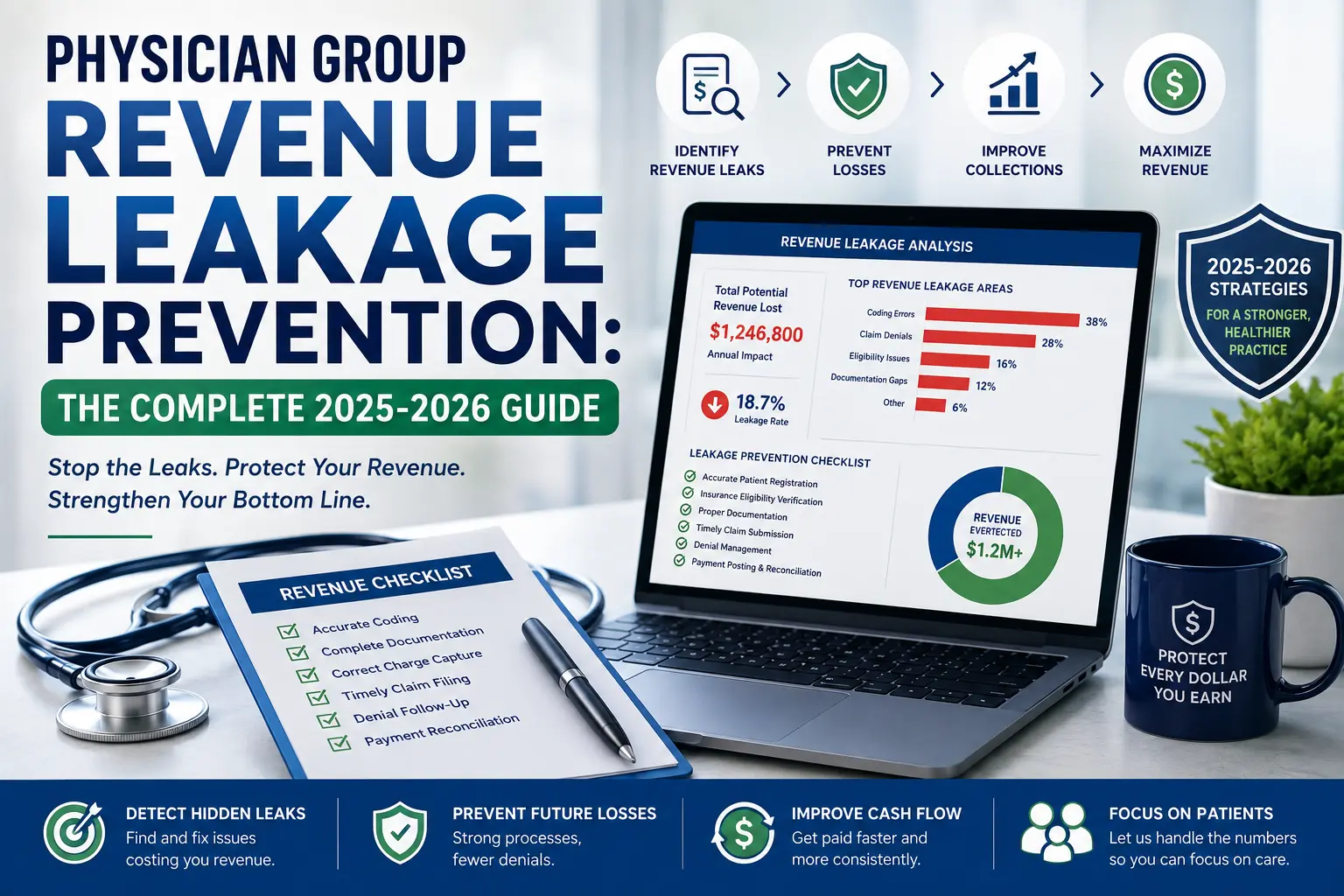
Most physician groups do not have a revenue problem they can point to. They have a revenue problem hiding inside numbers that already look normal. A denial rate of 7% sounds manageable until you split it by location and find that one clinic is running at 15%. A collection rate of 96% sounds healthy until you realize the other 4% represents a contracted amount you were owed, not a discount you agreed to.
This is what makes revenue leakage different from a billing error. A billing error gets caught and corrected. Leakage gets absorbed into “that’s just how the numbers look this quarter” and never gets questioned again.
For a multi-provider physician group, that absorption is expensive. This guide breaks down where leakage actually starts inside a group practice, what it costs in 2025 and 2026, and a governance framework you can put in place this quarter to close the gaps for good.
What Revenue Leakage Actually Means for a Physician Group
Revenue leakage is the difference between what your group is contractually entitled to collect for the care it delivers and what actually lands in the bank account. It is not the same as bad debt from self-pay patients who cannot afford their bill, and it is not the same as a legitimate, medically-necessary write-off. Leakage is money you earned and are owed, that never gets captured because a process step failed somewhere between the front desk and the remittance advice.
For a solo practice, leakage tends to concentrate in one or two spots, usually coding and follow-up. A physician group multiplies the problem. More providers means more coding styles. More locations means more front-desk teams applying eligibility checks inconsistently. More payer contracts means more fee schedules that can quietly drift out of sync with what claims actually pay. Group practices do not leak more because their staff is worse. They leak more because they have more seams, and leakage lives in the seams.
How Much Physician Groups Are Actually Losing in 2025-2026
The scale of this problem is no longer a guess. Several independent data sets from 2025 and 2026 point to the same range.
Multi-specialty physician groups are showing median revenue leakage of roughly 3.5% to 4.2% of net patient revenue, spread across denial write-offs, underpayments, missed charge capture, credentialing gaps, and aged accounts receivable. For a group collecting $2 million a year, that translates to $70,000 to $84,000 walking out the door annually. For a larger multi-specialty group, the same percentage produces losses between $150,000 and $400,000 a year.
Zoom out to the industry level and the numbers get bigger. U.S. healthcare providers collectively lose an estimated $125 billion a year to inefficient revenue cycle management, and national denial rates have climbed to roughly 12%. A recent MGMA Stat poll found that medical group leaders identify denials and appeals as the single largest revenue-cycle leak they face, cited by nearly half of respondents.
The pattern across every data set is consistent: leakage rarely comes from one dramatic failure. It accumulates from dozens of small, individually forgivable process gaps that nobody owns.
Where Leakage Actually Starts: 9 Sources Specific to Group Practices
1. Front-Desk and Eligibility Gaps
A large share of denials that show up weeks later trace back to something that happened, or did not happen, at check-in: an eligibility check skipped during a busy morning, a plan change that was not caught, an authorization that expired between the referral and the visit date. In a single-provider office, one person can eyeball this. Across five locations with rotating front-desk staff, informal checks stop working, which is exactly why groups need a standardized insurance eligibility verification process that runs the same way at every site, every time. Our insurance eligibility verification guide walks through how to build that into the scheduling workflow so it stops depending on any one staff member’s memory.
2. Coding and Documentation Drift Across Providers
Every physician documents differently, and every difference in documentation eventually becomes a difference in coding accuracy. Undercoding to stay safely below audit risk is one of the most common and least visible forms of leakage in group settings, because it never generates a denial. The claim simply pays for less than the service actually warranted, and nobody notices because nothing looks wrong on the remittance. Coding-level and documentation-level errors compound quickly across a roster of ten or twenty providers. A structured review of recurring medical billing mistakes by provider, not just by practice, is the only way to catch this pattern before it becomes a habit.
3. Credentialing and Enrollment Gaps
When a new physician joins a group, or an existing provider adds a location, credentialing delays create a window where claims either get denied outright or get billed under a supervising provider’s number, which introduces its own compliance risk. Groups growing through hiring or acquisition are especially exposed here, because credentialing timelines rarely move as fast as onboarding timelines. Every week a provider sees patients before their enrollment is finalized is a week of claims sitting in limbo or, worse, going out incorrectly.
4. Payer Contract and Fee Schedule Drift
This is the leak that hides best. Payers update fee schedules, groups negotiate rate increases, and somewhere in between, the numbers stop matching. Without a routine reconciliation of contracted rates against what is actually posted, a group can be paid below its negotiated rate for months before anyone catches it. This is sometimes called a “silent denial,” because the claim never rejects. It just pays less than it should, and the group accepts it as normal.
5. Denials That Never Get Worked
Not every denial represents lost revenue, but every denial that sits untouched past the appeal deadline does. Groups running multiple specialties often aggregate their denial rate into one number that looks acceptable, while one department is quietly running double or triple the group average. Denials need a workflow with an owner, a deadline, and a root-cause tag, not a folder that gets reviewed “when someone has time.” Our claim denial management guide covers how to build that workflow so denials get worked before the appeal window closes, not after.
6. Underpayments That Go Unchallenged
A short payment is not the same as a denial, and that distinction is exactly why it slips through. The claim shows as paid, the payment poster moves on, and the gap between what was billed and what was contracted never gets flagged. Left unmonitored, underpayments quietly become one of the largest single sources of leakage a group has, because there is no natural trigger that forces someone to look twice.
7. Prior Authorization Failures
Services performed without a valid authorization, or performed after the authorization’s approved scope has changed, are among the most preventable and most expensive leaks a group can have, because the entire claim is frequently written off rather than partially adjusted. As payers tighten authorization requirements across imaging, procedures, and specialty drugs, groups that treat prior auth as a front-desk afterthought instead of a tracked workflow lose entire claims, not partial ones.
8. Aged Accounts Receivable
Every day a claim sits past 90 days without follow-up, the odds of ever collecting it drop. Groups with fragmented AR ownership across multiple locations often cannot even say, on demand, what their AR over 90 days looks like by payer and by provider. If that number is not visible, it cannot be managed, and if it cannot be managed, it becomes the default place where recoverable revenue quietly turns into a write-off.
9. Technology and Workflow Fragmentation
Groups that grew through mergers or new locations frequently end up running two or three different practice management systems that were never fully reconciled. Reporting becomes inconsistent, claim scrubbing rules do not apply uniformly, and staff waste time reconciling data by hand instead of working denials and AR. Choosing and standardizing the right medical billing software across every location is one of the highest-leverage fixes a growing group can make, because it removes the manual reconciliation step that leakage hides inside.
A Framework for Preventing Leakage, Not Just Finding It
Most guides on this topic stop at “run an audit.” An audit tells you where you bled last quarter. It does not stop you from bleeding next quarter. Physician groups need a prevention framework with four ongoing pillars, each with a named owner.
Standardize. Every location runs the same eligibility, authorization, and coding-review process. Variation between sites is where leakage compounds fastest, so standardization is the foundation everything else sits on.
Monitor. Denial rate, first-pass resolution rate, and underpayment rate get tracked by provider, by specialty, by location, and by payer, not as one blended group number. Blended numbers hide the outliers that are actually costing you money.
Own. Every denial, every underpayment, and every aging claim over 60 days has a named person responsible for resolving it within a set number of days. An audit finding that is not assigned to someone is not a finding, it is a note nobody reads.
Reconcile. Contracted rates get checked against posted payments on a quarterly cycle, not an annual one, because fee schedules change more often than most groups review them. A quarterly reconciliation catches drift while it is still a few thousand dollars, not a few hundred thousand.
Groups that build compliance and audit discipline into this framework rather than treating it as a once-a-year event tend to catch leakage while it is still cheap to fix. Our medical billing compliance guide covers how to set up that recurring audit cadence without pulling clinical staff away from patient care.
2026 Revenue Leakage Benchmarks by Category
| Leakage Category | Typical Range (% of Net Revenue) | Most Common Root Cause |
|---|---|---|
| Denial write-offs | 1.0% – 1.8% | Front-end eligibility and authorization gaps |
| Underpayments | 0.7% – 1.2% | No routine fee schedule reconciliation |
| Missed charge capture | 0.5% – 0.9% | Documentation not translated into billable codes |
| Credentialing gaps | 0.3% – 0.6% | Enrollment timelines lagging behind onboarding |
| Aged AR write-offs | 0.5% – 1.0% | No follow-up ownership past 90 days |
These ranges reflect industry data on multi-specialty groups gathered across 2025 and 2026. Individual groups can fall well outside this range depending on specialty mix, payer contracts, and whether billing is handled in-house or outsourced.
A 90-Day Action Plan for Physician Groups
Days 1-30: Get Visibility. Pull denial rate, underpayment rate, and AR aging by location, provider, and payer. Most groups have never seen this data unblended, and the outliers usually surface within the first week of looking.
Days 31-60: Fix the Front End. Standardize eligibility verification and prior authorization tracking across every location using one checklist, one system, and one escalation path. This is the cheapest leak to close and it prevents the largest volume of downstream denials. A tightened patient registration process at intake is what makes this stick.
Days 61-90: Assign Ownership. Every denial category and every AR bucket over 60 days gets a named owner with a resolution deadline. Set up the quarterly fee schedule reconciliation as a recurring calendar item, not a one-time project.
Build In-House or Outsource: How Groups Should Decide
Groups with a stable roster of five or fewer providers and a dedicated, tenured billing team can often manage this in-house with the right monitoring in place. Groups that are scaling quickly, adding locations, or running more than one specialty usually reach a point where the internal team is stretched across too many payer rules and too many workflows to catch leakage before it compounds. At that stage, a dedicated revenue cycle management partner with specialty-specific denial workflows, active AR follow-up, and centralized credentialing support tends to close leaks faster than an internal team can build the same processes from scratch.
Frequently Asked Questions
What is a healthy revenue leakage rate for a physician group? Under 2% of net patient revenue is considered strong performance for a multi-specialty group in 2026. Anything above 4% signals systemic gaps rather than isolated errors.
How often should a physician group audit for revenue leakage? Quarterly, at minimum, with denial and underpayment trends reviewed monthly. Annual audits catch leakage only after it has already compounded into a much larger loss.
What is the biggest source of revenue leakage for multi-specialty groups? Denials and appeals consistently rank as the largest single source, based on 2026 industry surveys of medical group leaders, followed closely by underpayments that go unchallenged.
Does outsourcing billing eliminate revenue leakage? Outsourcing reduces leakage when the partner runs active denial management, contract reconciliation, and credentialing tracking. It does not eliminate leakage automatically. The workflow discipline matters more than who performs it.
Is revenue leakage the same as claim denials? No. Denials are one visible source of leakage. Underpayments, missed charge capture, credentialing gaps, and aged AR are equally significant but far less visible, which is why blended reporting often hides them.
The Bottom Line
Revenue leakage in a physician group is rarely one broken process. It is a dozen small ones running quietly at the same time, each one small enough to excuse and large enough, together, to change whether a group is thriving or just getting by. Standardizing the front end, monitoring by provider and location instead of in aggregate, assigning real ownership to denials and aging claims, and reconciling contracts on a quarterly cycle turns leakage from a mystery into a managed line item.
If your group has never seen its denial, underpayment, and AR data broken out by location and provider, that is the first place to look. The team at The Billing Advisors works with physician groups to build exactly this kind of visibility and close the gaps it uncovers.