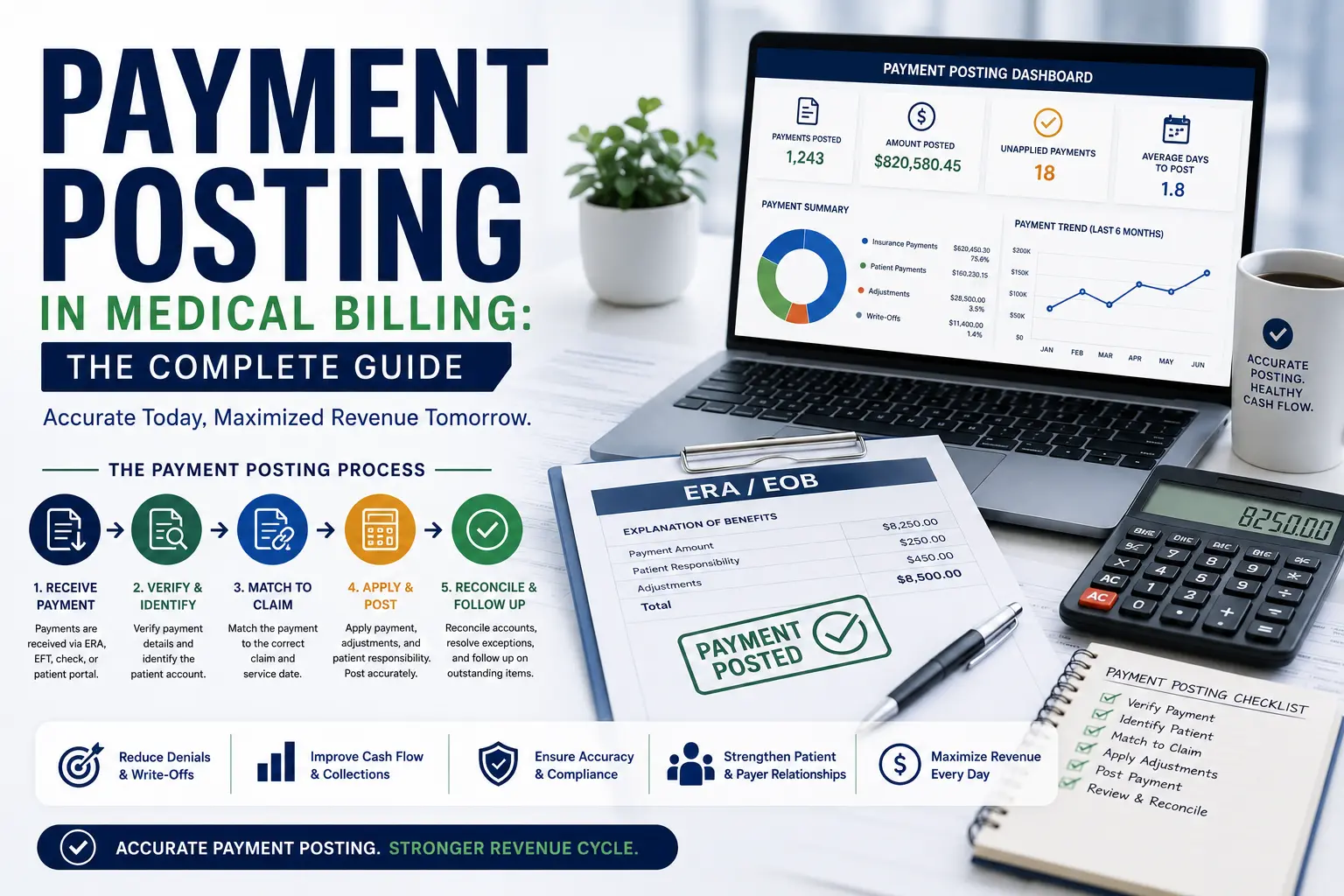
Payment posting is the step in medical billing where every dollar received from a payer or a patient gets recorded against the right claim, in the right amount, with the right adjustment code attached. Get it right and your accounts receivable tells you the truth. Get it wrong and you’re chasing balances that were never really open, missing underpayments that quietly drain revenue, and closing out the month on numbers nobody trusts.
This guide walks through how payment posting actually works, the documents and codes behind every entry, the errors that cost practices the most money, and the metrics that separate a well-run posting function from one that’s just keeping up.
What Is Payment Posting in Medical Billing?
Payment posting is the process of entering payments from insurance companies, patients, and government payers into a medical billing or practice management system, and matching each payment to the specific claim it belongs to. A posted payment isn’t just an amount. It carries the billed charge, the allowed amount, the amount actually paid, any contractual write-off, and whatever balance is left over, whether that balance moves to a secondary payer or lands on the patient’s statement.
Think of it as the reconciliation layer between what a practice billed and what it actually collected. Every other downstream process, from denial follow-up to patient statements to month-end reporting, depends on this step being accurate.
Why Payment Posting Sits at the Center of the Revenue Cycle
Payment posting doesn’t operate in isolation. It’s the bridge between claims submission and everything that happens next in revenue cycle management. A claim can be coded correctly, submitted clean, and adjudicated fast, but if the payment gets posted to the wrong account or the adjustment code gets misread, none of that upstream work shows up in the numbers.
Three things depend directly on accurate posting:
- Denial visibility. Denials and partial payments only surface when posting staff read the remark codes correctly and route the balance for follow-up instead of writing it off by default.
- Patient billing accuracy. If insurance posting is wrong, the patient statement is wrong, and that’s one of the fastest ways to trigger a billing dispute or an unnecessary write-off.
- Financial reporting. Practice leadership, CFOs, and billing teams pull collection rate, adjustment ratios, and payer performance straight from posted data. Bad posting means bad decisions further up the chain, which is part of why CFOs keep such a close eye on aging accounts receivable.
The Two Documents Behind Every Posted Payment: ERA and EOB
Payment posters work from one of two source documents, and understanding the difference matters more than most guides give it credit for.
| ERA (Electronic Remittance Advice) | EOB (Explanation of Benefits) | |
|---|---|---|
| Format | Electronic file (835 transaction), usually auto-imported | Paper or PDF statement |
| Volume | Handles multiple claims across multiple patients in one file | Typically covers a single claim or patient |
| Posting method | Can be auto-posted by the practice management system | Requires manual data entry |
| Speed | Same-day or next-day posting is realistic | Slower, dependent on mail or manual download |
| Error risk | Lower, but auto-posting rules still need periodic review | Higher, since every field is typed by hand |
Most practices run a hybrid model. High-volume payers send ERAs that post automatically through the clearinghouse, while smaller payers, workers’ comp claims, or paper-only payers still generate EOBs that a biller has to key in by hand. A posting team that treats every ERA line as “auto and done” without spot-checking the underlying codes will eventually let real denials slip through disguised as normal adjustments.
What Actually Gets Posted: Categories Beyond “Payment Received”
A lot of payment posting guides stop at “insurance pays, patient pays.” In practice, every posted transaction falls into one of several categories, and mixing them up is where reporting goes wrong.
- Contractual adjustment. The difference between the billed charge and the payer’s allowed amount, written off because of the payer contract. Not a loss, just the agreed rate.
- Denial-related balance. Payment reduced or denied for a specific reason (a missing modifier, a timely filing issue, lack of medical necessity). This needs to route straight into denial management, not get buried in a generic adjustment code.
- Patient responsibility. Copay, coinsurance, or deductible amounts that transfer to the patient statement.
- Secondary or tertiary transfer. Balance moved to the next payer in line when a patient has more than one insurance.
- Takebacks and recoupments. Payers reversing a prior payment, usually flagged separately so it doesn’t get confused with a new charge.
- Unapplied cash. Money that’s been received but can’t yet be matched to a specific claim or patient. Left unresolved, this becomes a black hole that hides real revenue.
Treating all six as one generic “adjustment” bucket is one of the most common reasons practices lose track of real underpayments.
The Payment Posting Process, Step by Step
- Receive the payment file. ERAs pull in electronically; paper EOBs and checks get logged in manually or through a lockbox.
- Verify the deposit against the payment file. The dollar amount received in the bank should match the total on the remittance before anything gets posted, otherwise reconciliation breaks later.
- Match each payment line to its claim. Every line item is tied back to the original charge using the patient account, date of service, and claim number.
- Read the adjustment and remark codes. This is where CARC and RARC codes come in (more below). This step decides whether a line is a normal contractual write-off or something that needs a human to chase it down.
- Post the payment, adjustment, and remaining balance. The system updates the claim status and, where applicable, moves a balance to secondary insurance or the patient.
- Flag exceptions. Underpayments, denials, and unapplied cash get pulled into a work queue instead of being posted and forgotten.
- Reconcile daily. Total posted amounts should tie out to total deposits for the day. Any variance gets investigated before it compounds.
Reading the Codes: CARC and RARC Explained
Every ERA and most EOBs carry two sets of codes that payment posters rely on constantly, and they’re worth understanding even if you’re not the one posting.
- CARC (Claim Adjustment Reason Code) explains why an amount was adjusted, such as a contractual obligation, a bundled service, or a non-covered charge.
- RARC (Remittance Advice Remark Code) adds supplemental detail, often pointing to the specific reason a claim was reduced or denied, like missing documentation or an incorrect modifier.
A posting team that reads CARC/RARC pairs correctly can tell the difference between “this is a routine write-off” and “this is a denial worth appealing” in seconds. A team that just posts whatever the software auto-applies will miss that distinction every time, which is exactly how recoverable revenue quietly disappears.
Manual vs. Automated Payment Posting
| Factor | Manual Posting | Automated (ERA) Posting |
|---|---|---|
| Best for | Low-volume practices, paper-only payers | High-volume claims, standard payers |
| Speed | Slower, limited by staff hours | Same-day, high throughput |
| Error rate | Higher, human data entry | Lower, but rules still need auditing |
| Cost | Lower upfront, higher labor cost over time | Higher setup cost, lower cost per claim at scale |
| Oversight needed | Line-by-line review | Exception-based review |
Automation isn’t a replacement for judgment. Even a fully automated posting rule set needs someone reviewing exceptions, underpayments, and denial codes that don’t match expected patterns. The goal isn’t “no humans,” it’s touchless posting for clean, expected payments and fast human review for everything else.
The Payment Posting Errors That Actually Cost Money
Most posting mistakes fall into a short list, and they compound quickly across hundreds of claims a week.
- Auto-posting denials as adjustments. The single most expensive error. A denial gets coded like a routine write-off and the claim never reaches the follow-up queue.
- Misapplied payments. A payment gets posted to the wrong patient, wrong date of service, or wrong claim, throwing off two accounts instead of one.
- Overlooking underpayments. The payer pays less than the contracted rate and no one compares the posted amount to the fee schedule.
- Letting unapplied cash pile up. Deposits sit unmatched for weeks, inflating AR and hiding the true financial picture.
- Skipping daily reconciliation. Small variances between deposits and posted totals go unnoticed until they’re large enough to require a real investigation.
- Ignoring secondary payer transfers. A balance that should move automatically to a secondary insurer instead sits idle or gets billed straight to the patient.
Most of these trace back to the same root cause covered in our broader breakdown of common medical billing mistakes: a process that relies on volume-based speed instead of exception-based accuracy.
Payment Posting KPIs Worth Tracking
If you can’t measure payment posting, you can’t tell whether it’s actually working. These are the metrics that matter most:
| KPI | What It Measures | Healthy Benchmark |
|---|---|---|
| Posting lag | Days between payment receipt and posting | 1 to 2 business days |
| ERA auto-post rate | Percentage of ERA lines posted without manual touch | 80% or higher for standard payers |
| Unapplied cash as % of receipts | Payments received but not yet matched to a claim | Under 2% |
| Reconciliation variance | Difference between bank deposits and posted totals | As close to zero as possible, daily |
| Denial capture rate | Percentage of denials correctly flagged for follow-up instead of written off | 95% or higher |
| Underpayment detection rate | Percentage of payments checked against the contracted fee schedule | As close to 100% as staffing allows |
Tracking these alongside your practice’s net collection rate and clean claim rate gives a far more complete picture than looking at total collections alone. A practice can hit its collection targets one month and still be bleeding money through unapplied cash and missed underpayments that simply haven’t been counted yet.
Payment Posting Best Practices
- Reconcile daily, not weekly. Small discrepancies are easy to trace on day one and much harder to unwind two weeks later.
- Separate denials from adjustments at the point of posting. Build this into the workflow rather than catching it during a later audit.
- Audit auto-posting rules quarterly. Payer rules and fee schedules change, and a rule set that was accurate a year ago can silently start misposting.
- Check payments against the fee schedule, not just the ERA total. This is the only reliable way to catch systemic underpayments.
- Resolve unapplied cash weekly. Set a standing process for tracking down unmatched payments before they age into a real problem.
- Keep a clean audit trail. Every posted line should be traceable back to its source document, which matters both for internal review and for external audits, similar to the standards outlined in our medical billing audit checklist.
- Connect posting to AR follow-up. Flagged denials and underpayments should feed directly into accounts receivable follow-up instead of sitting in a queue nobody owns.
In-House vs. Outsourced Payment Posting
Keeping payment posting in-house makes sense when volume is manageable, staff turnover is low, and the practice wants full control over posting policy and daily reconciliation. It struggles when claim volume grows faster than staffing, when specialized fee schedules require more oversight than a small team can give, or when posting backlogs start delaying denial follow-up.
Outsourcing tends to make sense once posting lag becomes a recurring problem, once unapplied cash or reconciliation variances keep showing up month after month, or once internal staff are spending more time catching up than staying ahead. A dedicated medical billing services team brings payer-specific posting experience and dedicated reconciliation staff without the overhead of hiring and training an in-house department from scratch. The practices that get the most value from outsourcing usually keep policy decisions, reporting oversight, and final approval in-house while handing off the high-volume, repetitive posting work.
How Payment Posting Connects to the Rest of Revenue Cycle Management
Payment posting doesn’t work in a vacuum. Clean data going into posting starts with accurate insurance eligibility verification upfront, so claims don’t come back with coverage mismatches that complicate posting later. On the other end, posting accuracy feeds directly into revenue integrity, since a practice can’t claim its revenue is accurate if the underlying payment data isn’t. And every underpayment or misposted line that goes unnoticed contributes to broader revenue leakage that’s much harder to spot once it’s buried in aggregate numbers.
Frequently Asked Questions
What is the difference between payment posting and charge posting? Charge posting records what a practice billed for a service, before any payment is received. Payment posting records what was actually paid against that charge. Charge posting happens first, payment posting closes the loop once a payer or patient responds.
How long should payment posting take after a payment is received? For ERA payments, same-day or next-business-day posting is the standard to aim for. Paper EOBs and manual checks typically take a bit longer, but a lag beyond two to three business days usually signals a staffing or workflow bottleneck.
Can payment posting be fully automated? Most of it can, especially for high-volume payers sending clean ERAs. But full automation without exception review is risky, since it can auto-post denials as routine adjustments and hide problems that need human follow-up.
What happens if a payment is posted incorrectly? An incorrect posting needs to be corrected with a reversal and a re-post, along with a note explaining the correction for audit purposes. Left uncorrected, it distorts both the patient’s balance and the practice’s financial reporting.
Does payment posting affect patient billing? Directly. The patient statement reflects whatever balance is left after insurance posting, so any posting error shows up as an incorrect bill, which is one of the fastest ways to generate a patient complaint or a billing dispute.
Who typically handles payment posting, in-house staff or a billing company? Both models are common. Smaller practices often keep it in-house for control, while practices with higher claim volume or recurring posting backlogs often shift some or all of it to a specialized medical billing services partner.
The Bottom Line
Payment posting looks like a back-office task until you realize how much depends on it being right: denial follow-up, patient billing accuracy, collection rate reporting, and the practice’s actual financial picture all trace back to how well payments get posted. The practices that treat it as a routine data-entry step tend to lose money quietly, through unapplied cash, missed underpayments, and denials that get written off by mistake. The practices that treat it as a controlled, measured process catch those problems before they add up.
If posting lag, reconciliation variances, or a growing unapplied cash balance sound familiar, it may be time to have a closer look at how your current process is structured, and whether it’s built to scale with your claim volume.