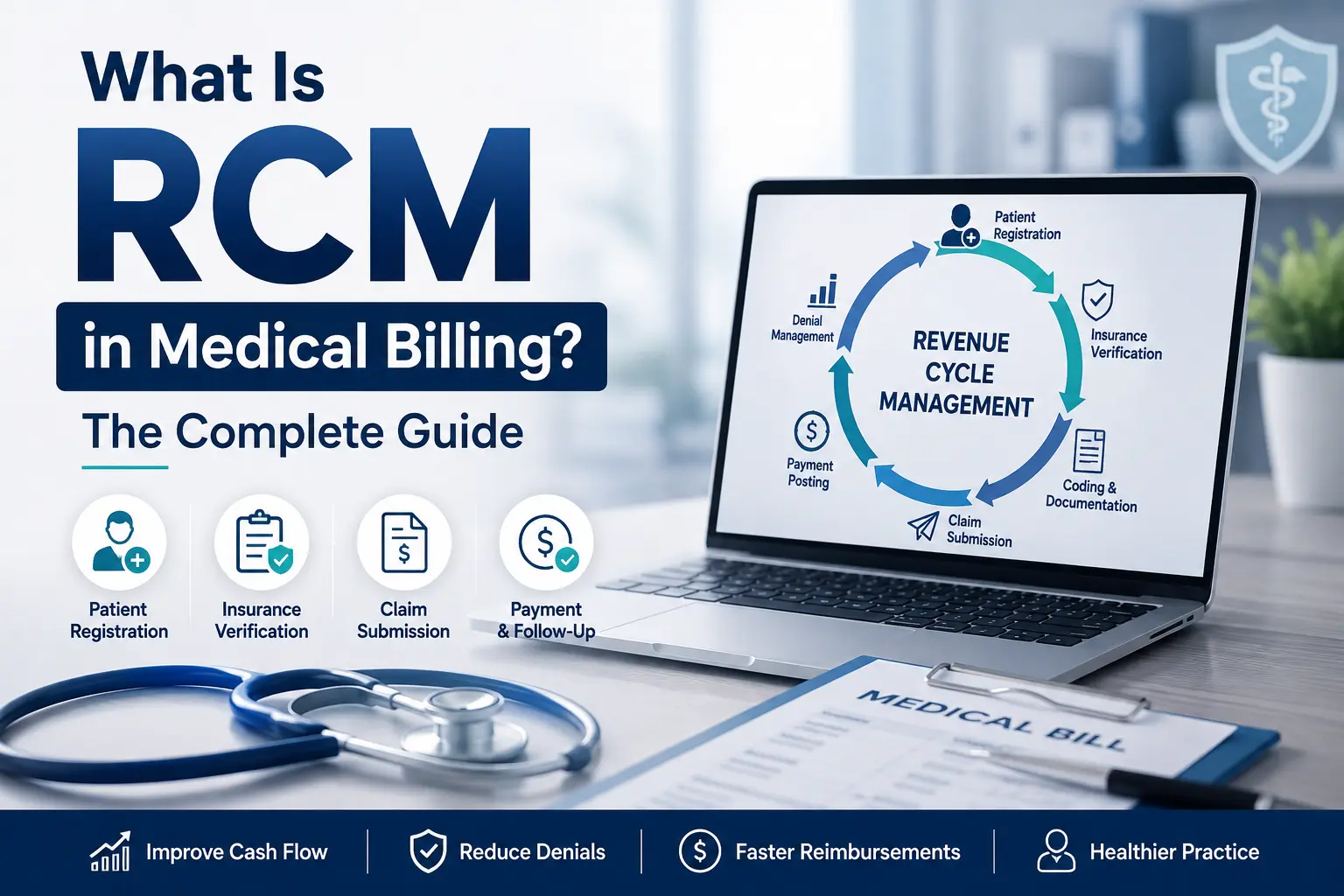
If you run a medical practice, you’ve probably heard the term RCM thrown around in almost every conversation about cash flow, denials, or staffing. It sounds technical, but the idea behind it is simple: RCM is how a healthcare practice actually gets paid for the care it provides.
Get it wrong, and claims sit unpaid for months, patients get confusing bills, and your front desk spends half the day on the phone with insurance companies. Get it right, and money moves through your practice the way it should, predictably, quickly, and with far fewer headaches.
This guide breaks down exactly what is RCM, how the process works from the first phone call to the final payment, which numbers actually matter, and how to decide whether your practice should manage it in-house or hand it off to a specialist.
What is RCM ?
RCM stands for Revenue Cycle Management. In plain terms, it’s the complete financial journey of a patient’s visit, starting the moment they book an appointment and ending only when the account is paid in full, whether that payment comes from the insurance company, the patient, or both.
RCM is not a single task. It’s a chain of steps that all have to work together. A mistake at the very beginning, like a misspelled name or an outdated insurance ID, can cause a denial weeks later that nobody sees coming until the claim bounces back.
Put simply: RCM is the system that connects the clinical side of your practice (the care you deliver) to the financial side (the money you collect for delivering it).
RCM vs. Medical Billing: What’s the Real Difference?
People use these two terms interchangeably, but they’re not the same thing. Medical billing is one piece of RCM, not the whole picture.
Medical billing focuses narrowly on turning a completed visit into a claim: coding it correctly, submitting it to the payer, and following up until it’s paid. If you want a deeper breakdown of that specific process, our guide on what medical billing actually involves walks through it step by step.
RCM covers everything billing does, plus everything that happens before and after it. That includes scheduling, insurance verification, prior authorization, patient collections, denial appeals, and financial reporting. Think of medical billing as the engine and RCM as the entire vehicle, the engine, the fuel system, the brakes, and the dashboard telling you how well it’s all running.
Why RCM Matters More Than Most Practices Realize
A lot of providers treat RCM as a back-office chore. It isn’t. It’s the difference between a practice that grows comfortably and one that’s constantly scrambling to make payroll.
A well-run revenue cycle:
- Gets claims paid faster, which keeps cash flow steady and predictable
- Cuts down on denials before they ever happen, instead of fighting them after the fact
- Reduces the administrative burden on front-desk and billing staff
- Gives patients a clearer, less frustrating billing experience
- Provides leadership with real financial visibility instead of guesswork
On the flip side, a broken revenue cycle quietly drains money out of a practice. Industry data consistently shows that a large share of denials, often cited around 85%, are preventable and trace back to front-end mistakes like bad eligibility checks or missing prior authorizations. That’s money left on the table for reasons that had nothing to do with the quality of care provided.
The Complete RCM Process, Step by Step
There’s no single official number of steps in RCM. Depending on the source, you’ll see anywhere from 6 to 16 steps listed. What matters isn’t the exact count, it’s understanding the three phases every practice moves through: front-end, mid-cycle, and back-end.
Phase 1: Front-End (Before the Visit)
1. Patient Scheduling The cycle technically starts here. How appointments are booked, confirmed, and managed directly affects no-show rates and how much lead time your team has to verify coverage. Practices that struggle with scheduling gaps often see it show up later as rushed, error-prone registration. Our team also handles this through virtual scheduling support for providers when practices need extra bandwidth here.
2. Patient Registration Demographic and insurance details get collected and entered into the system. This sounds basic, but a huge share of downstream denials trace back to a typo here, a wrong date of birth, a transposed policy number, an old address. If your registration process feels chaotic, this guide to improving patient registration is worth a read.
3. Insurance Eligibility Verification Before a patient is seen, someone needs to confirm the insurance is active, the service is covered, and the patient’s out-of-pocket responsibility is known. Skipping or rushing this step is one of the single biggest causes of denials industry-wide. We’ve put together a full insurance eligibility verification guide that covers how to do this properly.
4. Prior Authorization Certain procedures, imaging, and medications require payer approval before the service is delivered. Missing this step means the claim can be denied outright, regardless of medical necessity. This is a common enough pain point that we run a dedicated prior authorization and benefits verification service for practices that don’t have the staff time to chase approvals.
Phase 2: Mid-Cycle (During and Right After the Visit)
5. Charge Capture Every service, test, and procedure performed needs to be documented and recorded accurately. Anything missed here is revenue that never even makes it onto a claim.
6. Medical Coding Diagnoses and procedures are translated into standardized codes (ICD-10, CPT, HCPCS). Accuracy here isn’t optional, incorrect or outdated codes are one of the fastest ways to trigger a denial or, worse, a compliance issue down the line.
7. Claims Submission The coded claim is scrubbed for errors and sent electronically to the payer. Clean claims (ones accepted on the first pass, with no manual correction needed) move through the system dramatically faster than claims that bounce back for fixes. Our claims processing services focus almost entirely on pushing this first-pass acceptance rate as high as possible.
Phase 3: Back-End (After the Claim Is Submitted)
8. Payer Adjudication and Payment Posting The payer reviews the claim and decides what to pay, what to adjust, and what to deny. Once a decision comes back, payments are posted and reconciled against what was actually billed.
9. Denial Management Denials happen even in well-run practices. What separates a healthy revenue cycle from a struggling one is how fast denials get identified, corrected, and resubmitted. This is a specialty in itself, and it’s exactly what our denial management team handles day to day. For a more detailed breakdown of the strategy behind it, see our claim denial management playbook.
10. Patient Billing and Collections Once insurance has paid its portion, whatever balance remains gets billed to the patient. Clear, upfront communication about costs (ideally established back at the eligibility verification step) makes this stage far less painful for everyone involved.
11. Accounts Receivable (AR) Follow-Up Unpaid claims don’t fix themselves. Someone needs to be actively tracking aging claims and following up with payers before they age past the point of easy recovery. This is one of the most labor-intensive parts of RCM, which is why many practices lean on a dedicated accounts receivable follow-up service rather than letting claims quietly age out.
12. Reporting and Analytics The cycle closes with data. Reviewing what got paid, what got denied, and why, is what turns RCM from a reactive process into a proactive one.
There’s one more piece that technically sits outside the day-to-day claim flow but underpins the entire process: provider credentialing. If a provider isn’t properly credentialed with a payer, every claim they submit can be denied regardless of how well the rest of the cycle runs. Our credentialing services exist specifically to keep this from becoming a hidden bottleneck.
The KPIs That Actually Tell You How Your RCM Is Performing
You can’t improve what you don’t measure. These are the metrics that matter most in 2026:
- Days in Accounts Receivable (AR): How long it takes, on average, to collect payment after a service is rendered. A healthy range is generally 30 to 40 days. Anything creeping past 50 usually points to slow submission, high denials, or weak follow-up.
- Clean Claim Rate: The percentage of claims accepted by the payer on the first submission, with no corrections needed. Top-performing practices exceed 98%; anything under 90% signals front-end problems worth investigating.
- First-Pass Resolution Rate: Closely related to clean claim rate, this tracks how many claims are fully resolved without any rework.
- Denial Rate: The share of claims denied on first submission. A commonly cited benchmark is keeping this under 5%, though many organizations still run well above that.
- Net Collection Rate: Of everything you were actually owed (after contractual adjustments), what percentage did you collect? This is a better measure of financial health than gross collections, which can be misleading.
- Cost to Collect: How much it costs your practice, in staff time and overhead, to collect each dollar of revenue. Automation and outsourcing both tend to push this number down.
Tracking these consistently, month over month, is what turns RCM from guesswork into a system you can actually manage.
Common RCM Challenges Practices Run Into
Even well-run practices hit friction points. The most common ones in 2026 include:
- Rising claim denials. Payer rules keep getting stricter, and denial rates have been climbing industry-wide, not falling.
- Staffing shortages and turnover. Experienced billers and coders are hard to find and even harder to keep, and turnover in billing departments has been running high in recent years.
- Incomplete or inaccurate patient data. Most denials still trace back to something that went wrong at registration or eligibility, not something that went wrong at the payer.
- Rising patient financial responsibility. With high-deductible health plans now common, more of the bill lands directly on the patient, which means collections have become its own specialty.
- Fragmented technology. Practices running old, disconnected systems for scheduling, EHR, and billing tend to lose visibility into where claims are actually stuck.
None of these problems are unusual. What separates practices that stay ahead of them from practices that get buried is whether they’re actively monitoring the cycle or just reacting to whatever breaks first.
In-House vs. Outsourced RCM: Which One Fits Your Practice?
This is one of the most common decisions practices face, and there’s no universally right answer. It depends on your size, your existing technology, and how much control you want over the process.
In-house RCM makes sense when:
- You already have experienced, stable billing staff with low turnover
- Direct control over billing and patient communication is a priority (common in concierge or high-touch specialty practices)
- You’ve already invested in a modern practice management system with built-in scrubbing and denial tools
Outsourced RCM makes sense when:
- Your practice is smaller and can’t justify a full in-house billing department
- You’re dealing with rising denials and don’t have the specialized staff to manage them
- You want access to advanced billing technology and AI-driven tools without buying and maintaining them yourself
- Staffing costs, turnover, or training gaps are eating into your margins
Most outsourced RCM providers charge a percentage of collections, typically somewhere in the 3% to 10% range depending on scope and specialty, rather than a flat fee. For many practices, that cost ends up lower than what they’d spend on salaries, benefits, software licensing, and training for an equivalent in-house team.
If you’re weighing this decision for your own practice, our revenue cycle management services and broader medical billing services are built around exactly this kind of full-cycle support, so you’re not stitching together five different vendors to cover one process. You can see the full breakdown of what we handle on our services page.
How Technology and AI Are Changing RCM in 2026
The biggest shift in RCM right now isn’t a new regulation, it’s automation. AI-driven tools are now commonly used to:
- Flag claims likely to be denied before they’re ever submitted
- Automate eligibility checks in real time instead of relying on manual phone calls
- Speed up coding accuracy through AI-assisted suggestions (with human review still in the loop)
- Predict which denials are worth appealing based on historical payer behavior
None of this replaces experienced billing staff. It just removes a lot of the repetitive, error-prone manual work so people can focus on the claims and denials that actually need human judgment. If your practice is trying to figure out which tools are worth investing in, our medical billing software guide compares the major platforms in more depth.
Common RCM Mistakes That Quietly Cost Practices Money
A few mistakes show up over and over across practices of every size:
- Skipping or rushing eligibility verification to save time
- Letting claims sit instead of following up on aging AR
- Treating denial management as an afterthought instead of a daily task
- Under-training front-desk staff on registration accuracy
- Ignoring compliance requirements until an audit forces the issue
If any of these sound familiar, our guide to common medical billing mistakes and medical billing compliance guide both go into detail on how to spot and fix them before they become expensive habits.
Frequently Asked Questions About RCM
What does RCM mean in healthcare? RCM stands for Revenue Cycle Management. It’s the complete process healthcare organizations use to track a patient’s account from scheduling and registration through final payment, covering everything in between: eligibility checks, coding, claims, and collections.
Is RCM the same as medical billing? No. Medical billing is one part of RCM, specifically the coding, claims submission, and payment collection steps. RCM is the entire financial lifecycle, including scheduling, registration, prior authorization, denial management, and reporting.
What are the main steps in the RCM process? Most practices follow some version of: scheduling, registration, eligibility verification, prior authorization, charge capture, coding, claims submission, payment posting, denial management, patient collections, AR follow-up, and reporting.
Why do healthcare practices outsource RCM? Practices typically outsource RCM to reduce staffing costs and turnover risk, access specialized denial management expertise, and get AI-driven billing technology without having to buy and maintain it themselves.
What is a good denial rate for a medical practice? A commonly used benchmark is keeping first-submission denials under 5%. Many practices run well above that, which usually points to gaps in eligibility verification, coding accuracy, or documentation.
How long should it take to get paid after a claim is submitted? A healthy Days in AR benchmark is generally 30 to 40 days. Consistently running above 50 days is a sign that submission speed, denial rates, or follow-up processes need attention.
The Bottom Line
RCM isn’t just a back-office function, it’s the financial backbone of your practice. Every step, from the moment a patient books an appointment to the moment their final balance is paid, either protects your revenue or quietly leaks it.
The practices that stay financially healthy aren’t necessarily the ones with the fewest denials. They’re the ones that catch problems early, track the right metrics, and treat the revenue cycle as something to actively manage, not something to deal with only when a claim bounces back.
If you’d like a second set of eyes on how your current revenue cycle is performing, our team at The Billing Advisors reviews practices’ RCM workflows every day. Feel free to get in touch with our team and we’ll walk you through where the gaps are and what fixing them would actually look like.